
This week: Spicebush Swallowtail Likes Laurel
Hello!
Monarch butterflies may get all the press for their relationship with Milkweed, but Spicebush Swallowtails (Pterourus troilus) also need a specific type of plant for their very hungry caterpillars (spoiler: it’s Spicebush). But first, let’s figure out how to spot a Spicebush Swallowtail.
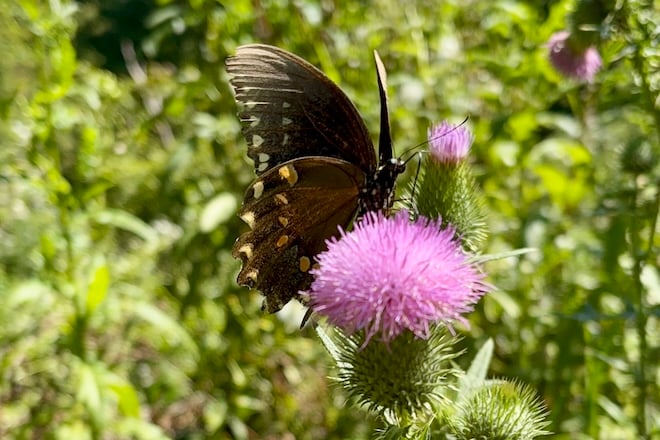
Identifying Spicebush Swallowtail
The Spicebush Swallowtail is found in Eastern North America, from southern Canada to Florida. In its caterpillar stage, the Spicebush Swallowtail is leaf-green with blue spots and comical-looking large eyespots. Because of its color, it is easy to overlook; it blends in while it munches on leaves.
However, you can’t miss the Spicebush Swallowtail butterfly. It’s a large, dark-colored butterfly with a three- to five-inch wingspan. It has yellow-orange spots and blue to blue-green scales. The female has bold blue coloration on her hindwings; males sport a duller sprinkling of blue-green. While the Spicebush Swallowtail resembles a few other butterflies, the telltale identifying mark is a missing orange spot on the underside of the hindwing, where there’s a dash of blue instead.
Spicebush Swallowtails are most often found in natural areas and robust gardens where there are copious flowers to feed from all summer long.
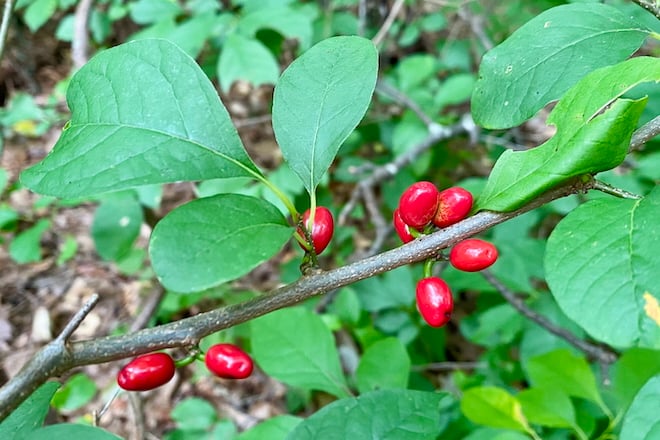
Host Plants
In addition to feasting on flower nectar, female Spicebush Swallowtails lay their eggs on the underside of leaves of members of the Laurel family. When the larvae hatch, they build shelters from folded leaves to hide from predators during the day, and at night, they feast. In the Northeast and Mid-Atlantic, these all-important host leaves are Sassafras (Sassafras albidum) and Northern Spicebush (Lindera benzoin). Farther south, larval host plants include Red Bay (Persea borbonia), Swamp Bay (P. palustris), and Southern Spicebush (L. melissifolia).
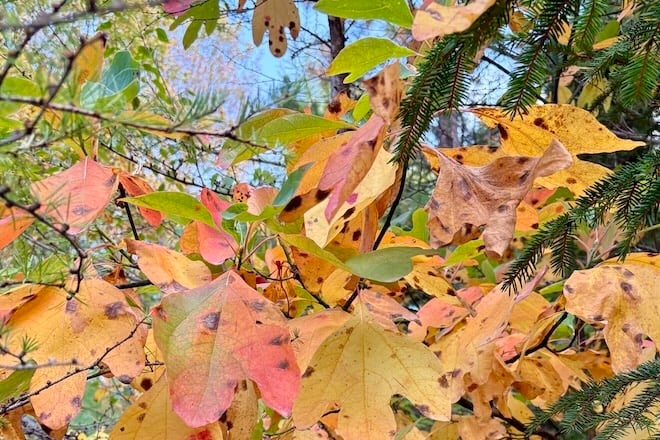
Unfortunately for the Spicebush Swallowtail, the fungal disease Laurel Wilt is killing Red Bay and Sassafras from Kentucky down to Florida, threatening their all-important larval food source. Thankfully, the disease has not yet traveled north to endanger our Sassafras, but it’s worth watching.
Elsewhere:
In other butterfly news, The Xerces Society recently released the Plants for Monarchs finder. Type in your ZIP code or location and it’ll recommend butterfly host and nectar plants. No surprise, it’s a lot of native plants.
Have a great week,
Julie