This week: That Tree’s Not Dead, It’s a Larch
Hello!
This week, we are traveling a little north (or up, if you have a nearby mountain) to look at Eastern Larch (Larix Laricina), also called Tamarack. This fall stunner is a unique member of the Pine family: it’s a deciduous conifer whose needles turn golden yellow before they fall every autumn, busting the misconception that all conifers are evergreen. The only other native tree in our region to drop its needles every fall is Bald Cypress, which leads some people to mistake these trees for dead in the winter.
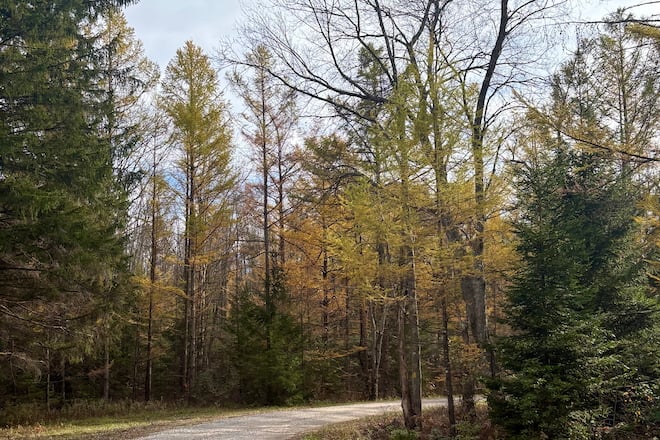
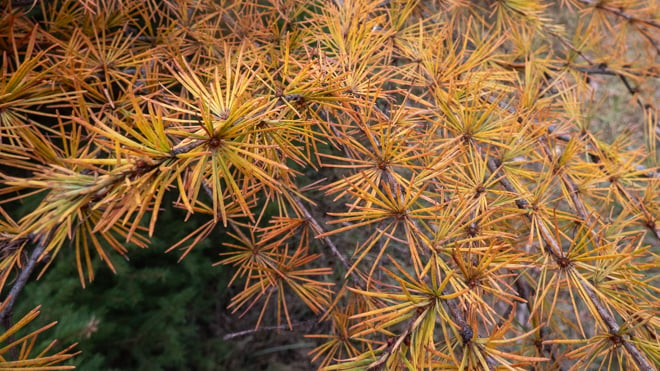
When it is not brilliant yellow or a winter skeleton of twiggy branches, Eastern Larch has soft, short needles and bears maroon-tinged, rounded cones about one inch in diameter. It grows to 80 feet tall and 30 feet wide, with a narrow form. Eastern Larch is a full-sun tree and, as a result, is a pioneer species in cleared, soggy areas where it gets the most light.
Pennsylvania is about as far south as this tree goes: it prefers cool summers and frigid winters, and its native range extends to the Arctic Circle. In Pennsylvania, you’ll find it in the northern tier and in the Laurel Highlands.
Fun with Common Names
The origin of the common name Tamarack is disputed. Some say it’s an Algonquin (Western Abenaki) word for snowshoe wood, while the botanist Michaux attributed Tamarack’s coinage to Dutch settlers. The Oxford English Dictionary identifies Tamarack’s earliest use in print in 1805, in Lewis and Clark’s journals: “The Mountains..Thickly Strowed with falling timber & Pine Spruc fur Hackmatak & Tamerack.” Hackmatak is another common name for Eastern Larch and comes from a German word for resin (not Dutch). And a different spelling, Tacamahaca, was used to describe trees in the 1700s. The OED suspects that Tamarack’s name comes from settlers blending languages and pronunciations to create something new, but no one can say for sure.
But what about those snowshoes? Well, root fibers were used for basketry and sewing. The Cree used Larch wood to make toboggans, and the Ojibwa used the roots to construct canoes, including the upper bindings. No doubt, one could use either the roots or the wood (or both) to make a pair of snowshoes.
Elsewhere:
Did you know that an adult oyster can filter 50 gallons of water a day? This NPR article explains how oysters are being used to improve the health of the Chesapeake Bay.
Have a good week,
Julie