The Mind of Ben Wesley #1: i am the sum of the books and the movies i own

to begin, something of a disclaimer:
So, fun fact, I did some statistical analysis of the several people who subscribed to this newsletter, and a full 41% of you are actual published authors in some capacity or another. Which is a bit intimidating, since I'm ... not much of a writer myself. (I've just started the second semester of my junior year in college, and I can't describe how relieved I was to realize I wouldn't have to write a research paper this semester.)
Anyway, here's the complete breakdown:

All the same, I'm attempting to go on a hiatus from Twitter for the duration of this semester, and so -- attempting to follow in the footsteps of D.L. Mayfield and Alan Jacobs -- I decided to experiment with putting out email newsletters in lieu of tweeting. I've titled this "The Mind of Ben Wesley", after a particular blog post by Dr. John Fea of Messiah College.
You'll forgive me if I'm not quite sure how to transition from short-form tweets to more long-form writing like this. In writing this, I've let myself be far more rambly than I could've been; I don't know whether this will be perceived as a feature or a bug. Do write me back if you feel like it.
college life (or, Backpacks vs. Satchels):
Over winter break, some people I follow on Twitter got into an...interesting conversation about the merits of backpacks versus satchels.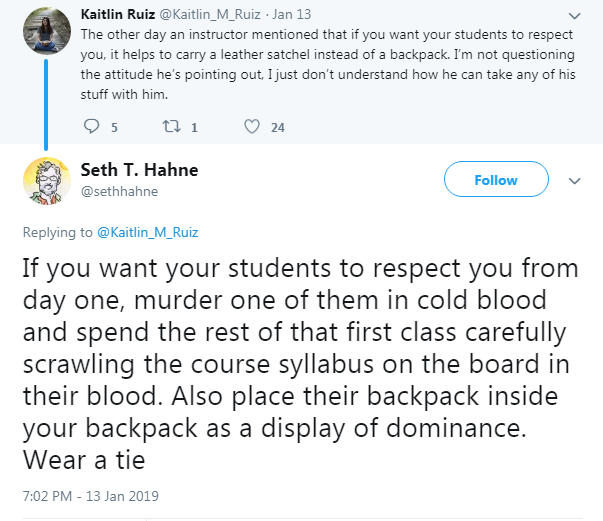
(Yes, I went on twitter.com to get that screenshot. No, I don't think it counts as breaking my hiatus.)
I made a short animation based on that odd interaction, actually, and I think it turned out rather well.
As for myself, last semester I bought a cheap laptop bag from Walmart because I figured it was close enough to a satchel that I could use it as one. I think I maybe used it half the time?
However, I'm starting this semester trying something entirely different: showing up to class with nary a backpack or satchel or laptop bag in sight, instead taking all my notes in notebooks small enough to fit in my left inside coat pocket, and stuffing any syllabi or handouts into my right coat pocket until I can file them away in a larger folder. I half-feel rather ingenious. Perhaps I should just feel lucky that, as a male, my clothing tends to have enormous pockets.
i am the sum of the books and the movies i own (or, the part you might as well skip):
I made the above sentence the subject of this missive because I feel it sounds kinda cool and edgy (doubly so in lowercase)--and, honestly, if there's one aspect of my life I'm materialistic in, it's my near-addiction to buying DVDs. (And sometimes books. Also just Bibles in general? I have a lot of Bibles. Though I don't own a Wonder Bible, even though I saw one just the other day at Big Lots! for $15, which is a great deal since those things normally retail for $40.)And I've got more (although not much more) than a few "Christian films" in my DVD collection. My personal favorites are the ones with time travel: There's Time Changer, a thrilling drama about a Bible professor in 1890 attempting to change his seminary board's unanimity policy (in order to obtain their endorsement for his questionable book manuscript before it goes to print!) -- before Gavin MacLeod, who inexplicably owns a time machine, sends him to 2002 to gawk at the depths of moral depravity America has fallen into. And, oh the insanity of The Return of Professor Phineas T. Boggs: David and the Giant, a 2.5hr-long filmed stage musical from South Carolina about a group of middle-schoolers attempting to find the titular Professor Boggs (last seen entering a Future Time Machine) while simultaneously filming a movie based on the events of the prequel musical and also fighting with the production company, Vain-Glory Films, to keep the Bible in the script and not have Professor Boggs rap his opening number. There is a song about loving phonics, and telling time (complete with an actor walking around on stage dressed as a giant clock), and another song about the alphabet for good measure; but by intermission, a full 13 people have managed to take a time machine back to Bible times, where they learn valuable life lessons and watch David not just incapacitate, but definitely decapitate, Goliath.
That was the second Boggs musical. You're just gonna have to believe me when I say it's not nearly as weird or bad as the third one. (My life goal is to write the fourth.)
But the films and books I really like are the "edgy" selections that, while not being necessarily "Christian" in and of themselves, take Christianity seriously: First Reformed. Jesus Christ Superstar. Wise Blood. Shadowlands. (Well, at least the 1985 television version of Shadowlands that gets sold at LifeWay as C.S. Lewis through the Shadowlands. I haven't seen the 1993 remake starring Anthony Hopkins, though I've read that the latter film decided to pretend C.S. Lewis only had one stepson instead of two. Interestingly, Douglas Gresham--the stepson who did not get erased from the 1993 film--has in the past several years been getting rather chummy with the creator(s) of the afore-mentioned Boggs musicals, as the same people have been mounting stage productions of Narnia books never before seen on stage. They've been advertising a meet-and-greet gala with Gresham, as well as a "Master Class" with him that's coming up next month, though what skill he's supposed to be teaching is not specified. It's bizarre.)
But I digress.
I saw First Reformed at an arthouse cinema over the summer. (I think that may have been the first film I saw in a theater by myself.) I was enthralled by the intricately plotted script, but also just by seeing an environment on screen that I recognize, as it were. I've never attended a megachurch or had a pastor who wore a clerical collar; but I know what it is to sit in those pews -- I know what it is to listen to enthusiastic youth room testimonies, and sometimes be confused by them. From reactions I saw online, I gather that I'm not the only Christian who loved First Reformed for being a faith-centered, if not faith-based, film.
And yet, I've been liking First Reformed less and less over recent months. It's a film that revels in the silence of God. (It's probably not a coincidence I count Job and Ecclesiastes among my favorite books of the Bible.) Yet maybe I mistook First Reformed's portrayal of a silent God for something like theological depth. It is a tensely plotted, well-made, well-acted film. But perhaps saying it's "asking the hard questions" is an overstatement.
In First Reformed and the Book of Job, God is silent until just before the end of the narrative.
But I've been starting to read Lamentations, and also some Flannery O'Connor; and from them, one sometimes gets the impression God is not necessarily silent--but rather, violent. The verses that stuck with me the most from Lamentations read:
He is a bear lying in wait for me,
a lion in hiding;
he turned aside my steps and tore me to pieces;
he has made me desolate;
he bent his bow and set me
as a target for his arrow.
He drove into my kidneys
the arrows of his quiver...
The first time I read "A Good Man Is Hard to Find" by Flannery O'Connor, I was surprised when a friend of mine explained that the Misfit can be viewed as a Christ figure. The character, after all, is a renegade serial killer on a murder spree. "Shoot me through the heart, Lord Jesus!" my friend enthused
I was confused at first, but the "moral" of O'Connor's story is, presumably, that some bad people could've been good "if it had been somebody there to shoot [them] every minute of [their] life." So maybe his prayer isn't so strange: make me a good person, Lord, even if it means I have to be shot dead every minute of every day, whatever that looks like.
The Misfit shoots [spoiler redacted] three times through the chest with his gun. Jeremiah complains that God has shot him through the kidneys with His arrows, using him for target practice.
A violent God, indeed; but also a good one. For Lamentations continues:
The steadfast love of the Lord never ceases;
his mercies never come to an end;
they are new every morning;
great is your faithfulness.
“The Lord is my portion,” says my soul,
“therefore I will hope in him.”
...
For the Lord will not
cast off forever,
but, though he cause grief, he will have compassion
according to the abundance of his steadfast love;
for he does not afflict from his heart
or grieve the children of men.
(The Biblical quotes are from the ESV translation.)
(I did some brief googling to see if anyone had connected the verses of Lamentations 3 with "A Good Man Is Hard to Find", and while nothing came up immediately, I did get references to Jeremiah 5:1, which reads in part, "see if you can find a man, one who does justice and seeks truth". One could say Jeremiah thought that...a good man is hard to find.)
I suppose First Reformed is less about what God is doing than how we ought to serve Him: in the face of ecological disaster, is it better to focus on saving the world, or saving souls? Businessman Ed Balq is the antagonist of the film: his enterprises are among the environment's top polluters. He also provides large donations to the local megachurch, helping countless people with their daily lives -- at the cost of the church's silence on issues that would affect Balq's bottom line. And yet by the end of the film we come to realize that Balq-funded Pastor Jeffers has probably done more good on the whole than Reverend Toller, whose narrow-minded focus on saving the earth never extended to saving his own physical and mental health.
Which brings me back to the afore-mentioned low-budget 2002 Christian film Time Changer. It's a bit more theologically intricate than most Christian films, with a controversial moral I'm not sure I even agree with completely: the film explicitly posits that teaching morality without also teaching Christ is worse than not teaching morality at all. Two characters disagree on this, and their controversy is resolved when the teach-morality-alone guy visits the future and comes to the conclusion that the moral filth he sees is a direct result of removing the authority of Jesus Christ from His moral teachings. ("Don't you know that stealing is a sin?" he asks a young girl who had just attempted to abscond with his hot dog. "Says who?" she replies.) Returning to the past, any optimism he may have had for the future is shattered. "I believe I was witnessing the End Times," he says. (The fact that comparing 1890 America and 2002 America is used as proof of precipitous moral decline worldwide is problematic in both its Amero-centrism and the possible implication that the abolition of Jim Crow laws was peanuts' worth of improvement next to the unquestionable abomination of department stores selling low-cut dresses.)
I don't think writer/director Rich Christiano meant for Time Changer to be a metaphor for how premillennial dispensationalism replaced postmillennialism in American theological thought, but I think the film works well on that level. (For those of you still reading who need a refresher, premillennial dispensationalism is the view of the End Times popularized in the Left Behind series: the world is getting and will get worse and worse until Jesus "raptures" all Christians to Heaven, there will be 7 years of hell on earth, then Jesus will come back with an army and establish His Kingdom on Earth for 1,000 years. Postmillennialism--which was a lot more popular in the 1800s, it doesn't have much traction nowadays--was the belief that we Christians would basically turn the world into a Christianized utopia, after which Jesus would return to the basically-already-perfect world. A large number of Christians are amillenialists, but that's not relevant for our purposes here.)
The characters never discuss their eschatological beliefs explicitly, but given that protagonist Russell Carlisle lives in 1890 America and seems optimistic about spreading nonsectarian moral beliefs, I have a hard time not reading him as a postmillennialist. In the future, we learn that Carlisle dies in the 1930s: he will live to see World War I but not World War II. Since postmillennialism is characterized by a belief that the world is essentially getting better and better, World War I in real life was influential in causing postmillennialism's fall in popularity: in the face of such violence, large-scale optimism seemed nearly untenable. Carlisle--whose beliefs, one imagines, might've transitioned from postmillennialism to premillennialism anyways had he lived a normal life--becomes pessimistic about the world's moral direction from his trip ~110 years into the future, declaring 2002 to be the End Times and agreeing that one ought not teach morality without the Gospel.
One might think Carlisle, living in 1890, still has hope of changing the future. Perhaps he and his cohorts failed to spread morality only because they failed to attach the authority of Christ to His commands. We modern folks are just so bad at being good because we forgot there's a Reason to be good people.
Partially. If there was no hope whatsoever of changing time, the film would not be called Time Changer. But the real reason to not teach morality without Christ, Gavin MacLeod's character explains, is that outwardly good people are less likely to perceive their need for a Savior. "Being a good person" is often an obstacle to one's individual salvation.
Now, if you're a postmillennialist, as I interpret Carlisle as being in the beginning of the film, you expect to build a good society, so perhaps your main focus is on getting people to be good. Save society first, save as many individuals as you can along the way.
But with premillennialism, society's eventual destruction is taken as a given. Convincing individual people to act morally without converting them to Christianity will hardly improve society while simultaneously imperiling their very souls, arguably. Teach Christ, not morality. Save souls, not society. So says Time Changer.
In a way, it's the exact same message as First Reformed. In Time Changer, God Himself will soon end human history due to human wickedness. (The time machine malfunctions when Gavin MacLeod tries to send a Bible to 2070.) In First Reformed, global warming will do that. Whether or not God is behind global warming is up for debate, but it's still punishment for humanity's sins against nature.
Professor Russell Carlisle learns that, in the face of humanity's inevitable moral decline, he must spread the gospel alone, working for the salvation of individual souls as best he can. Reverend Ernst Toller learns that, in the face of Earth's impending doom, he must give up his grand dreams of single-handedly taking down Balq Industries and merely accept what love is offered to him.
Or something like that.
But Toller's salvation in the end of First Reformed is of an entirely earthly nature. Throughout the whole film, he is a preacher who, with one exception, never really prays, much as he protests otherwise. The trappings of spirituality are used to tell a story that concerns God relatively little.
And that is the crux of why I like First Reformed less than I did. Flannery O'Connor's Wise Blood is also about a preacher who doesn't pray; none of its main characters are even properly Christian. Yet it is still fundamentally a story of being unable to escape Jesus Christ. And so, I'm inclined to replace First Reformed in my entertainment choices with Wise Blood for the future.
the rest of the pie charts:
I began this missive with a pie chart breaking down how many of my subscribers were published authors. Anyway, I also made a number of other pie charts breaking down the stats on y'all, so here they are, just for fun: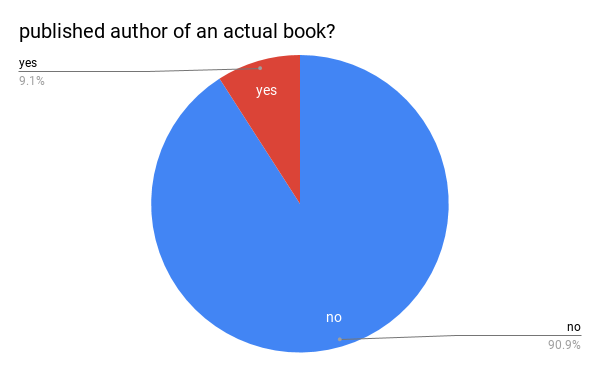
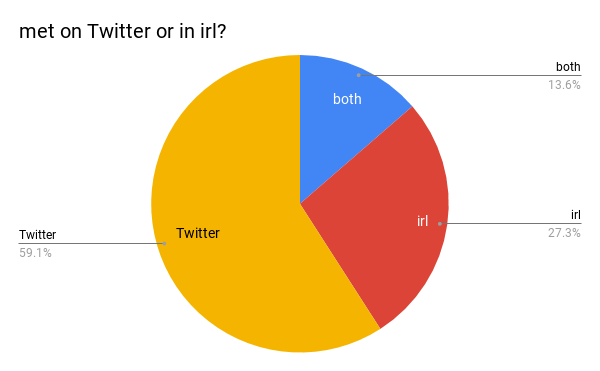
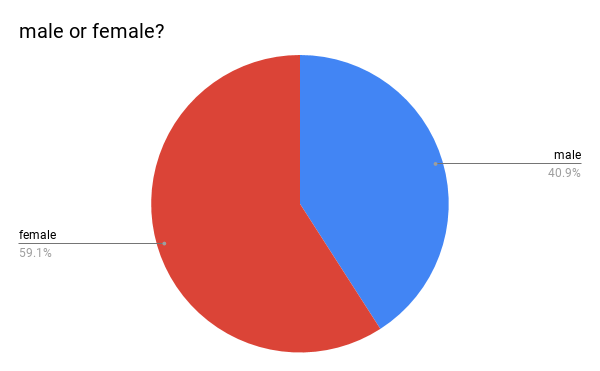
 Looking at this, I suddenly noticed that I have the exact same number of subscribers who are female as subscribers who I know exclusively from Twitter as I have subscribers in their 20s. For the record...there is not a 100% overlap between any of those categories.
moving forward
And now, the part of the Last week, I walked into a building in downtown Lancaster, Pennsylvania for an internship (well, "traineeship") interview: my last chance to do something this semester with an organization outside my college, and maybe earn some money at the same time. It was a youth-focused organization, so as I sat down to wait for the supervisor, I noticed "Interview Tips" pasted to the wall. "Dress appropriately." I hadn't even put on a tie that day. And my resume made me a dubious fit for the position. "I've already failed this," I thought to myself. "All that remains is to endure it."
I was wrong. It seems I'll be working there this semester as soon as I get my clearances settled--though I probably won't be in Lancaster City much, rather going to Columbia, which isn't particularly far.
"When can you be in Columbia?" I was asked. I didn't know, but it didn't take me long to find out, because I had the bus schedules on me--and I've ridden the line to Columbia several times already, so I knew exactly where to look for its schedule in the booklet. Funny story: I've never had occasion to be in Columbia in and of itself, but last year, I rode a series of five buses almost all the way back home in the middle of finals week to see if I could make the journey on public transportation. The route took me through Columbia, and I've made the trip a couple times since. No one really thought it was smart of me to make that trip, but perhaps it ended up helping me this week.
I'm taking three classes this semester. Two of them seem rather fun so far. The other one is an elective I didn't have to take, per say, but the topic is computer graphics--seeing that I've been playing around with 3D modeling and animation since I was 9, I felt obligated to myself to take the course. I'm told assignments near the end of the semester could take 15 to 40 hours to complete. [Long sigh...] Hopefully I'll be able to remember I'm taking this course because I wanted to.
Also, my (second) driver's license exam is on Saturday. Being at college, I haven't been driving lately, and I'm feeling more nervous than I expected to be. Living on-campus, taking buses to the mall and the city, it's far easier for me to see cars as dangerous superfluities--and I'm half-worried that, fearful of being sucked into a car-centric lifestyle, I'll somehow subconsciously choose to fail Saturday's test.
Before I left Twitter, I mentioned wanting to build up more of an "artistic" portfolio this year. In that area, I've had a half-triumph. For some time now, I've occasionally helped put posters out around Lancaster City for The Row House Forum, a local Presbyterian organization led by a certain Reverend Tom Becker, who hosts monthly presentations by evangelical thought leaders and other cool people on a variety of topics. (I discovered the Row House when I went to hear Karen Swallow Prior speak there in April 2017 on Jane Austen; since then, they've hosted James K.A. Smith, Katelyn Beaty, Matthew Dickerson, and my old youth pastor's brother-in-law. For any of you who have seen Dr. Prior's new book On Reading Well and its lovely linocut illustrations--the illustrator, Ned Bustard, is a Row House board member and close friend of Becker's; Prior and Bustard met at the same Row House Forum that was my first introduction to the organization.) Hoping that the illustrator of On Reading Well won't begrudge me for trying to do his normal job, I asked Tom Becker if I might try my hand at making a Row House poster design. And long story short, it seems my design will be used on March's poster.
Finally, I might as well mention -- I'm a bit sheepish having it out in public, since it's a bit personal and not actually all that good -- but I spent a while last semester making the closest thing I have to an artistic masterpiece, and it's on my YouTube channel here.
things i believe despite everything (or, "I'm almost done, I promise"):
I have two friends whose names are Noelle and Dryver. They're some of the strongest Christians I know.Sometimes when they pray, they say things like "Lord, we pray against the spirit of anxiety", and when they do, I'm not sure what to think. Something in that strikes me as the sort of prayer one ought not to pray. I want to label it as a type of prosperity gospel, because if I can label it that way, I can discount it.
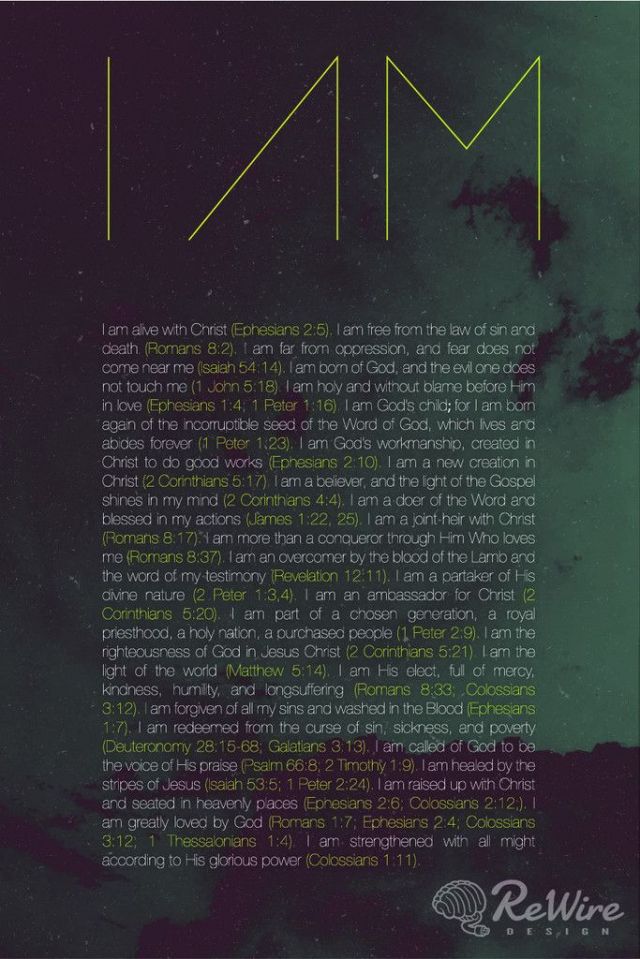
And yet. When Dryver and Noelle say that the most important thing is to find your identity in being a child of God, I believe them. I'm not sure the Bible talks too much about personal identities as such--not even sure that the idea of individual identities even existed then. This does not diminish the impact of Noelle's "I AM" poster, listing Bible verses describing who we are in Christ.
As of this week, I am older than both my parents were when they married each other, which is almost embarrassing, because I myself do not yet function as a truly independent adult. I wouldn't characterize our relationship as strained, exactly, but occasionally I get complaints that I think I know better than them. To some extent, this is true. I'm a full 20 years old after all; it's about time for me to start trusting my own opinions.
And yet, when my dad says something to the effect of that the essence of true masculinity is: working, suffering, doing what is to be done; that there are probably Biblical and philosophical reasons for this but the reasons don't matter because the really important thing is that you actually do what you have to -- I believe him. And I don't know how much we'd agree in our conceptions of masculinity, or even how much I believe in the idea of "masculinity" as opposed to just humanity; but I believe this: That there is only to do what is to be done.
I hope you all are well. Again, feel free to reply, either by responding directly to this email or else by writing me at [email protected]. Prayer requests, book/film recommendations (even though I don't guarantee I'd get around to reading/watching them), general feedback...send it my way, friends.
-Ben