The Mind of Ben Wesley #2 (or #4, depending on how you count it)

Hi friends!
Well, would you look at this mess. I attempt to start a "newsletter," send out one 15-page edition in January, and don't send any more updates for months!
In fact, I wrote, like, two entire newsletters in February and March, not to mention various unfinished drafts -- but each of them ended up veering off into talking about things I'm not quite comfortable talking about publicly yet, such as my relationship with my girlfriend, areas of theology I'm working through, and that time last month when I got the police called on me and was lectured by them on how it looked like I might have been buying drugs. (Man, I'm so glad my dad thought that was a funny story.)
So, after all this time, I've finally hit upon a genius solution: copy-and-paste the good material from what I did write, and leave out the parts I don't want to show the entire world!
At any rate, I'm sorry if this newsletter is a bit rough and not as engagingly personal as my previous one, but I'm afraid I'm just going to keep tweaking the material unless I hit "send" sometime. So I'm pleased to foist more uninformed summary and analysis of random bits of (sometimes obscure, often "Christian") culture upon y'all!
And if you'd rather not read this--well, in another week I'll be back on Twitter with more personal, light-hearted, short-form content for you to read instead!
(Did all that sound too self-deprecating? I hope not.)
Roll film!
* * *
lincoln in the bardo and the power of stories
I recently read Lincoln in the Bardo by George Saunders for the first time. I did not think it was as great as I expected it to be based on the reviews: that is to say, I did not think it was better than sliced bread itself. I found it merely Very Well Done and Mildly Enjoyable.One scene in particular sticks with me. But I'm afraid that I must first explain the set-up.
The premise of the book is that after people die, they must accept the fact of their death--accept that their life on earth is fully over, that it is time to face Eternity--and until doing so, exist as ghosts. As in most ghost stories, I presume, Lincoln in the Bardo's ghosts generally have unfinished business--but of a mundane sort. These sad specters aren't trying to avenge their own deaths; they want to be nursed back to health and life so they can finally consummate a marriage, or enjoy the beauty of nature, or finally be recognized as the genius they were.
The ghosts fight off the call to enter the final state of their afterlives by reciting stories to themselves and each other: stories of what they missed out on and somehow still hope to return to.
Yet the stories deform them. Hans Vollman, who continuously recounts the story of how he was struck on the head with a beam mere hours before he and his wife were planning on consummating their marriage, manifests himself grotesquely (and to some readers, I'm sure, humorously) as a naked man with an unreasonably large sex organ. His friend Roger Bevins, who committed suicide and changed his mind too late, starts growing swarms of extra eyes and ears and noses whenever he starts describing the sensory pleasures of everyday life he wishes to appreciate again.
Those are just the two main protagonists; most of the other ghosts also have some disturbingly weird visual form of their unfulfilled desires manifesting in their "bodies," as it were.
In the climax of the book (spoilers ahead), the ghosts all band together to try to possess Abraham Lincoln, who is still alive because the novel takes place in 1862. It's an arduous task, but it gives the spirits a goal and a purpose for once in their afterlives. And as they all finally start doing something besides throwing self-centered pity parties to each other, something relatively unexpected happens: the deformities disappear. Vollman has clothes appear on him. Bevins has only two eyes for once.
See, the stories the ghosts told to themselves and each other were all true, technically speaking. But by focusing on one specific story--and often choosing to forget the context around what actually happened--the stories became misleading and dangerous.
It's an important lesson and one I can relate to. The stories we tell ourselves are how we compartmentalize the past, how we make sense of what's happened. How we tell stories about our past shapes how we think about our past. But I think what Saunders is getting at with this depiction is that telling certain stories and not others, or omitting inconvenient details from our stories, is a pernicious form of lying to yourself.
The ghosts eventually remember the inconvenient details, such as that Vollman's widow visited his grave with a new husband and children, grateful that he didn't insist on consummating their marriage in his life. What he remembered as a tragedy had a silver lining he wouldn't admit.
But what allows them to remember is not wracking their brains for forgotten information. It is purposeful action that--at least temporarily--gives escape to the need and desire to make sense of things, releases Vollman and Bevins and company from the orbit of self-centeredness long enough for them to gain the perspective they need.
* * *
Thomas Edison, Patch the Pirate, and Lauri Lebo
(,or, two atheists and a Baptist)
Growing up, I think you'd forgive me if I made the mistake of thinking Thomas Edison was a minor hero of the Christian faith. An animated video in my conservative church library was dedicated to his life; my Christian homeschool textbooks lauded his work ethic. A children's music-and-story CD also in my church library featured Edison somewhat prominently. "Perseverance? How do you spell that?" a young child asks the famous inventor. "W-O-R-K!", Edison replies, in a voice that inexplicably sounds like an Ed Wynn impression.So imagine my surprise, when, in late elementary school, I tried partly working my way through a way-too-thick biography of Edison for a research paper and realized that Edison was rather definitively not religious in any way. (I wasn't actually that surprised--though, now, I do vaguely remember trying to acclimate myself to the idea that the inventor of the lightbulb had been burning in hell for about 80 years.)
But perhaps we can say it's a bit strange that Edison has (in my view, at least) been valorized for exemplifying a "Protestant work ethic" when he wasn't even Christian.
Back to the children's music-and-story CD I mentioned. (You'll forgive me if you've read me rant about this on Twitter before.) If you thought the Christian time machines I talked about in the last newsletter seemed weird, they have nothing on the 1986 "Patch the Pirate" adventure The Great American Time Machine. (Available on Spotify!) The premise: two (presumably human-sized) rodents from Bonkinland have been dispatched to time-travel through America's history in order to learn the secrets of America's greatness before Bonkinland destroys America and establishes itself on top of the nation's ruins. Where is the time machine? Well, inside one mouse's tooth, of course. It grows to full size once the tooth is painfully extracted. Who could possibly guide them through history? Why not (in addition to Patch the Pirate &co.) the Statue of Liberty, who inexplicably comes to life (she has a New Yawk accent, of course), before being shrunk down to human size by the rodent's shrink-ray gun! (How is Bonkinland not already the richest country in the world? They have time travel and shrink ray technology!)
The CD attempts to draw morality lessons from history, but its version of history is one in which a turkey and an eagle argue at the first Thanksgiving over who between them would be invited to the Thanksgiving feast and which would be the national bird. Thomas Edison himself is trying to invent fried chicken by electrocuting a bird--but the bird instead lays a glowing pear-shaped egg. "I've invented the pear!" Edison yells, before realizing he's actually invented...the first light bulb! Yesirree, kids, Thomas Edison invented the light bulb accidentally while trying to invent fried chicken.
Speaking of which, when was fried chicken invented? Hm. According to Wikipedia, there was a recipe for it in a 4th century Roman cookbook.
But more to the point, is this whimsical depiction of Edison actually a sly, smart allusion to the fact that Edison actually publicly electrocuted animals to death with AC current, in an attempt to garner support for his DC current electricity? (Darn it, guys, Wikipedia tells me that this too may be a mere myth. But I believe my point still largely stands!)
At any rate, the characters conclude in the end that the real secret of America's greatness is its historical foundation on Christian principles, further confirming that the story takes place in a bizarre fantasy world. Bonkinland does attempt to destroy America, but their secret weapon, Bonkincorn, turns out to just be over-sized popcorn, which no one really minds.
(Patch the Pirate CDs are still being produced--they even made an animated DVD recently--but "Patch"--in real life, Ron Hamilton, rather well known as a hymn-writer in his own right--was announced to have been diagnosed with early-onset dementia about two years ago. He's 68 now, and looks a bit more odd than I suppose he used to in his pirate costume.)
However, this is just one of about four Patch the Pirate adventures in which Patch and his crew travel through time. In a later adventure, Evolution Revolution, a certain Professor Lambourghini builds a time machine into his Model T Ford and attempts to drive his car billions of years back through time--only to unexpectedly bounce off the "Wall of Time" (the beginning of time) less than ten thousand years before the present day! Evolution disproved! Wow!
(Suffice it to say my upbringing was creationist.)
Ah, to be back in my eighth grade biology class at the KDO ("Kid's Day Out") co-op! ("What's a co-op?" my public school friends would later ask when I described my educational history. "It's sorta like once-a-week private school for homeschoolers," I would reply.) Our teacher was widely agreed to be The Absolute Best. The highlight of Biology class every year, of course, was the unit on creationism and evolution, during which the class prepared for and had a formal debate between the two viewpoints. (Anyone who volunteered to fight for evolution was allowed to; the rest had to draw pieces of paper. I was one of only two in my class of--oh, I don't know, 15 or 20?--who volunteered for the evolution side.)
The evolution side was widely agreed to have lost the debate. In retrospect, I regret trying to explain on the whiteboard how something might have come from nothing after all; I probably should've just insisted that such questions are outside the purview of science proper, which can only accept naturalistic explanations. My main vague memory is that of one of the creationist girls yelling something about clams at the bottom of the ocean, I don't know what.
I don't remember what side Jacob, who I went to church with, was on during the debate; but I know he was in my Biology class that year. Which is somewhat interesting, because it wasn't until several years later that I realized his dad had, not too many years earlier, become slightly enmeshed in Kitzmiller v. Dover Area School District, one of the biggest trials concerning creationism since the Scopes "Monkey" Trial. In fact, I hadn't even realized such a trial had taken place, and practically in my own back yard at that.
Most of my knowledge of the fascinating Dover v. Kitzmiller trial comes from Lauri Lebo's book The Devil in Dover, which I believe I first read in the summer of 2014. It was an engaging and troubling read.
Perhaps it's regrettable that I read a book that was rather openly one-sided, but agree with her application or not, Lebo--a former journalist at my local paper who covered the trial--makes a valid point about her frustrations with working in a pure journalistic context: journalists can be pressured to give equal space to "both sides" of a conflict even when one side has not earned a seat at the table, so to speak.
It's rather similar to a point creationism's most ardent defender, Ken Ham, tries to make: everyone has a perspective. Trying to hide your perspective in the name of appearing """objective""" doesn't do anything but sometimes trick people into thinking you're actually unbiased. Which is why Ken Ham, a creationist, freely admits that the Bible influences his perspective on science--that when he sees "scientific evidence" that evolution is false and the earth is only 6,000 years old, he is doing so because he is presupposing the literal truth of Genesis. And that's fine.
But creationism was not the perspective the board of the Dover Area School District wanted presented to students. Supposedly.
What I didn't realize before reading Lebo's book is that there is a ostensible distinction between creationism and intelligent design, both terms I had heard often before and assumed were the same. Creationism is the view that science ought to be interpreted in light of the Bible, and that doing so will lead one to see that science in fact confirms a young earth and divine creation of distinct species. Intelligent Design leaves the Bible out of it, merely stating that evolution is untenable scientifically (and, thus, that the best explanation for the appearance of life is that it was designed by some intelligence--but not necessarily the Christian God).
The board members claimed they wanted to make students aware of competing theories to evolution--namely, intelligent design. (This was accomplished through the reading of a four-paragraph notice in classrooms.)
Two board members resigned in protest over this, and the lawsuit soon followed. The remaining board members voted in two replacement board members. Lebo, with implicit derision, noted that one of the new public school board members was "a man who home schools his children." That man? I know him from church. One of those homeschooled kids? Was Jacob, who I debated creation and evolution with for a class project in eighth grade. Wild, if you ask me.
(The entire reason I found this out, actually, was from watching the first several minutes of the NOVA documentary on Kitzmiller v. Dover in 11th grade history--I was shocked to see a face I recognized in the background on screen for about half a second.)
The trial (I mean, the board got sued in practically minutes) hinged on the question: was intelligent design a scientific theory in its own right? Or--since the Supreme Court ruled in 1987 that creationism was religion, not science--was intelligent design merely an attempt to repackage creationism without the explicitly Christian aspects?
Unsurprisingly, the court found what I could've told you: there's really no functional difference between intelligent design and creationism. Reviewing differences between drafts of the intelligent design textbook students were referred to revealed that the word "creationists" had just been swapped out with "design proponents" after the Supreme Court ruled against creationism in and of itself. In one instance, the attempt to replace "creationists" with "design proponents" resulted in a draft with the phrase "cdesign proponentsists", leading to a number of inevitable jokes about missing links and transitional forms.
(I was watching a movie recently and eventually realized that, though the film was recent, the script was from around 2005. At one point, the protagonist rants, "The president is a war criminal! America is going down the tubes and you’re talking about g--d--n intelligent design!" I suppose that was originally a reference to the 2004 Dover trial. Again, interesting.)
Some years ago, I brought up the trial with a friend from church who was attending Dover High School, wondering if he knew any more about it than I did since he was at the school where it all went down. "They ruled against God, is all I know," I think he said. But that's a bit of a strange characterization since, as I understand the trial, all the defense had to do was prove that their position of intelligent design wasn't motivated by trying to spread literalist Christianity in science class. The judge had to either rule "against God" or concede that intelligent design didn't really have anything to do with Him.
At any rate.
When I picked up The Devil in Dover again, though, I quickly realized that I wanted to find just one page in it, a personal anecdote from the life of Lebo, who relates in the book part of her journey from believing in Jesus as a child to being an middle-aged atheist getting a tattoo of the Flying Spaghetti Monster.
I suppose I might as well just put in a picture of the whole page:
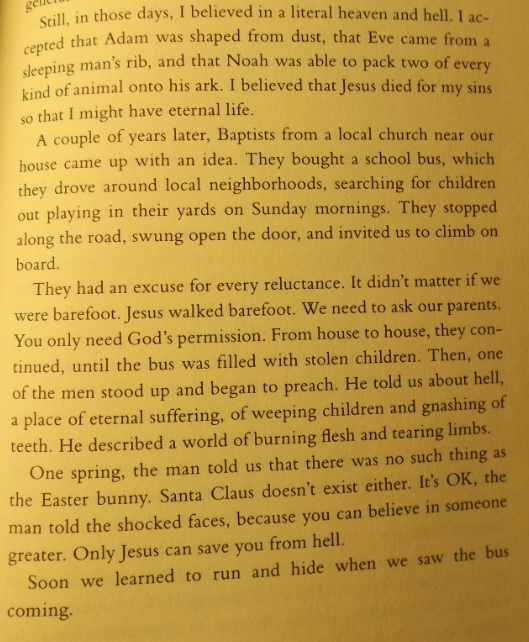
There. Regardless of the whole creation-evolution controversy, with four paragraphs I read in the summer of 2014, I found myself forced to reconsider my entire position on children's ministry outside the church. I'm not saying that anyone I've known would encourage children to get on any bus without parental permission; I don't think that's the case. But the impulse is understandable to me. After all, what's more important than a soul?
(As I remember, the conclusion I came to after reading The Devil in Dover was (and, I suppose, still is): that for reasons I did not fully understand but clearly must accept, parental rights must simply be respected absolutely. And similarly, what is taught in schools should be determined primarily by those who teach it.)
Now, in our modern age, where "rationality" and "reason" is the end-all-be-all, a few people (looking at a particular English teacher I used to have) have apparently gotten the ridiculous idea that the solution to all this would be to raise children without any particular religious affiliation, taking care to expose them to a wide and varied range of ideas, and letting the child themselves decide when they come of age what seems most reasonable to them. But worshipping God isn't an opinion; it's something you do. And so if you're a Christian with kids, I firmly believe you should training them in habits of worship before they're old enough to fully understand what it's entirely about--because, again, understanding is kind of secondary. I think. That is what James K.A. Smith said, right?
I don't have a whole lot of sophisticated music taste, so I've been listening to MANIA by Fall Out Boy a lot lately, mainly because "I always make such expensive mistakes" is a lyric I feel in my bones. My classes are actually all going pretty well--and I'm mostly enjoying them too!--which feels unusual for this point in the semester. (For as much as I fanboy out over college professors at other institutions, my own grades can be embarrassingly dismal.) But while I'd normally be excited, I also have something else in my life that I was supposed to contact people about like two months ago, which I've been almost getting around to for days that have quickly turned into weeks and it's just casting a pall over my life at this point. Then again, most of the problems in my life seem to stem from me being behind on things and then not letting the relevant people know I'll be late. (The same song I mentioned earlier also has lines that go, "So when I say I'm sorry I'm late, I wasn't showing up at all / I mean I really didn't plan on showing up at all.")
* * *
Thus ends the copy-and-pasted material from a while ago! (Yay?)
I recently discovered a tucked-away section of my college library where they sell books for a quarter each, and I've been able to get some really good additions to my personal library--most recently, The Moviegoer by Walker Percy. I haven't read it before, but I'm currently maybe half-way through. I admit only realized the book existed when my now-girlfriend sent me an excerpt from it maybe 2 or 3 years ago when she had to read it for a college class; but I am finding the book tremendously charming. However, not too many pages in, my memory of reading this article began resurfacing. Initially drawn in by protagonist Binx, it suddenly occurred to me that if I was going to approach the book in such a friendly manner upon first reading, I ought to eventually reread it once I've finished -- keeping in mind second time round that Binx is somewhat of a sick person.
Apropos of nothing: in my last newsletter, I mentioned I was about to take my second driver's exam, having failed the first one. I passed the second one! I am officially a licensed driver, so y'all should stay off the roads...as soon as I get a car, that is. That's a little humor for you there. It's funny because I imply you should stay off the roads because I'll be a dangerous driver, when the reality is that you should stay off the roads because cars are demonic.
One last thing to up my word count hopefully to my customary 15 pages: I tried writing a poem about someone I know (the person I'd probably call "aunt" if I was from a family that designated family friends with titles of biological relations) a couple months ago. I haven't gotten a great response to it, but I nonetheless like what I wrote and want to share it with you, so I'm going to paste that at the very bottom of this email.
Anyway. Shoot me an email if you feel like it; it would actually make my day. (Just so long as you don't expect a response too soon. It *is* finals week. Oof, the semester really did go by way too fast.) Really hope y'all are doing well.
-Benjamin
In a nondescript place in the Forest of Beige,
We planted a seed
Or — picked out a pebble
And none of the passerby noticed the cage:
Our stupendous, quite ordinary temple.
There’s a kingdom in the cabinet
A thousand miles wide:
It’s right there, just next to the sherry.
And I am the queen, the magnanimous magnate:
Long will I reign, long as I choose to tarry.
For I am an hundred and twenty years old
And I’ll live a hundred years more
As the prophecy foretold —
Or till I see the end of the war
Call me your monarch
Give me space to be human
By which I mean: in your retellings of legend
Kindly refrain from pretending
I fit your conceptions and mores.
I needed no man —
I fought every battle:
And most of the victories I carried.
I did it all in floral sleeves;
Then told all my daughters to marry.
What a miracle: to make a home
To call our own
Out of green carpet and couches
And old tapes of Richard Thomas.
I recently discovered a tucked-away section of my college library where they sell books for a quarter each, and I've been able to get some really good additions to my personal library--most recently, The Moviegoer by Walker Percy. I haven't read it before, but I'm currently maybe half-way through. I admit only realized the book existed when my now-girlfriend sent me an excerpt from it maybe 2 or 3 years ago when she had to read it for a college class; but I am finding the book tremendously charming. However, not too many pages in, my memory of reading this article began resurfacing. Initially drawn in by protagonist Binx, it suddenly occurred to me that if I was going to approach the book in such a friendly manner upon first reading, I ought to eventually reread it once I've finished -- keeping in mind second time round that Binx is somewhat of a sick person.
Apropos of nothing: in my last newsletter, I mentioned I was about to take my second driver's exam, having failed the first one. I passed the second one! I am officially a licensed driver, so y'all should stay off the roads...as soon as I get a car, that is. That's a little humor for you there. It's funny because I imply you should stay off the roads because I'll be a dangerous driver, when the reality is that you should stay off the roads because cars are demonic.
One last thing to up my word count hopefully to my customary 15 pages: I tried writing a poem about someone I know (the person I'd probably call "aunt" if I was from a family that designated family friends with titles of biological relations) a couple months ago. I haven't gotten a great response to it, but I nonetheless like what I wrote and want to share it with you, so I'm going to paste that at the very bottom of this email.
Anyway. Shoot me an email if you feel like it; it would actually make my day. (Just so long as you don't expect a response too soon. It *is* finals week. Oof, the semester really did go by way too fast.) Really hope y'all are doing well.
-Benjamin
In a nondescript place in the Forest of Beige,
We planted a seed
Or — picked out a pebble
And none of the passerby noticed the cage:
Our stupendous, quite ordinary temple.
There’s a kingdom in the cabinet
A thousand miles wide:
It’s right there, just next to the sherry.
And I am the queen, the magnanimous magnate:
Long will I reign, long as I choose to tarry.
For I am an hundred and twenty years old
And I’ll live a hundred years more
As the prophecy foretold —
Or till I see the end of the war
Call me your monarch
Give me space to be human
By which I mean: in your retellings of legend
Kindly refrain from pretending
I fit your conceptions and mores.
I needed no man —
I fought every battle:
And most of the victories I carried.
I did it all in floral sleeves;
Then told all my daughters to marry.
What a miracle: to make a home
To call our own
Out of green carpet and couches
And old tapes of Richard Thomas.
Don't miss what's next. Subscribe to The Mind of Benj. Wesley: