
Why the Mediterranean Diet Keeps Winning
Every January, a new "miracle diet" shows up on your feed. Keto one year. Carnivore the next. Some trend that involves eating in an eight-hour window while standing on one leg.
And yet, when scientists actually study which eating pattern holds up decade after decade, one keeps winning: the Mediterranean diet.
🫒 What Actually Is It?
Here's the thing: the Mediterranean diet isn't really a "diet" in the deprivation sense. There's no forbidden list. No macros to hit. No app pinging you at 6pm because you haven't logged your fat grams.
Think of it less like a rulebook and more like a template. It's how people in Greece, Italy, and southern Spain have eaten for generations, built around one simple idea: whole food, minimally messed with.
🍽️ What's Actually On the Plate
A typical Mediterranean meal leans on:
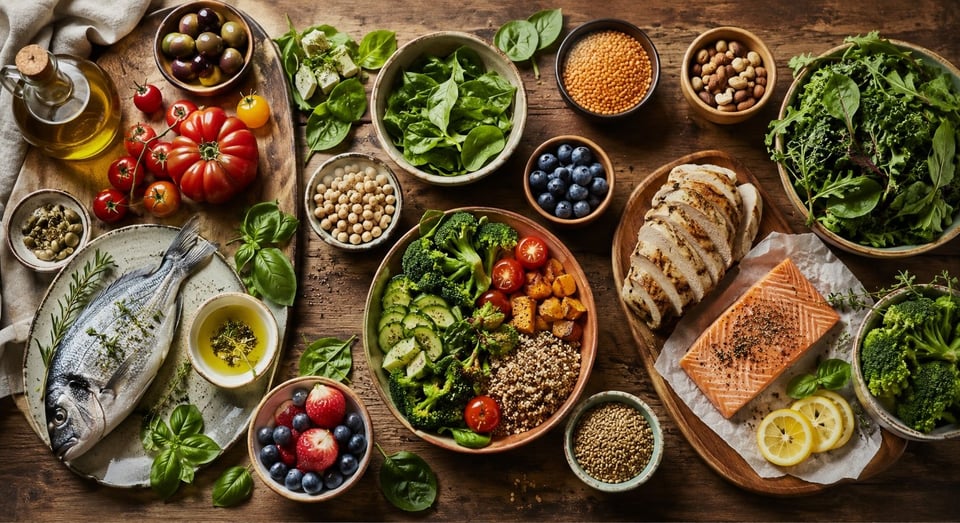
Plants as the main event. Vegetables, fruit, whole grains, beans, and lentils fill most of the plate.
Fat, but the good kind. Extra virgin olive oil replaces butter as the default fat.
Protein, mostly from the sea. Fish shows up a few times a week. Red meat and processed meat show up rarely.
Dairy in moderation. A little yogurt, a little cheese, never the star of the show.
No single "superfood" is doing the heavy lifting here. It's the combination that matters.
🧑🍳 Meet Jake and Marcus
Jake and Marcus both want to eat healthier. Jake goes all in on a trendy 30-day "clean eating" plan: no grains, no dairy, no fruit. He loses some weight in week one, mostly water, then can't sustain it and quits by week four.
Marcus does something less exciting. He swaps his usual sandwich for a bowl of chickpeas, greens, and olive oil dressing. He starts having fish twice a week instead of deli meat. Nothing feels restrictive. Six months later, Marcus is still doing it. Jake is back to his old routine.
That's the real edge of the Mediterranean approach. It's boring enough to actually stick.
🩸 The Blood Sugar Angle
Here's where it gets relevant for anyone watching their glucose. A typical Mediterranean meal naturally stacks three things that slow down digestion:
Fiber from vegetables and legumes
Healthy fat from olive oil and nuts
Protein from fish, beans, or yogurt
That combo means glucose gets released into your bloodstream slower and steadier, instead of spiking and crashing the way it might after a plate of white pasta alone. Same idea we talk about a lot here: it's rarely the food itself, it's what you eat it with.
What's New at GlucoSpike
Blood sugar logging is live (currently in beta). Log your readings alongside your meals and start connecting the dots.
Swap suggestions now highlight ingredients you can add to your shopping list, so better choices are ready to go next time you cook.
Build a recipe with your AI coach. Tell it what you're craving, get a Mediterranean-friendly version back.
Spike Triggers, a new view showing your top glucose triggers from the last two weeks.
🔄 The Twist: You Don't Need to Shop at a Greek Market
Here's the part people miss. You don't need olive groves or a flight to Sicily to eat this way. The principles translate to whatever's already in your grocery store:
White bread → Whole grain bread
Butter → Olive oil
Chips or candy → Fruit with a handful of nuts
Deli meat → Grilled chicken, fish, or beans
None of these swaps require a new identity. They're small edits to meals you already eat.
✅ The Takeaway
You don't need to chase the next trending diet. Add more plants, swap in healthier fats, keep protein on the plate, and go easy on ultra-processed food. That's basically it.
Small change this week: Add one extra serving of vegetables to lunch, or trade your usual dressing for a drizzle of extra virgin olive oil. Consistency beats perfection.
Still feeling like food and glucose are a mystery? Don't stress, stress doesn't help your sugar, anyway. Leave it to GlucoSpike AI to decode the patterns. No sensors. No manual tracking. Just smart insights based on what you eat. Progress doesn't need to be complicated. Just simple and consistent.
See you next week,
Chai
— Founder, GlucoSpike