
Sunday Edition Review: Invisible
Look ma, I made it (I think, maybe)
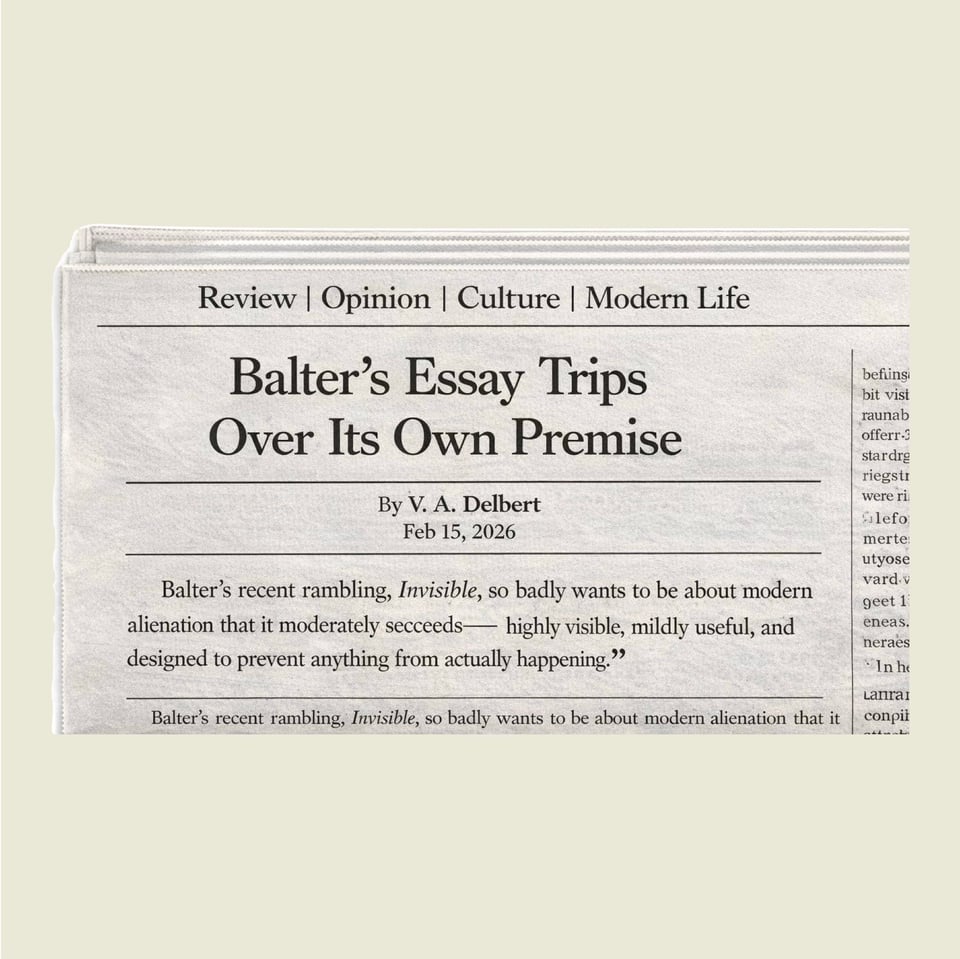
Review | Opinion | Culture | Modern Life
By V. A. Delbert
Feb 15, 2026
Reprinted with permission
Balter’s recent rambling, Invisible, so badly wants to be about modern alienation that it moderately succeeds - though not without tripping over the familiar furniture of its own premise.
Ultimately this is a safe essay about safety, which is a bit like being an orange cone at a highway construction project: highly visible, mildly useful, and designed to prevent anything from actually happening.
The author catalogs a series of recognizable micro-scenes - gyms, airplanes, coworking spaces, Ubers - with a practiced eye and a steady hand.The details are competent, occasionally sharp, and clearly lived-in. The problem is that they are also exhaustively familiar. One could argue that this familiarity is the point. One could also argue that the author has mistaken recognition for revelation.
The ghost metaphor, while serviceable, arrives a tad early and is leaned on heavily. NPCs, Minecraft, invisibility - these are not wrong, exactly, but they are well-trodden shortcuts in contemporary musings about disconnection.
The piece knows this, or seems to, which may explain its defensive insistence that the behavior in question is not shyness, nor etiquette, nor fear of rejection.
This insistence, however, raises suspicion: essays rarely protest this much unless they are unsure of their own footing.
The suggestion that we avoid one another not out of anxiety but out of a reluctance to incur obligation is the most provocative claim here. Unfortunately, it arrives late and is treated gingerly, as if the author doesn’t quite trust it to stand on its own. The conclusion gestures at consequence without naming one. Obligation, we are told, is dangerous - but how, and to whom?
Balter, you can do better.
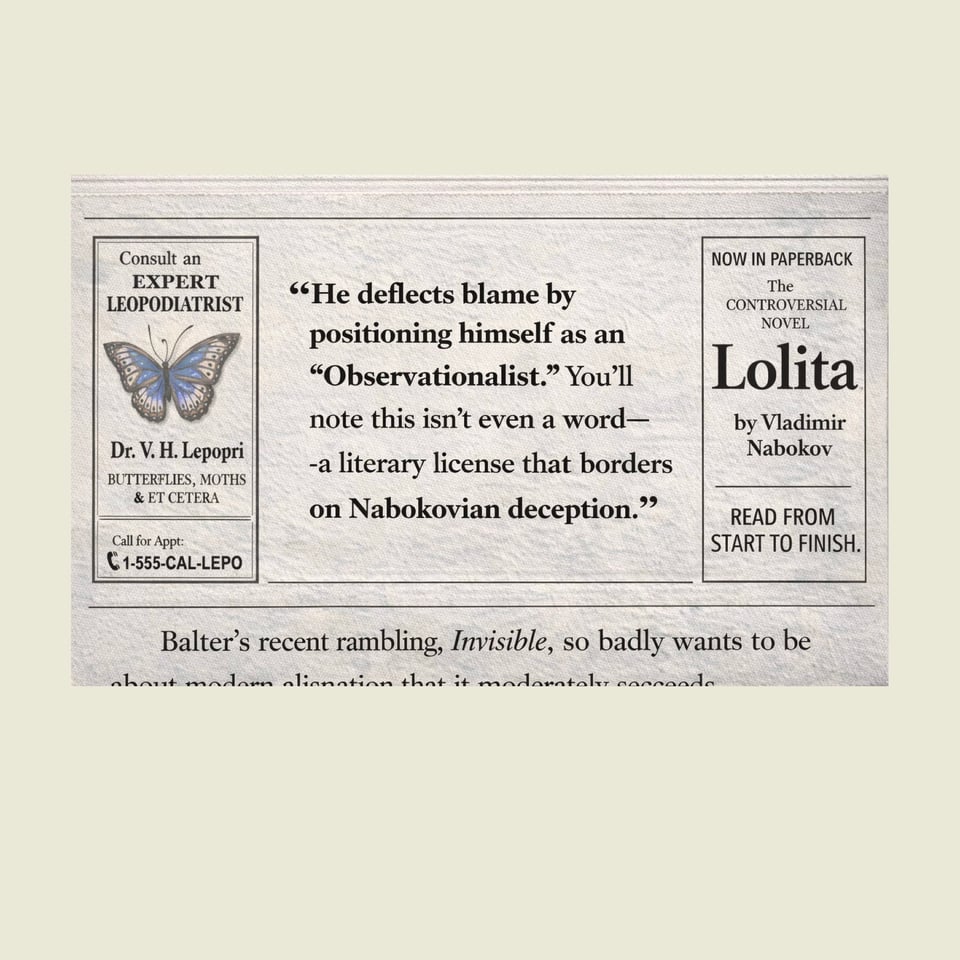
Speaking of Balter, there is also a curious absence at the center of the piece: the author himself. He deflects blame by positioning himself as an "Observationalist.” You’ll note this isn’t even a word - a literary license that borders on Nabokovian deception.
And yet - unfortunately - Invisible is moderately readable. It is cleanly written, disciplined, and unapologetic about its seriousness. The prose does not strain. The sentences hold. Balter clearly knows how to move through a paragraph without embarrassing himself, which in 2026 will get you a bag of walnuts and possibly spare you from being maced by ICE.
More irritating, the essay’s restraint is deliberate. It refuses melodrama. It does not prescribe connection or scold the reader into eye contact. It simply describes the avoidance and lets the air sit heavy around it. One keeps waiting for the author to overreach - for a tidy lesson, a moral crescendo, a redeeming anecdote - and he declines. It could be he was just out of ideas, or maybe that discipline, though maddening, is real.
This is not an essay that changes the conversation. It is an essay that may not change anything at all. It certainly will not solve loneliness. But it may follow you, quietly, the next time you decline to say hello. And for a piece so suspicious of visibility, that is an almost irritatingly effective form of presence.
V. A. Delbert is a contributing critic covering culture and modern life.
Published in the Sunday Edition