062626 / REHEARSING OTHERWISE
a revised rehearsal note
REHEARSING OTHERWISE is a series where I share experiments in writing rooted in black study1. These are dispatches from the rituals of play I facilitate in my own writing practice, embodying disobedience (or, dis-embodying obedience)2 through methods of reading and writing Otherwise34. I publish these tangential5 drafts with commentary as a gesture toward the revision process.
★ ★ ★
For this rehearsal, I’ll be focused on reading Writing Otherwise, using prompts6 to respond to the text chosen blow.
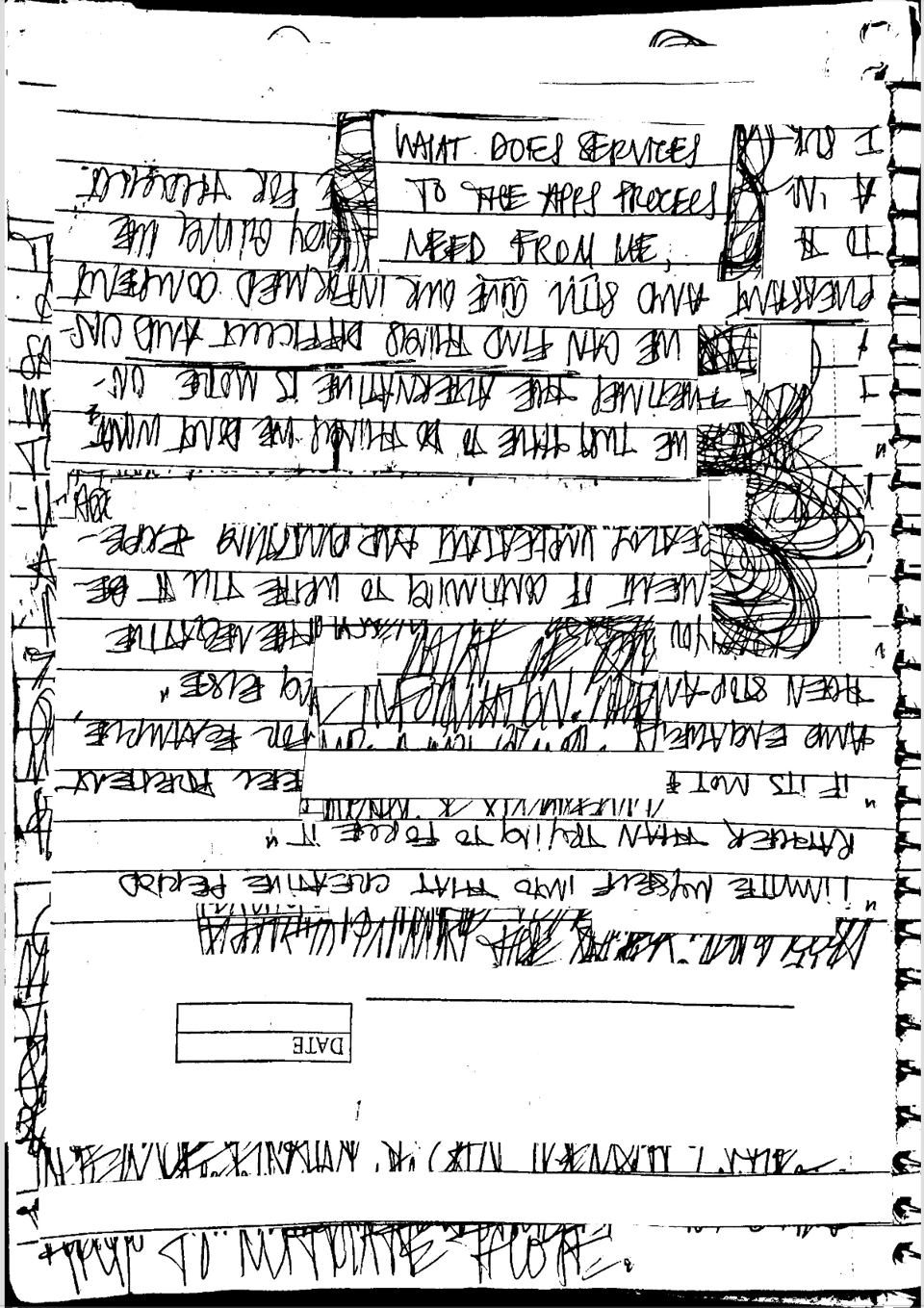
How do you write non-readability into the text?
………………………………………………………………………………………………………………………………………………………………coherent.
,,,,,,,,,,,,,,,,, combination of grounding my thoughts, and playing ‘‘‘‘‘‘‘‘‘ with drawing ‘‘‘‘‘‘‘‘‘‘‘‘‘‘‘ to loosen up ‘‘‘‘‘’ ……………………………tough work ……………….. And I thought……………………………………………………………………………. I honestly just collage ,,,,,,,,,,,,,,,,,,,,,,,,,,,,,,,,,,,,,,,,,,,,,,,,,,,,,,,,,,,,,,,,,,,,,,,,,,,,,, no longer ………... But I think ,, collage ,,,,,,,, is writing too, ………………………………………….. quiet and coming ………………………. ———————————————-with the pen—’’ i’m not instantly making sense ,,,,,,,,,,,,,,,,,,,,,,,,,, ,,,,, ………………………………………………………………………………………………………………………………………………….. In order of coherency, in order to say something ,,,,,,,,,,,,,,,,,,,,,,,,,,,,,,,,,,,,,,,,,,,, in order to ‘be writing’ ………………………... So ——————————————————————————————.
While reading this text, what brings you pleasure?
upside down—’’’’’’’’’’. But ——————————————————————————————— when I ——-…………………….. ,,,,,,,,,,,,,,,,,,,,,,,,,,,,,,, ,,,,, when generating writing, ,,,,,,,,,,,,,,,,,,,,,,,,,,,,, read. When I read ——————————-,,,,,,,,,,,,,, however, I suddenly —————————————————————————————-- …………………………………………… reveal. What is ) wrong ((((((((((((((((((((,,,,,,,,,,,,,,,,,,,, ))))))))))))))
??????????
How do you disengage with a desire for plot/narrative, and instead seek a more embodied way of moving through a text?
“????????????????????????????????????????????” is suspended in a wall ;;;;;;;;;;;;;;;;;;;;;;;;;;;;;;;;; ——————————————……………………………... …………………………………………….. paper amidst ………………………………………………………………... ,,,,,,,,,,,,,,,,,,,,,, a narrative building ,,,,,,,,,,,,,,,,, ,,,,,,,,,,,,,,,, and more of a soundscape. ,,,,,,,,,,,,,,,,,,, ,,,,,,,,,,,,,,,,,,,,,,,, then I guess ‘‘‘‘‘‘’………………... ………………..listen, instead.
★ ★ ★
And that brings this rehearsal to a close.
Thanks for studying rehearsing alongside me,
[Thanks for being an audience…?]
Paris
REFLECTION7: What feelings and sensations came up for you while you were reading this newsletter? For example, did you feel curious, tense, or stimulated? How did these feelings show up in your body? For example, did you sense these emotions in your breath, your hands, or torso while reading this newsletter?
P.S. This is a revised version of a previous entry of Rehearsing Otherwise. To see the original draft, check out the journal entry 012926 / REHEARSING OTHERWISE.
“…there is a distinction to be made between black studies and black study. Despite its radical origins, Black Studies as an academic discipline is now assimilated into the corporate university and too often reduced to performative reform. Alternatively, study is ‘a mode of thinking with others separate from the thinking that the institution requires of you.’ As a mode of practice, as Stefano Harney puts it, study is happening with and against the university and, most importantly, outside the university…I would posit that black study is the practice of refusal of Western civilization.“ — djones, Black Study as Practice: Claiming the B-Side as Black Study. (2023). ↩
“There remains some aspect of my speaking that expects a different mode of expression than English provides…This comes from a desire to resist assimilation, but equally, it arises out of a sense of exploration or adventure, a sense of puzzlement: as if something has happened to my occupation of the language, where a kind of split occurs. I move through it and see myself moving at the same time. It’s a double consciousness, a questioning that simultanates my rendering of experience.“ — Renee Gladman, The Sentence as a Space for Living: Prose Architecture ↩
see footnote 3.↩“I think these ideas of world building really gives this freedom of also trusting what you already know and what you're already carrying, but also try to imagine other ways of being together, or other ways of encountering something. …thinking about alternative histories that is not through the lens of colonialism…there’s always a possibility to think of other ways of being together.” — Sandra Mujinga, “"I cheer for the monsters." | Artist Sandra Mujinga | Louisiana Channel.“ (2023). ↩
“A tangent can be a generative digression that invites learning or an abrupt change in course that introduces you to new ideas. Tangents are not mistakes rather, they are offerings…A tangent is a form of waywardness…” — Kameelah Janan Rasheed for Orange Tangent Study ↩
see footnote 3.↩The format for this reflection question is a riff on those featured at the end of each chapter of Making & Being by Susan Jahoda & Caroline Woolard of BFAMFAPHD. ↩

