
Ask the Texts: How does Origen answer Celsus's charge that Christianity appeals only to the ignorant?
Each answer provided by Ask the Texts is built by searching directly through Appian Way Press's translations and revisions of early Christian writings.
How does Origen answer Celsus's charge that Christianity appeals only to the ignorant?
Origen of Alexandria, in his work Against Celsus, directly refutes the charge that Christianity appeals only to the ignorant, calling it "a lie." He argues that while the divine word does call "foolish, lowly, insensitive people, slaves, women, and children" "in order to improve them," it also calls "those who are much different from them." Origen emphasizes that Christ is "the Savior of all people," including "wise or simple," and serves as "an atonement" "to the Father" "for our sins," not only for believers but "for the whole world," drawing on 1 Timothy 4:10 and 1 John 2:2 respectively.
Origen challenges the premise that education or wisdom are hindrances to faith. He asks what prevents an educated person from knowing God, suggesting it would be "more useful through this to reach the truth." He states that "truly being educated is not bad; education is a path to virtue," and that caring for "the best words" is good, provided one understands what constitutes the best and true words that encourage virtue.
Furthermore, Origen redefines who the "truly uneducated" are. He asserts that "No one will explain the matters of divine wisdom to the most uneducated or foolish." He identifies the truly uneducated as those who "are not ashamed to speak to lifeless things, calling upon the weak for health and expecting the dead for life, and begging for help from the most hopeless," including those who imagine "imitations of divinity in the hands of the unskilled." He states that Christians aim to free "the last among us" from this kind of ignorance and foolishness, while also expecting "the wisest should understand and grasp divine hope."
Origen also acknowledges a role for human wisdom, stating that "it is not possible for someone who has not trained in human wisdom to approach the divine wisdom," even while recognizing that "all human wisdom is foolishness compared to the divine." He points to the profound teachings within Christianity, such as the "word of wisdom through the Spirit" and the "word of knowledge according to the Spirit," which Paul mentions (1 Corinthians 12:8), as evidence that Christianity presents deep insights "to those well-educated in Christianity," something Celsus apparently fails to recognize.
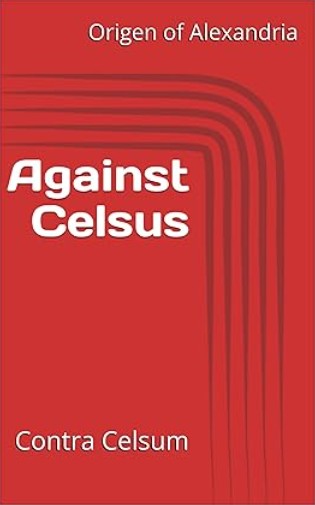 |
Origen of Alexandria, Against Celsus: Contra Celsum
Origen of Alexandria’s monumental apologetic work, Contra Celsum (Against Celsus), written around 248 AD, systematically refutes the arguments of the pagan philosopher Celsus, who had criticized Christianity in his work The True Word.
|
Enjoying Ask the Texts? Subscribe to get new issues by email.
This answer was generated on November 7, 2026 using a retrieval-augmented generation (RAG) system built on Appian Way Press's own translations and revisions of early Christian writings, with the gemini-2.5-flash language model producing the final answer text from the retrieved passages.
Copyright © 2026 Rick Brannan
