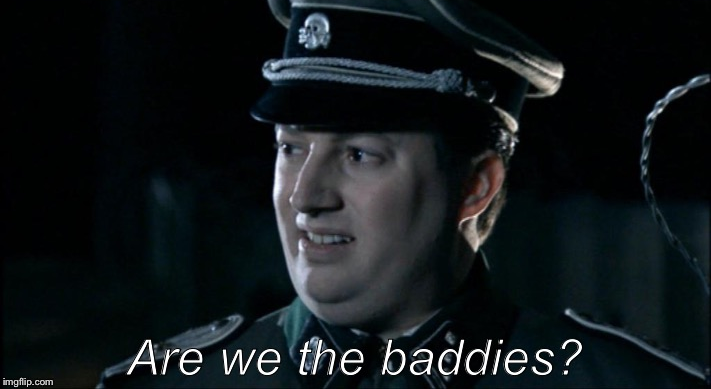
my favorite trope of the year: are we the baddies?
Thanks for your patience, wonderful readers. Today I’m kicking off writing about a topic that has shaped a lot of my thinking behind the scenes all year.
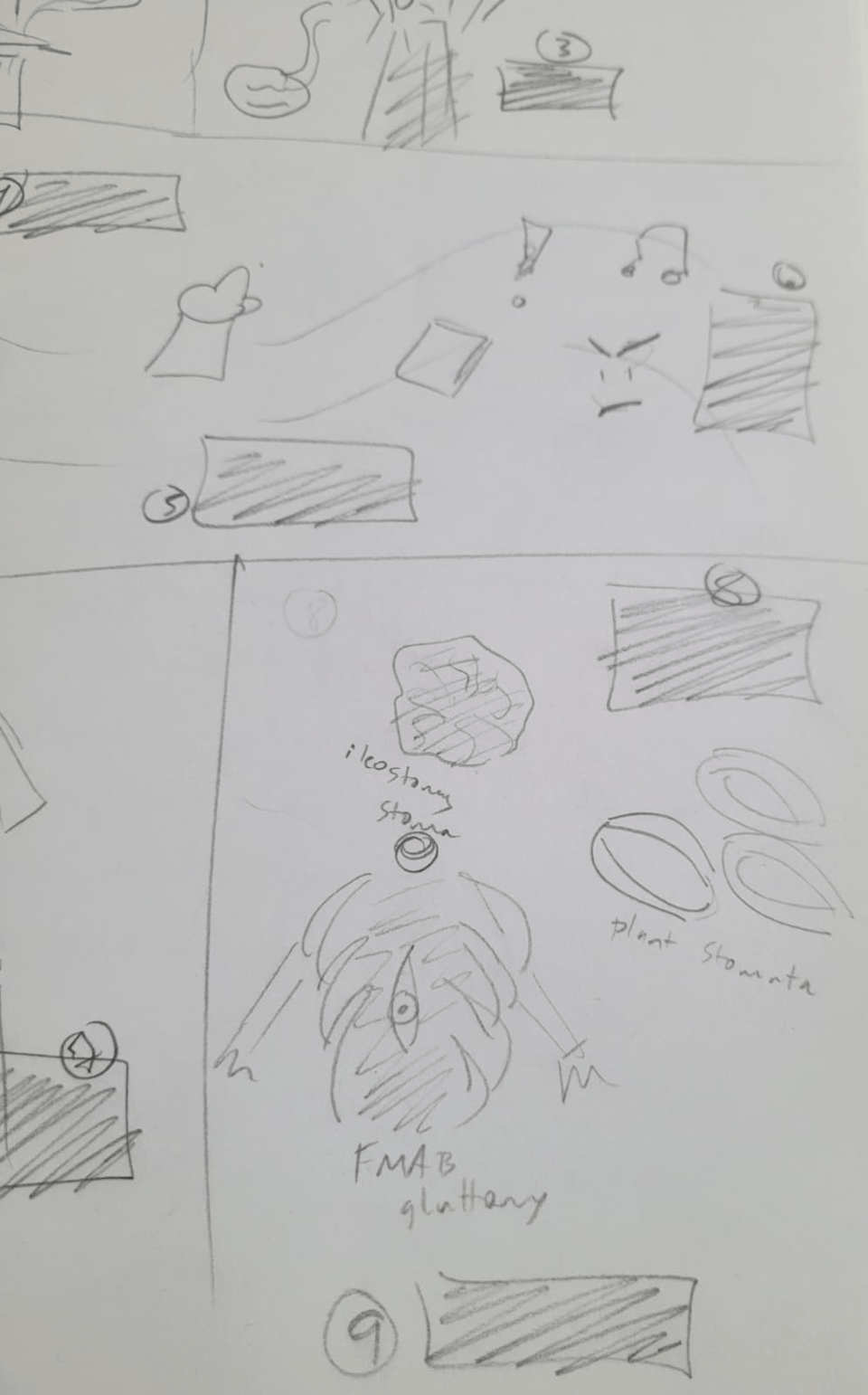
I’m actually drawing something, I swear
I’m working on a comic about some of the mental gymnastics I do with my feelings about having an ileostomy. Here’s a zoomed-in part of the story board, which I desperately need to get back to…if you can read my writing, maybe this sounds like a fun mix of images to see properly drawn out? 😅
My favorite trope of the year: Are we the baddies? (existential edition)
(technically this includes spoilers for, like, every novel, movie, or series I mention below. All the stories mentioned are ~3-25 years old, so 🤷)
Earlier this year I finally convinced my spouse to watch The Good Place, my favorite TV show of all time, with me. Fortunately they liked it well enough. This re-watch prompted a lot of thoughts from me, and one of those was the beginning of a realization about realizations: I absolutely adore stories where a subset of the protagonists figure out that they’re in “the Bad Place”…or that they’re architects of the Bad Place themselves, and that the Bad Place is bad, actually.
I realize this isn’t one singular trope, but I group stories that have protagonists realizing they’re in the Bad Place with those that have protagonists realizing they’ve perpetuated the Bad Place because there are some additional themes I’ve noticed in stories that fall into these categories that I find compelling: namely, I particularly enjoy the stories where either one of these realizations leads to questioning their entire worldview or world structure, and then doing something about that.
If I think back on media that has impacted me a lot over the past decade, and especially in the past few years, the following come to mind:
The Good Place
(honorable mentions for various media where people realize they were raised in a cult)
Some topics that overlap to some extent across these are:
Protagonists realizing they’re in “The Bad Place”
Protagonists realizing they are part of The Problem / part of making the Bad Place a truly Bad place
Prominent figures in a “society” revealed as sinister, manipulative, and irredeemable
The overall message of, “wow, this system sucks, we need a better one”
Subset of the characters working to undo said bad system (they don’t necessarily need to succeed)
(for its own installment, maybe) the Bad Place sometimes takes on Imperial proportions
(There’s also a bit of scientific themes in the “magic systems”, for (lack of a better term, across them as well, but that’s a different conversation for a different edition.)
I considered giving this a different title in order to differentiate from the meme based on “Are we the baddies?”, a pretty popular and hilarious comedy sketch by Mitchell and Webb. If you’re not familiar, basically a Nazi realizes that, well, it’s bad to be a Nazi because he realizes how there’s a mean-looking skull on his uniform. (I’m pretty sure Tamsyn Muir, the meme-loving author of the Locked Tomb series, which famously features necromancers in an interplanetary imperial society with lots of skeletal aesthetics, can recite this sketch by memory.)
If you’re curious to see other examples (the only example in common with my list is FMAB), someone made a 15-min video about this trope and how it can resolve. I’ve focused on the examples where figuring out someone is a “baddie” or a citizen of the Bad Place triggers an existential crisis; this video goes more into examples where baddies double down on badness, what kinds of characters wind up having these realizations, etc. (For Locked Tomb fans, I’d consider Jod a baddie who doubles down on badness rather than coming to terms with, uh, everything he’s ever done; I find characters like Harrowhark and Coronabeth much more interesting from this morality angle. For FMAB fans, Colonel Mustang could be a former baddie trying to redeem himself by working to make the world better, though arguably he’s still perpetuating the same evil system. The Elric brothers are the characters who realize they’ve been duped into over-performing in a fucked up society and, towards the end of the series, strive to root out the rot.)
On an aesthetic level, I love these themes for a variety of reasons.
There’s an element of existential horror about them: finding out you are so ridiculously misinformed about the world around you is truly terrifying. How someone reacts to receiving information about being implicated in perpetuating something ranging from awful to population-crushing tells you a lot about them and their potential to grow as a person.
For story-crafting, it creates a huge opportunity to weave together world-building, character development, and plot in epic ways.
I can’t resist stories that mix creepy/gothic aesthetics, horror elements, and characters spanning the moral grey area; often these stories have at least two of these.
Some of the examples listed here, like The Good Place and Dungeon Meshi, start silly but wind up with deep societal and philosophical messages.
Lastly, it’s gratifying to see stories that take the audience through the grind of people figuring out their world is messed up, coming to terms with that, and sorting out what to do about that.
For anyone who’s been reading along for a while or who knows me beyond this newsletter, you can imagine how much I’d like to use this trope as a lens at looking at this moment in 2025 as well as in my personal experience. Tune in next time for that!
Latest inspo
I recently happened upon Alemeda’s music, and basically every one of her songs is a bop. For fans of 00’s pop punk and indie rock. “Beat a B!tch Up” features Doechii and it goes so hard!
Speaking of music, I recently fully switched over to Tidal from Spotify. There’s no 🧊 ads and generally less fuckery, a better shuffle function, and better pay per stream for artists. It’s pretty easy to switch over, too!
I finally read the “gay trauma book”, aka In the Dream House by Carmen Maria Machado, and loved the structure of it: noting all the motifs and tropes in one’s own story while writing a poignant narrative is no easy feat. A master class in writing. Machado has a way of making a story of an abusive relationship (yep, big CW) horrific in the way a horror novel or thriller typically is.

