
the slantwise histories is out now!
tour stuff and some big feelings about fairy tales
news
my short story collection, the slantwise histories, is out today! it's an indie next pick (blessed are the booksellers) and it got wildly generous reviews from library journal and locus! there are eleven old stories (including "the six deaths of the saint," "the knight and the butcherbird," "a witch's guide to escape," and "mr. death") and four brand new ones. the audio version is narrated by Jeanette Illidge and Jenn Lee! buy it wherever books are sold, or check it out from your local library, or ask your girlfriend to get it for your birthday.
tonight is the first event on my tour! which includes both US stops and (for the first time) UK stops. i can't wait to meet all of you <3
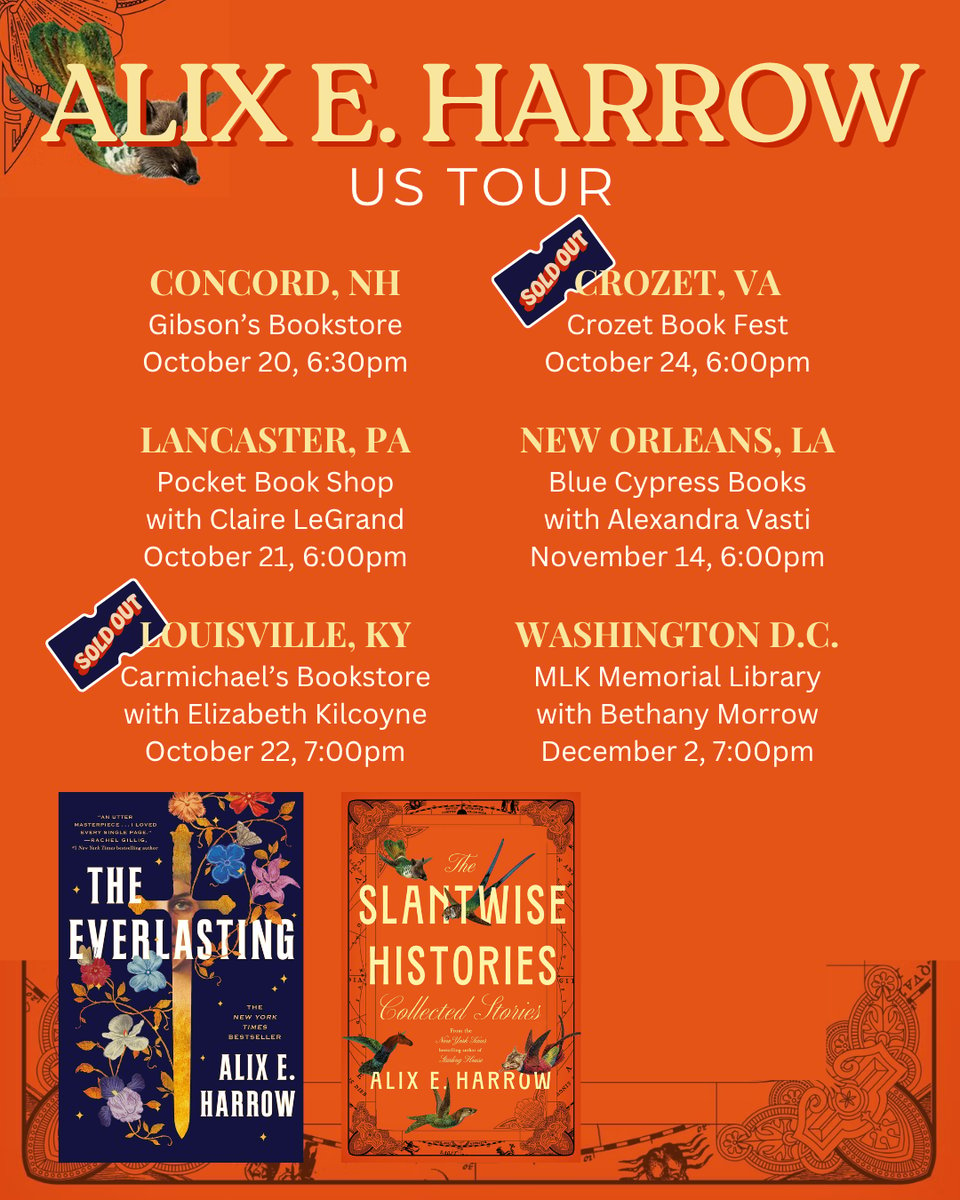
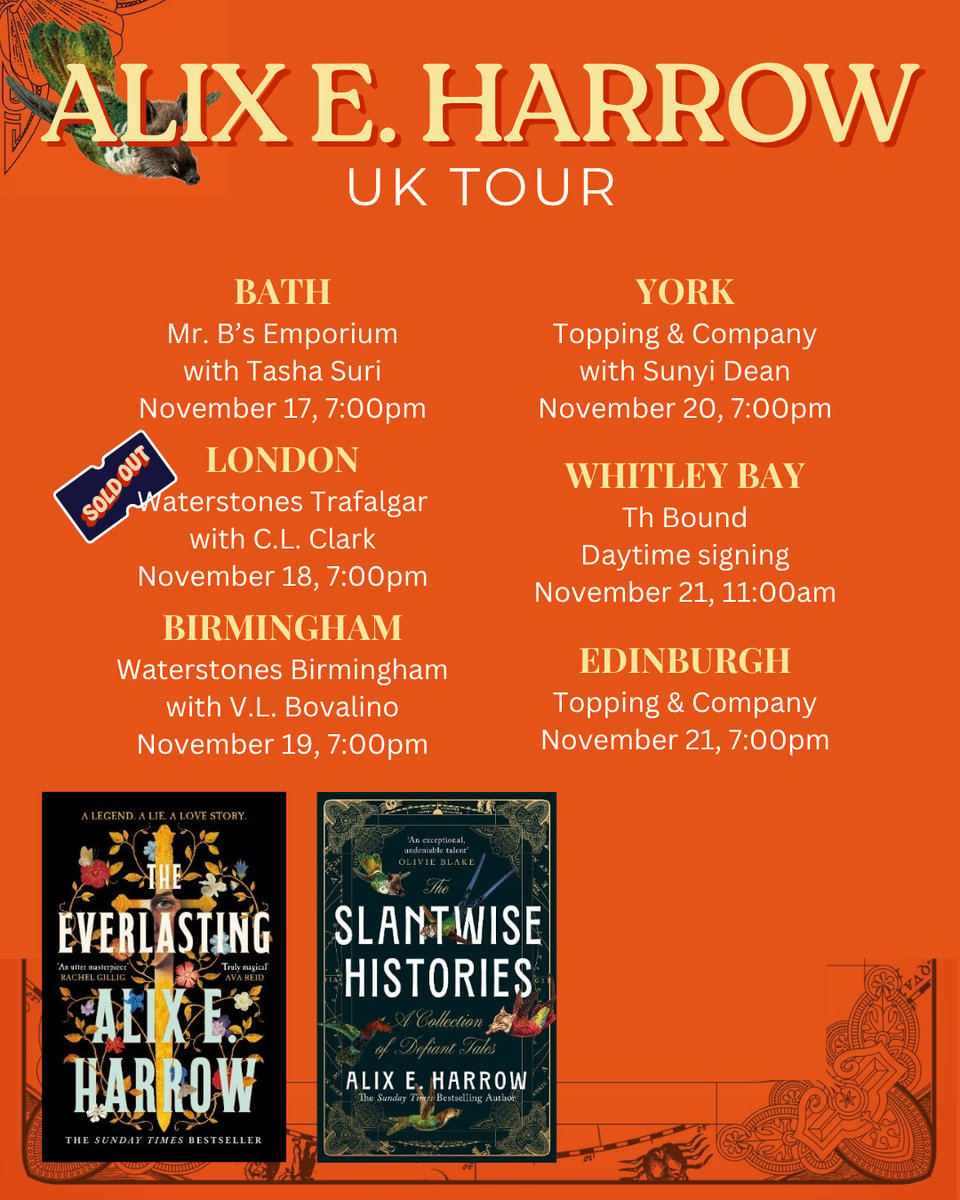
oh, and also: the paperback release for the everlasting is delayed! it'll be out november 10th, now. this is part of the industry-wide printing & shipping problems that have plagued a lot of fall releases. i can't prove it's because we live under a petulant, violent autocracy that keeps starting and losing wars, but i know in my heart who to blame.
on the language of dusk
i find it difficult to talk about these stories without talking about my kids. and yes, alright, i have difficulty talking about anything without talking about my kids, because i have a disease where i think everyone on earth secretly desires to hear more about them.1
it's also a natural consequence of my own personal chronology. this collection spans about ten years of my stories, which is about how long i've been a published author, which is about the age of my oldest child. my life as a writer is my life as a parent; i don't remember how old i was when i wrote any of these, but i know exactly how old the kids were. my milestones and theirs are all tossed together in the same box in the attic: first tooth, first tour, done with diapers, done with dev edits, the winter i cut off their long hair in the backyard and the spring i found that same hair woven into a robin's nest, and the story i wrote afterward, about loving a shapechanger.
(i have had periods of anxiety about this personal and professional enmeshment. the sleek, corporate (white) feminism of the 2010s had warned me never to let my children outrank my ambition. protect your space, rise and grind, outsource all that menial domestic labor to some other, less ambitious woman! then came the reactionary (white) trad wife feminism of the 2020s, warning me never to let my ambition outrank my children. they grow up so fast, what kind of mother wouldn't churn her own ice cream, who needs voting rights! but at some point i read that le guin first thought of the tombs of atuan while on a roadtrip with her three children, during a game of alphabet,2 and i calmed down somewhat. perhaps the harsh divide between domestic labor and profitable labor, between the artistic and the menial, is a false one; perhaps an ambition is just what you work toward, every day.)
but there's another reason this collection makes me want to talk about my kids. it has to do with what short fiction is, and what it is to me, and how i learned to write it. earlier this year i might have told you that i taught myself to write in my early twenties. i would have talked about the craft books i assigned myself (le guin's steering the craft, vandermeer's wonderbook, bird by bird, king's on writing), and the short fiction authors who taught me what contemporary genre could be: sofia samatar, amal el-mohtar, kelly link, kij johnson, catherynne valente. i pursued them on purpose, with intention and attention, nervously compensating for my lack of formal artistic education. if you can't get a store-bought MFA, homemade is fine.
i was doing a version of this bit to the coode street podcast guys, how i didn't really read short fiction until i decided to write it, etc, when gary k. wolfe said, "well, except for fairy tales, obviously." oh. yeah. obviously. ha ha! don't mind me, i'm just gathering the remnants of my self-made myth around myself!
he's right, of course: i grew up with my mother's edition of grimm's fairy tales (bound in plasticky purple leather, with a sewn-in ribbon bookmark). we had both edith hamilton and d'aulaire's. for my eighth birthday i got virginia hamilton's collection of Black folklore, gorgeously illustrated by the dillons. when disney announced the mulan movie, i told my teacher (who was not paid enough for that kind of shit) all about the original ballad, which mom had read to me from one of her old textbooks.
that's where i learned to write. so did you, probably, even if your mother didn't have a lit degree. our first fiction is all short fiction: bedtime stories, picture books, the songs your mawmaw sings. fairy tales, tall tales, myths, fables, bible stories, family stories, old stories. once upon a time. what had happened was. in the beginning.
so, what do they teach us? i don't mean teach in the sense of values or ethics—although these are considered children's stories, and children's stories are often just a variety of their parents' moral anxieties stuffed into animal suits, like bad taxidermy. i mean: what do they teach us about craft? about storytelling, and the point of storytelling?
they teach us the rhythm of a story, i think, before anything else. where they begin, where they end, the beats that lead us like breadcrumbs from end to end. i remember when my kids first started trying to tell jokes: they didn't have the punchlines or the vocabulary, but they had the rhythm. knock knock, they would begin, because that is where you begin if you want to make someone laugh.
we learn the shapes of stories. their tropes and repetitions. the patterns that have been repeated so many times they've acquired a kind of resonance, an echo in the air, as if a hundred different musicians on hundred different instruments have all played the same note. we know these patterns so well that we begin to anticipate them: the rightful heir will return to the throne; the rich man will regret the way he treated that harmless-seeming beggar woman; the boss will have a second health bar. there is a comfort in this logic, these simple if-x-then-y equations.
but we learn, too, the illogic of stories, especially if we venture past the versions that have been smoothed and softened for us, and find the weird, wild old shit. we find ourselves falling into a deep and dimly lit place, stumbling through the dark. this is where we find what le guin calls the language of night. she says:
the great fantasies, myths and tales are indeed like dreams: they speak from the unconscious to the unconscious, in the language of the unconscious—symbol and archetype. though they use words, they work the way music does: they short-circuit verbal reasoning, and go straight to the the thoughts that lie too deep to utter.3
it is only in this language that we believe a woman might swallow a spruce needle and give birth to a raven. that a snake might circle the world. that wolves might walk on two legs and speak to us, and that men might grow the hooves and snouts of pigs.
it is not an especially peaceful or comforting language, for all that the fantastic is so often accused of escapism. these stories are full of murder, death, sex, war, damnation, incest, torment. hot iron shoes and beheaded horses and cannibal women. and yet the grimms called their first collection children's and household tales, and they were not incorrect! in every class of third graders there are always a few greek mythology freaks.4 my neighbor's fifth grader recently recommended the book cinder, in which a cyborg cinderella is used for medical experiments. in a sanitized, brightly-lit world, where there are things so awful the grownups won’t even name them: the children long for the dark.
because what those stories really taught us, over and over, is something we would later understand to be the simple truth: that the world is often chaotic and cruel and unjust. that we might find monsters lurking in our woods, our beds, our mirrors. that the way is long, and the way is dark.
but, in the very act of reading a story, we are made less alone. there is some other person who is walking in the dark with us, talking softly. take my hand, they say, and walk with me. only for a little ways—these stories are short, remember—but by the end of it you will believe in sunrise. i will tell you about goodwill and bravery and true love, and when i am done someone else will tell you another story, and in this way you will go on, from hand to hand, through the dark.
it is these kinds of stories that i've spent the last ten years reading to my children and revisiting in my fiction. this ouroboran exchange, reaching from hand to hand through the dark, is the work i do every day, and therefore the closest thing i have to an ambition. the reason gary said "obviously" after "fairy tales" is that so many of the stories in this collection are retellings, or at least echoes of retellings. there's a daphne story and a eurydice story, and a changeling child and a little mermaid. an animal bride, a transformation chase, a handful of happily ever afters, a whole lot of kentucky. a great deal of darkness, and a great deal of light.
i'm not, of course, fluent in the language of the night—you only get a few of those authors per generation, and you are not reading kelly link's newsletter right now. i speak, at best, the language of twilight, or maybe dusk.
it’s getting dark out. take my hand, just for a little while, and let me tell you about sunrise.
further reading
speaking of old stories and dark stories: the woods all black is out in paperback on november 3rd! you won’t regret it!
i also really dug hannah whitten’s new gothic, reliquary. tis the season for a girl running away from eldritch horrors in a blood-soaked wedding dress!!
even if you don't like kids as a genre, i assume you will like my kids. is this reasonable? well, yesterday my 8yo cried, softly, because they remembered that fruit flies only live for a day. so i would have to say yes. ↩
she also named three of the islands of earthsea after her children's baby names. "one gets a little jovial and irresponsible, given the freedom to create a world out of nothing." jovial and irresponsible is exactly how i feel about my job. from 1973’s "dreams must explain themselves," in the language of night. ↩
from 1974’s “the child and the shadow,” which admittedly dives into some gooey jungian psychology stuff that i am simply not capable of taking seriously. ↩
my child's teacher did request, gently, that they not draw the birth of athena in such graphic detail. fair. ↩

