
on other people's writing
some news, and a close reading of a short story that isn't mine
news
oh, lord, i should send these out more often.1
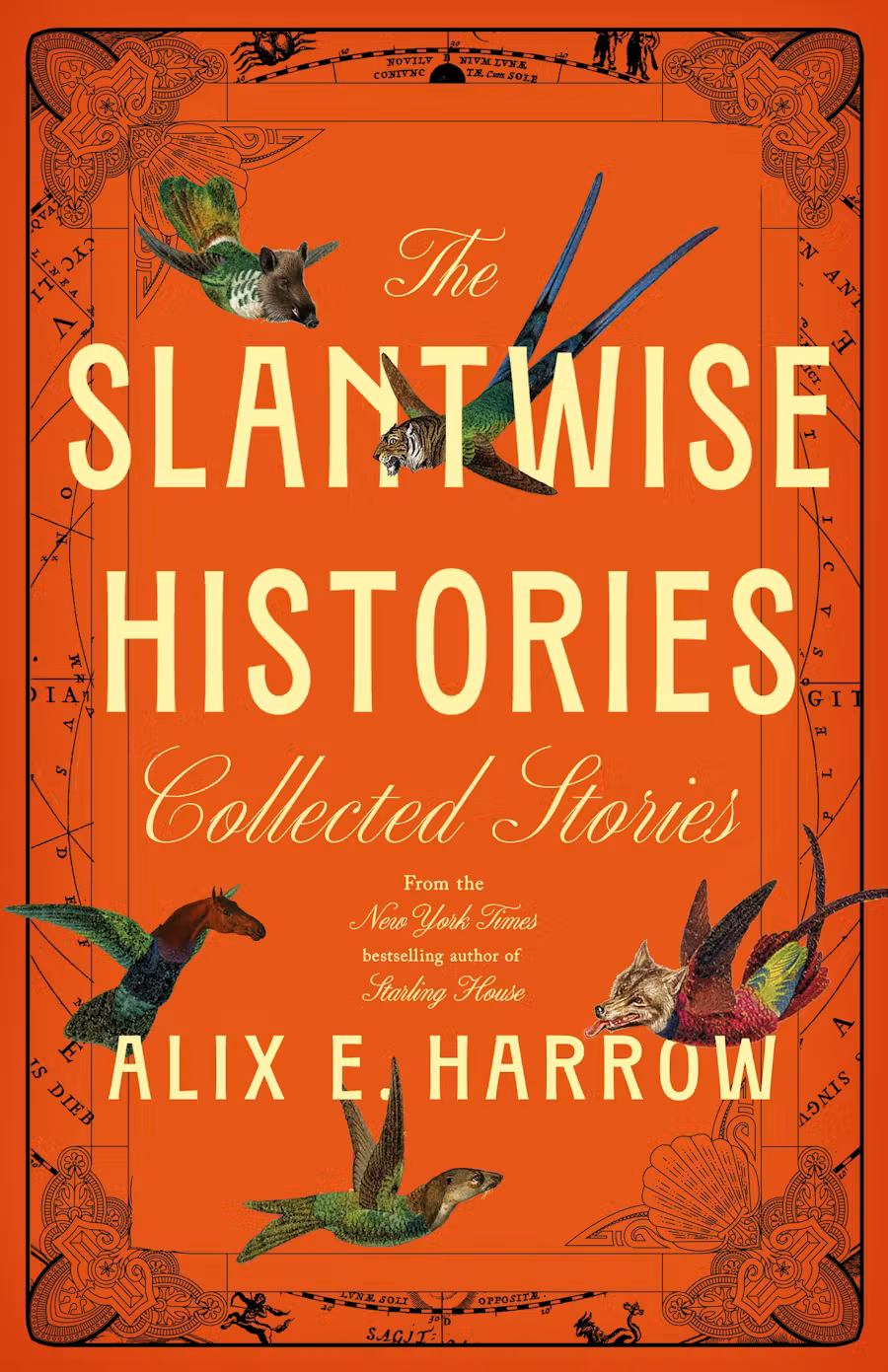
i have a short story collection, the slantwise histories, coming out on october 20th! containing eleven of my previously-published stories and four brand new ones (the new ones are: the brothers grimm as con men, post-apocalyptic appalachian librarian, reverse little mermaid, and 1940s lesbian pulp). you can preorder it here (or signed/personalized editions from my local indie). i’m also giving away a couple of arcs: one for new subscribers to this newsletter, and one for previous subscribers, open internationally. you don’t have to do anything to enter, except be subscribed! i’ll email the winners on monday :)
and the paperback of the everlasting is coming out a week later, on october 27th (pre-order here)! the us edition has a modified version of the original cover, which i love.
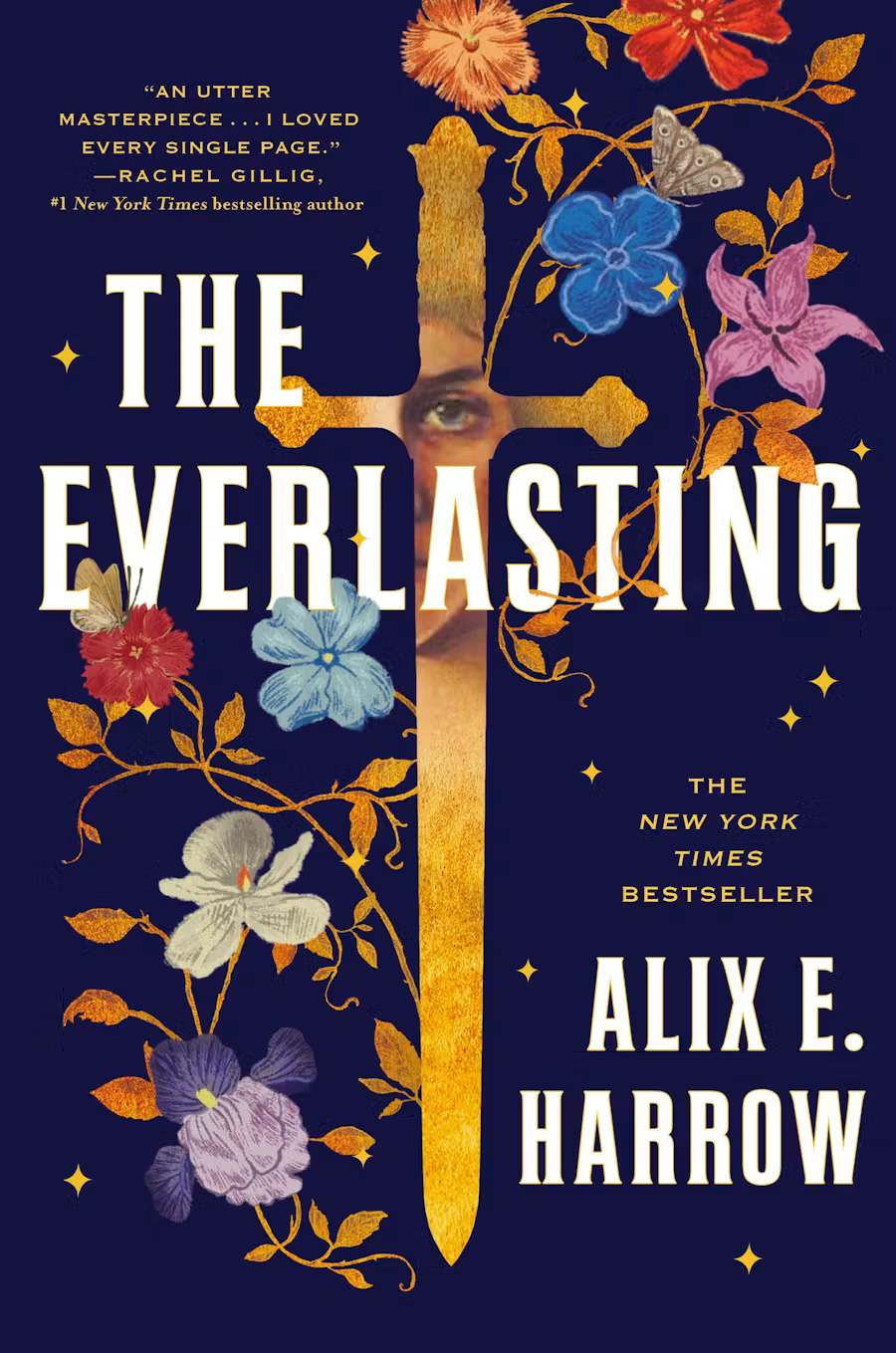
the everlasting has also been acquired by netflix?? with daphne ferraro and working title signed on? i’m using question marks here to communicate my overall incredulity, but these are actually statements of fact. the everlasting also—well—i find myself wanting to slip this casually into the conversation, perhaps with an lol to soften it—well it won the hugo for best novel. i don’t think many people have the privilege of being able to say—precisely, down to the day—when their professional life reached its apogee. i am writing to you from the very top of the ferris wheel, swinging gently in the wind, marveling.
on other people’s writing
i’ve been doing a lot of interviews and podcasts and events lately, as you do before a new book comes out. it’s pretty fun, most of the time, and sort of relieving: you spend years thrashing around in word documents, entirely alone, riddled with ambitions and doubts, until finally some nice person hands you a mic and asks what the hell you’ve been doing. it’s flattering! and—in an environment of shrinking arts coverage and a collective devaluation of the written word itself—it’s a rare privilege.
but it’s also, at times, performative, in the literal sense of a performance. repetitive, certainly. cringe, even! sometimes, walking back to the hotel after an event, i am struck with a real feeling of shame: as if i’m leaving a party and just now realizing i spent the entire time talking about myself, and everyone was too polite to interrupt me. i find myself thinking wistfully that i should go on tour to talk about other people’s books. i would be good at it. i would sell a hundred copies a night.
by sheer luck, one of the interviews i did recently sort of was that: a two-person book club with a local journalist, who offered to let me pick a book (i chose kelly link’s white cat, black dog) and talk with him about it.
it was, get this: so fun. none of us are writers because we fell in love with our own writing; we fell in love with other people’s writing, and we keep on falling in love with it. why else would we spend all that time thrashing around in word documents! we’re trying to reverse-engineer what we’ve seen someone else do better; we’re all art students sitting in the museum with our sketchbooks out.
it was fun, too, to talk specifically about short fiction. short story writing is such a particular art, both more prescriptive and more freeing than longform fiction. it’s a space of play and experimentation, of higher stakes (every line counts!) and lower stakes (but basically no one will read it!). they can feel fussy and contemporary, an invention of the MFA, and eerily ancient—an invention of the long winter night, or the sleepless child, or the shadows cast on the cave wall.
anyway, it occurred to me that i could sort of do the same thing here. there’s no law that says i have to talk about my own short stories! i could, instead, choose one i like and sort of talk my way through it.2 not as an authority or an expert—i am not being falsely modest when i say i am neither of those things—but as a fellow reader. as another art student sitting in the museum, sketchbook propped on my knees.
of course i spent too long choosing a story. i've taught "the ones who walk away from omelas" to highschoolers before, and feel a great aggravation that it’s more famous as an ethics experiment than as a piece of craftsmanship.3 i’ve read kelly link’s “the girl who did not know fear” enough times to be able to quote the queer, violent relief of the last line.4 i have a signed edition of sofia samatar’s tender (brag), and still think often of the formal brilliance of “the ogres of east africa.” just yesterday i stumbled over sharang biswas’s “thirteen swords that made a prince: highlights from the arms and armory collection” and felt !!! manifesting above my head. it’s a tragic romance told entirely in museum plaques, or, more accurately, in the absences of the plaques. short stories, like histories, are always told in part by their omissions! how smart, to slip a queer love story into those silences!
but in the end i thought i ought to talk about one of the stories i studied on purpose (one of the pieces i sketched in the museum, if you will permit me to beat a dead metaphor). i read kij johnson's "26 monkeys, also the abyss”5 more than a decade ago. i found it serendipitously, in some list or roundup, and i remember that all the other stories on the list felt…labored. effortful. they lumbered. but this one! i felt it in my chest: an effervescence, an irreverence, a pure delight. it seemed either to be taking something unserious very seriously, or taking something serious very unseriously; what else, really, is fantasy for?
let’s start with the first line, which sits wholly alone on the page:
Aimee’s big trick is that she makes 26 monkeys vanish onstage.
many of us, when we first set out to write, refuse to say what we mean. we want to be artists, and we associate fine art with obscurity and density; also, we’re cowards, and we’re afraid that if we tell you exactly what the story is about you’ll laugh at us. but see, here, the power of telling the reader—straightforwardly, immediately, and with panache—what’s happening! perhaps they do laugh—perhaps laughter is not the enemy of art! perhaps that little shock of absurdity and delight pulls your reader in more effectively than three self-serious paragraphs of close-third past-tense describing the stage and the lights and all twenty-six of the monkeys!
oh, but i’ve already made a mistake. you might have, too—my eyes skipped right over the big number 1 above that first line. structures that are standardized and therefore invisible in novels (chapters, section breaks, parts) aren’t standardized at all in short fiction. the structure is therefore an opportunity to slip just a little more meaning into your three thousand words. in this case, you see that 1 and think of lists, of counting. you think: okay, so i bet there are 26 of these. (there are not).
the next section describes the vanishing act itself: 26 monkeys climb into a bathtub, there’s a flash of light, the bathtub is empty. later, the monkeys all return to the tour bus with impossible autonomy and competence—they “get themselves glasses of water from the tap,” for example. this is, i would argue, the first, subtle moment of true fantasy in the text. the vanishing trick is, after all just a trick—it said so, in the first line!
but then we get:
Aimee has no idea what happens to them in the bathtub, or where they go, or what they do before the soft click of the dog door opening. This bothers her a lot.
there is in every story a premise— Aimee’s big trick is that she makes 26 monkeys vanish onstage—and at least one reveal—Aimee has no idea what happens—which alters the premise.
with this reveal we have departed firmly from the ordinary. this isn’t stagecraft or smoke and mirrors; this shit is weird. but this is also the literal first line that tells us how aimee feels. This bothers her a lot. how relatable! who isn’t bothered by the chaos and madness of the world? who doesn’t, at this point, want to know where the fucking monkeys are going??
now we’re on the same team as aimee. now we like her, at least a little. if you’re going to make your readers step into the weird or fantastic, the obviously, aggressively untrue, for god’s sake: don’t make them go alone.
in the next bit we learn how she acquired the monkey act (another lesson: you do not have to tell a story in chronological order). there is, too, slipped into a list of things aimee has:
a stack of show posters from a few years back that say 24 MONKEYS! FACE THE ABYSS;
if there’s one thing i learned form my middle school language arts teacher, it’s that you have to pay attention when the title appears on the page. it’s the law. but this isn’t quite the title, is it? it’s a puzzle, instead (24? FACE?) which causes us to suspect two things: that the number of monkeys is unstable in some fashion, and that the abyss does not turn out to be something you face, with a verb, but only exist alongside, with a conjunction.
directly after this list—which includes the introduction of a boyfriend!—we get this little abyss of a sentence:
Aimee has no idea where anything comes from any more: she no longer believes that anything makes sense, even though she can’t stop hoping.
it’s the tonal equivalent of a rug pull. we’ve been lulled, from the beginning, by the levity of the concept. by that frank, funny first line, even by the title. but aimee no longer believes anything makes sense. we can infer that aimee once did; we don’t know when she stopped, but now that event looms just out of sight, casting a shadow on the circus act.
okay. next we meet a couple more of the monkeys by name, Pango the capuchin and Mimi the chimpanzee (who is not actually a monkey). Zeb, who is always the last monkey up the latter. then we get an expansion of the bathtub act, which we’ve already seen. interesting, in a short story, to revisit the same scene; why? to make us, the reader, feel the repetition, maybe—it’s an act they perform over and over, 127 times a year. or simply to let us listen to aimee’s stage patter, and begin to hear the frustrated grief of it: where do they go? some dark abyss? we cannot follow.
this is followed by a list (another list!) of aimee’s monkeys. the list does not add up to 26, even if you count the pregnant one as two. this creates in me a deep and unscratchable itch for certainty, which i share with aimee.
she’s obsessed with the mystery of where the monkeys go. sometimes they even bring stuff back! foreign coins, or durian fruit! it (as has been mentioned) bothers her a lot:
Aimee never knows anything any more. She’s been living without any certainties, and this one thing – well, the whole thing, the fact the monkeys get along so well and know how to do card tricks and just turned up in her life and vanish from the bathtub; everything – she coasts with that most of the time, but every so often, when she feels her life is wheeling without brakes down a long hill, she starts poking at this again.
that event is looming closer behind us, now. it’s breathing down our necks. our protagonist is clearly dodging it, burying it in lists and mysteries. she decides that perhaps Zeb is the secret magic behind the trick:
Because there’s always a reason for everything, isn’t there? Because if there isn’t a reason for even one thing, like how you can get sick, or your husband stop loving you or people you love die – then there’s no reason for anything. So there must be reasons. Zeb’s as good a guess as any.
ah, there it is. grief. please, please note the shift to second person. it’s so natural we hardly notice it, because we do it ourselves all the time! we’re telling a story to a friend, wanting them to sympathize: so, you show up late, covered in coffee- or we’re asking a question to the audience, forcing them into our shoes: what do you do next?
very soon aimee runs from second person all the way to a hypothetical third—These are some ways Aimee’s life might have come apart—and then back to second:
Nothing is certain. You can lose everything. Eventually, even at your luckiest, you will die and then you will lose it all. When you are a certain age or when you have lost certain things and people, Aimee’s crippling grief will make a terrible poisoned dark sense.
that final accusatory sentence hits me like a cartoon hammer straight in the chest, staving me inward. it’s not an original argument or a surprising one: it’s just, horrifically, inescapably, true. it’s the kind of truth that we can’t look straight at for very long, if we’re going to keep waking up and feeding the monkeys and performing on stage. it’s the terrible abyss that hangs like bathtub over all of us: absurd, mundane, inexplicable. and, perhaps, conversely, a little magical.
by this time, Zeb’s age has been mentioned enough that you know what’s coming, and it does. he passes on the tub trick to Pango, and curls up in his cage with his favorite toy. shortly after we are told:
Here’s the trick to the bathtub trick. There is no trick. The monkeys pour across the stage and up the ladder and into the bathtub and they settle in and then they vanish. The world is full of strange things, things that make no sense, and maybe this is one of them.
bold, in a story that has been running on one particular mystery, to leave the mystery unsolved. but listen: the world is full of strange things! and not all of them, perhaps, are awful. and not all of them have to be experienced alone—the monkeys have “figured out a way to all be together and share it,” after all, and aimee has geof.
in the final two sections, aimee sells the show to someone who has “the shell-shocked look of a man eaten hollow from the inside.” she settles down with geof. one night:
They hear the refrigerator close and come out to the kitchen to find Pango pouring orange juice from a carton.
They send her home with a pinochle deck.
it’s the 24th section, in a story with 26 monkeys in the title. you might have been expecting 25, after zeb died; i was. i think of this as a final point about the fundamentally unsolvable and chaotic nature of the universe. a last mystery, a last trick. or, perhaps, a last laugh in a sad story: if there were 26 monkeys, you would have 24 remaining if you subtracted Zeb and Mimi. who is a chimpanzee, if you recall, and not actually a monkey.
further reading:
speaking of other people’s writing…i read isaac fellman’s notes from a regicide a couple of weeks ago and annoyed at least two groupchats about it. this makes three. it’s so good u guys.
also, lex croucher’s the unmagical life of briar jones! a magic school book that understands that the class, race, and gender dynamics of your average elite boarding school would not be improved by the introduction of magic!
my little brother has his first game coming out this december!!! it has been extensively play-tested by my kids, who believe (correctly) that the point of the game is to make the most absurd machine possible.
this is just an obligatory acknowledgement, like when i preface an email with “so sorry for the delay.” i have no real plans to improve my behavior. ↩
much like george saunders does in a swim in the pond in the rain, except without any real expertise ↩
think about her use of second person! the way it demands complicity from the reader! the way we are each collaborators in the building of paradise!! it’s a story that wouldn’t have worked any way except in the one it was told, which is my own working definition of craft ↩
“i might get a little blood on the seat, but what’s a little blood?” the narrator is referring both to getting her period on a plane, and to her imminent transformation into a werewolf. ↩
originally published in asimov’s science fiction, in 2008, it won the world fantasy, and was a finalist for the hugo and nebula. ↩

