Random Curation logo

Random Curation

Archives
Subscribe

Random Curation Random Curation

Archive

The Paradox of Buridan's Ass

In my post where I gave the world (you’re welcome!) the word animalisine, I referred to the French philosopher Jean Buridan, as does Sheldon in this clip from the always entertaining Big Bang Theory:

#8
December 9, 2020
Read more

Larry the Lyricist

An attempt at a nonsense verse tongue twister for those in need of exercising their Rs and Ls.

Larry the lyricist was a clothes horse.
A right euphonious equine if you please.He travelled heavy and never light, by train and ship and never flight.Upon each rarely ragged arrival he would request:“Large paraphernalia, glad rags, pray where to leave?”"Look left left luggage looms large," a response."Carry on waxing lyrical," neighed Larry squirrelling away.

#7
December 6, 2020
Read more

I Now Know Gnu

Following on from my initial post regarding animalisine words, below as promised is the list of the animals and their corresponding animalisine word:

#6
December 2, 2020
Read more

A Limerick

#5
November 29, 2020
Read more

Those Animal '-ine' Words

A previous post acted as a good gateway to a whole list of words which relate to animals. As a group, they all for the most part have the suffix ‘-ine’. The leading part of the word is most likely derived from Latin (please don’t hold this to me as I need to check this as I plough through the list). I’ve hunted high and low and as of the date of this post’s posting, I’m yet to find out what this group of words is called. So in the absence of that, I propose to call them the animalisine words. See what I did there? Clever huh? Probably won’t even use that word again now!

#4
November 26, 2020
Read more

To Wales in a Car

#3
November 23, 2020
Read more

The Science of Divinity

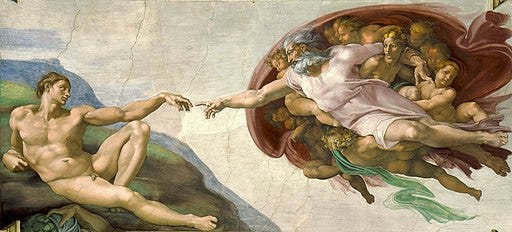
Michelangelo - Creation of Adam (cropped)

I’m no expert in religious understanding or thought. As with most things I have a cursory knowledge that, when the time is right, I dig a little deeper in to. Having said that, this little snippet from the excellent In Our Time Radio4 show did make me chuckle for some reason:

…it’s quite hard to use Newtonian physics…to prove…divinity of Jesus Christ.

A little more to listen to as follows.

#2
November 20, 2020
Read more

Lingua Franca

So you try to learn a little more each day. Well, you should be. For too many years I assumed that lingua franca was a French expression. Furthermore, my definition of what the term meant was not entirely accurate. I casually used the expression in the sense that communication was being conducted using one common mother tongue language. For example, if I travelled to Peru and met a local who spoke English then our lingua franca was English. Alas, ce n’est pas.

Lingua franca is the common language that people use to communicate with when they have different native languages. So if that Peruvian I met spoke French (as do I, a little) then French would be our lingua franca. It would never be English nor Spanish. French is quite appropriate here as I always assumed that the phrase lingua franca was originally from French. Again, ce n’est pas. It’s Italian and the literal translation is Frankish Language. So who spoke Frankish and why did I think lingua franca was French?

Frankish was the ancient West Germanic language of the Franks and contributed to the vocabulary of what we now know as modern French. Well, that helps, doesn’t it? Sure, it puts a tick in my head as to why I assumed the expression to be French. The Franks started from rather humble beginnings as a tribe that had, by the third century, settled between the Lower Rhine and Ems River (an area which is now Belgium and the Netherlands). After the fall of the Roman Empire, the Franks seized the chance to grab land, advanced westwards and were eventually to rule much of what we today know as France. They never got hold of Brittany though. Those slippery Bretons were a tough breed. Of Celtic lineage, they had links back to Devon and Cornwall in Southern England. I guess the thought of those unruly Saxon Brits marauding across the English Channel ensured that Brittany remained outside of the Frankish empire.

By the end of the ninth century, inter-family squabbles ultimately lead to the downfall of the Frankish empire. Their last great leader, Charlemagne, although not able to leave successful ruling heirs, did manage to leave some rather longer-lasting legacies: the establishment of catholic Christianity as the Western Europe religion with the Pope as its leader; the creation of the Holy Roman Empire; and the foundations for the Kingdom of France. France deriving its name from the Franks. The Germans still refer to France as Frankreich.


#1
November 17, 2020
Read more
  Newer archives
Powered by Buttondown, the easiest way to start and grow your newsletter.