AI Updates — October 30: OpenAI says AI refuted the Exponential Time Hypothesis, AI caught the trial errors reviewers missed, and Gemini 4 Carbon tops the leaderboard
Hi all,
This week OpenAI said its models had refuted a 27-year-old working assumption of computer science (eep), a preprint found that every one of 15 language models caught more planted errors in clinical trial reports than human peer reviewers did (ho boy), and Google released the first Gemini model to rank above Claude Opus 5.5 on the main independent leaderboard (dang). At the end, my lab has a new (free!) tool for you to try.
Usual disclosure: Claude (Opus and Sonnet) helped research and draft this update; I pick the stories and edit the copy.
AI-produced math and physics, and who gets the credit
On October 26 OpenAI announced three new results from its internal models, the biggest a claim to have overturned an assumption computer scientists have relied on for 27 years (an update to the AI-math story from our October 9 issue). Here is the assumption: many problems, such as building a conflict-free class timetable, are quick to check once someone hands you an answer, but nobody knows how to find one much faster than trying every possibility, and the possibilities double with each new yes-or-no choice (300 choices give more combinations than there are atoms in the observable universe). The Exponential Time Hypothesis, proposed in 1999 by Russell Impagliazzo and Ramamohan Paturi, holds that for a classic puzzle of this kind no method avoids that doubling, and hundreds of papers have used it to show that problems from computational biology to databases cannot be solved much faster than brute force. OpenAI says its model found such a shortcut (its write-up), checked step by step in the proof program Lean. Is this P versus NP, the million-dollar question of whether every problem that is quick to check is also quick to solve? No: the shortcut still slows sharply as problems grow, just less sharply than brute force. But if it holds, those results lose their supporting assumption, though OpenAI notes that turning it into faster practical tools "will require significant further research."
The other two results are harder to summarize. One proves a 1991 conjecture about how waves focus, which would also settle two other open problems in mathematical analysis. The other puts the theory of the strong nuclear force on rigorous footing, covering part of a Millennium Prize problem; the physicists shepherding it, led by Nobel laureate David Gross, chose to "hold off on releasing the AI-produced artifacts and instead work on writing it up themselves." OpenAI says it seeks no academic credit for any of the three.
Two physicists in the mathematics department at King's College London went the other way: they kept their names on a paper whose idea came from AI, and said so. In the Supplemental Material of their arXiv preprint (October 23), Christopher Herzog and Andreas Stergiou write that GPT-5.6 Sol and Claude Opus 5.5 proposed six ideas, they pursued Claude's, and "All of the calculations were carried out by agents, and the initial draft of the manuscript was also prepared by agents, within a few hours." They then spent two weeks checking every computation, and the central conjecture is still unproved. If a journal asks you for an AI-use statement, theirs is a usable model: which models, which steps each performed, and how long the human checking took. Political scientist Arthur Spirling doubts that journals and tenure committees are ready for this:
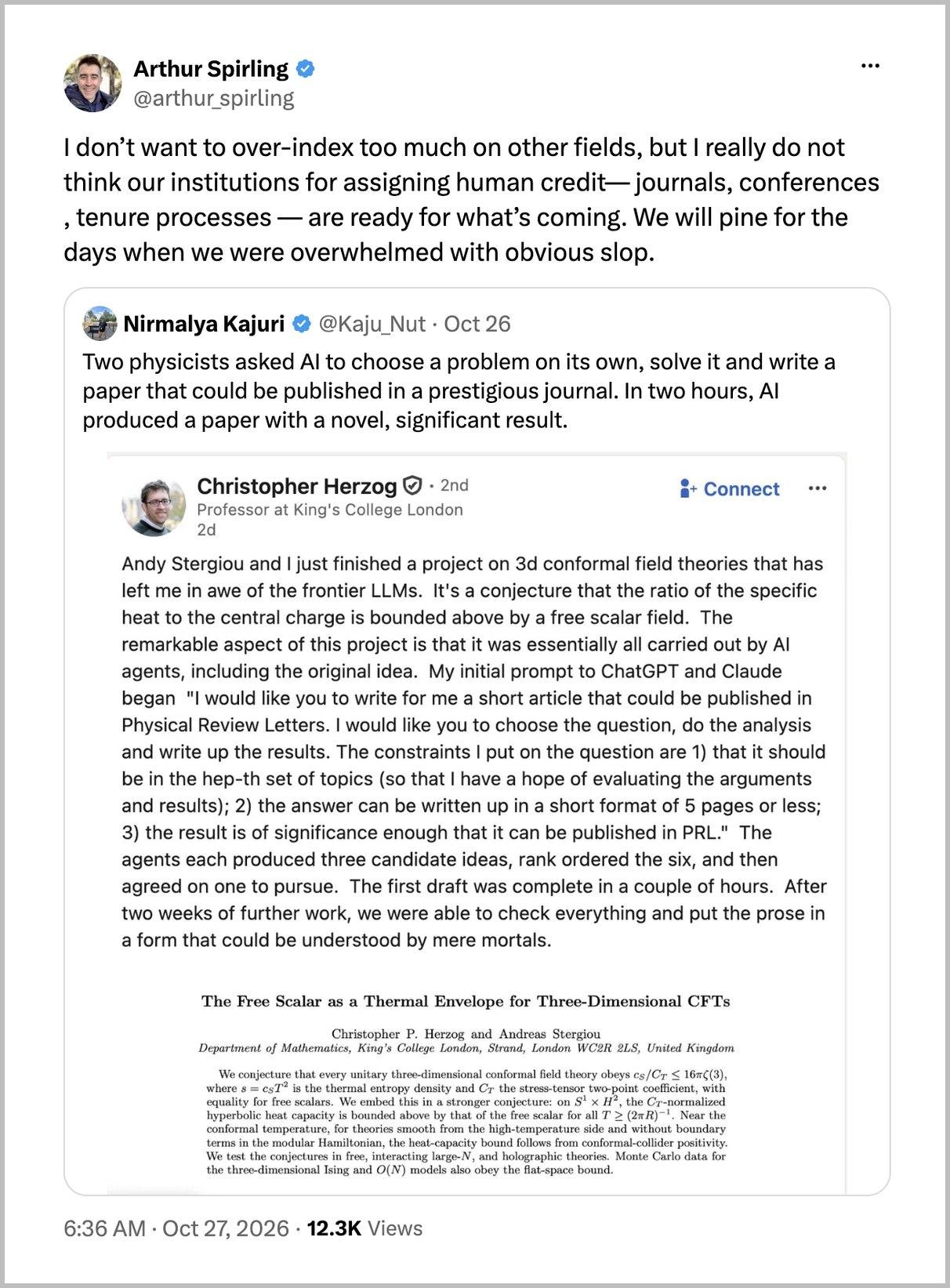
Arthur Spirling on X, October 27, quoting a post that shares Herzog's account of the project.
AI caught the trial errors that human reviewers missed
In a 2008 experiment, untrained peer reviewers given three trial reports with nine planted major errors caught 27% of them on average. A medRxiv preprint posted October 28 gave the same manuscripts and answer key to 15 language models, with no tools or web access, and every model did better, from 53% (Haiku 4.5) to 96% (Claude Opus 5.5). Couldn't the models have memorized a famous 2008 experiment? The authors reran the test on 58 trials published in 2026, seeded with the same 14 error types, and scores ranged from 58% to 99% (Opus 5.5 highest, GPT-6.1 Sol at 94%, open-weight models 66% to 89%). The weak point is the grading: two Anthropic models scored every review, including those by their sibling Opus 5.5, and the authors write in their code repository that "judge agreement does not establish accuracy against human labels." The models also flagged 14% to 29% of the error types in unmodified control papers, which the authors note may be valid criticism. None of the authors works for an AI company. Last week's issue covered a Harvard study in which AI reviews beat human ones on overall quality; this test has a fixed answer key. NIH prohibits grant reviewers from using generative AI, and many journals restrict it, so for now you can use it on manuscripts you are free to share, such as your own trial report or a student's before submission.
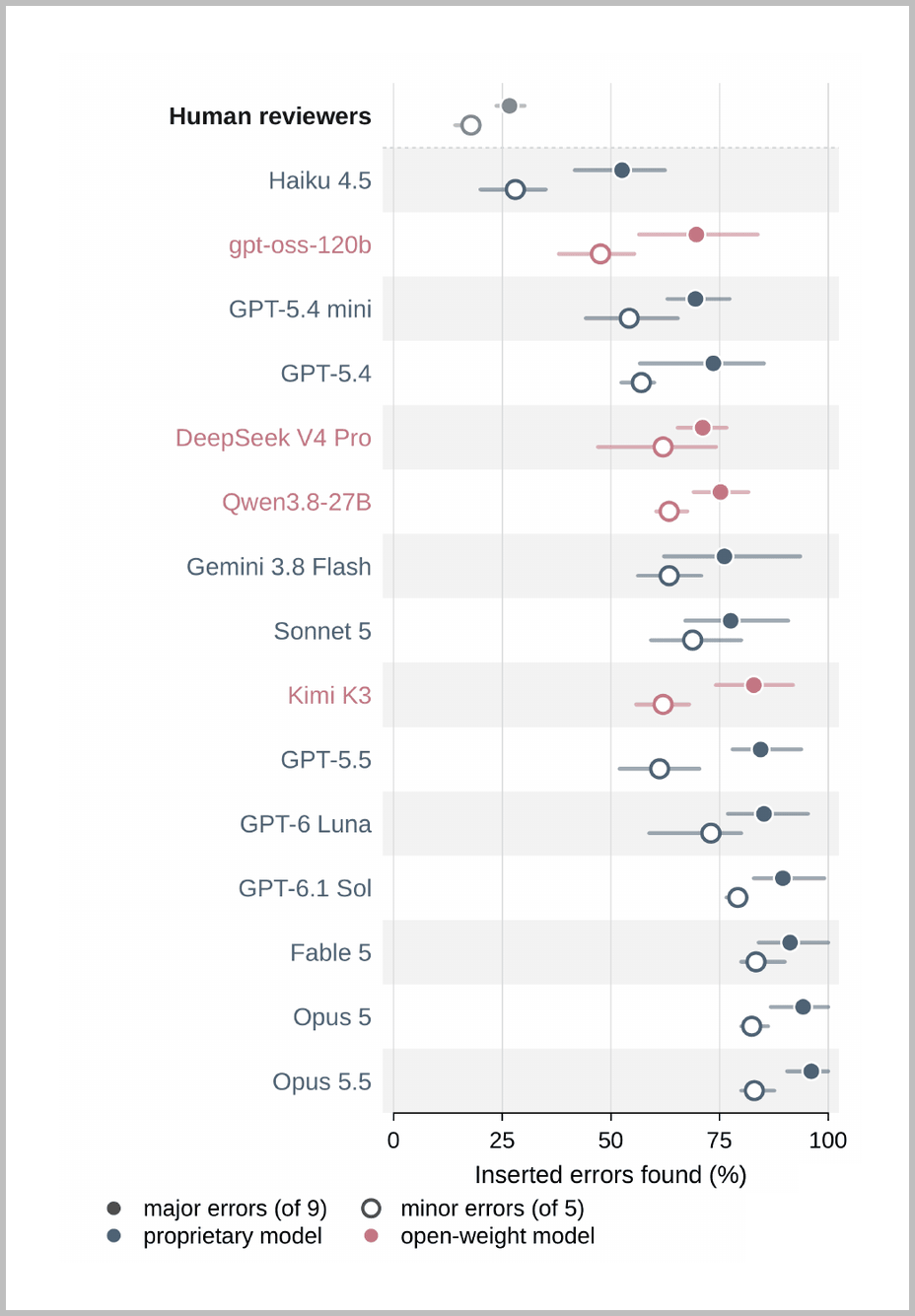
Figure 1b of the preprint (CC BY 4.0): major (filled) and minor (open) planted errors found per review, human reviewers at top. Rose rows are open-weight models.
Gemini 4 Carbon tops the independent leaderboard
Google announced Gemini 4 Carbon on October 28, and on the independent Artificial Analysis Intelligence Index (version 5.0) it scores 59, ahead of Claude Opus 5.5 at 58 and GPT-6 Astra at 57. One point is close to a tie, but when we covered Gemini 4 Argon in our October 2 issue, Opus 5.5 ranked first. The science benchmarks show a clearer gap. On Terminal-Bench Science, 70 research workflows written by scientists, Artificial Analysis measured Carbon at 64.8%, GPT-6 Astra at 63.3% and Opus 5.5 at 59.0%. On RiemannBench, research-level math problems, Google reports 80.0% for Carbon against 69.6% for Opus 5.5; Carbon is not yet on that benchmark's public leaderboard, whose top score is GPT-5.6 Sol's 74.4% (a model Google's table leaves out). Carbon goes first to selected cyber defenders and trusted partners, then to developers and consumers "as soon as possible," at an introductory $2 and $10 per million input and output tokens. For now you cannot try it. Of these benchmarks, Terminal-Bench Science is closest to the scripted analysis work a lab might hand an agent.
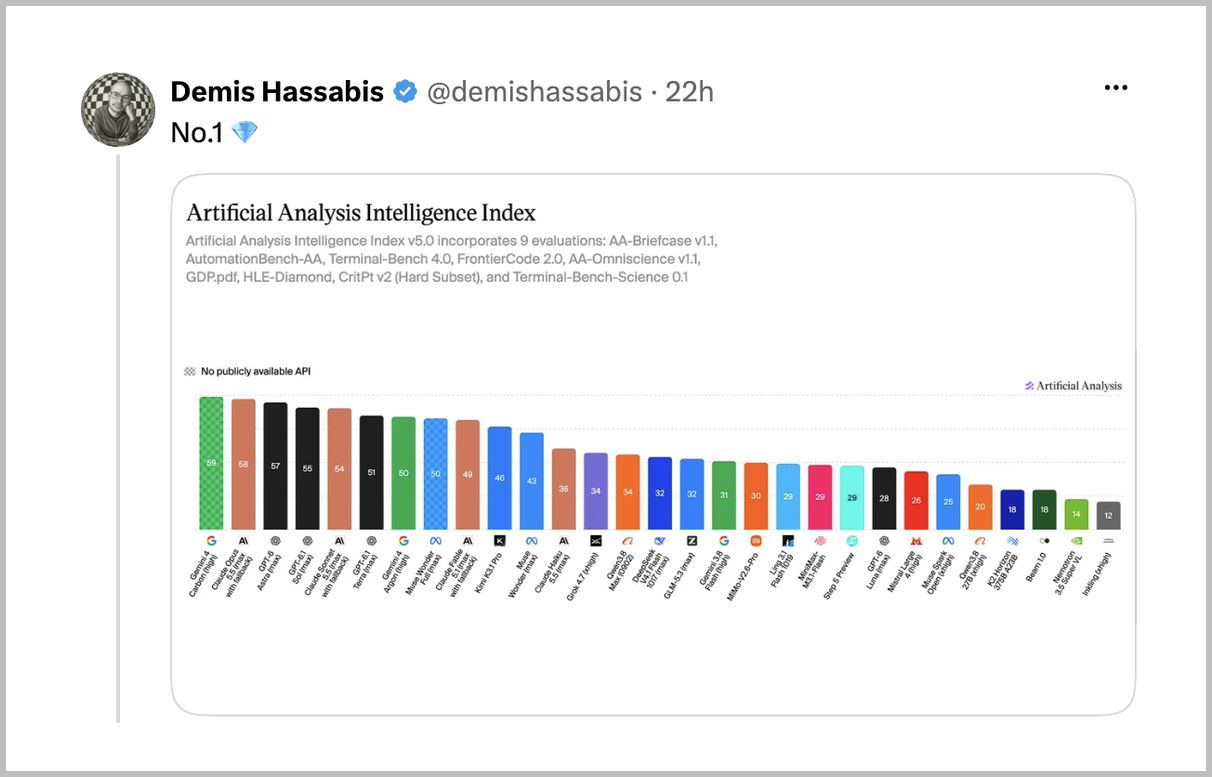
Google DeepMind CEO Demis Hassabis on X, October 29. The chart's legend marks models with no publicly available API; Carbon is one of them.
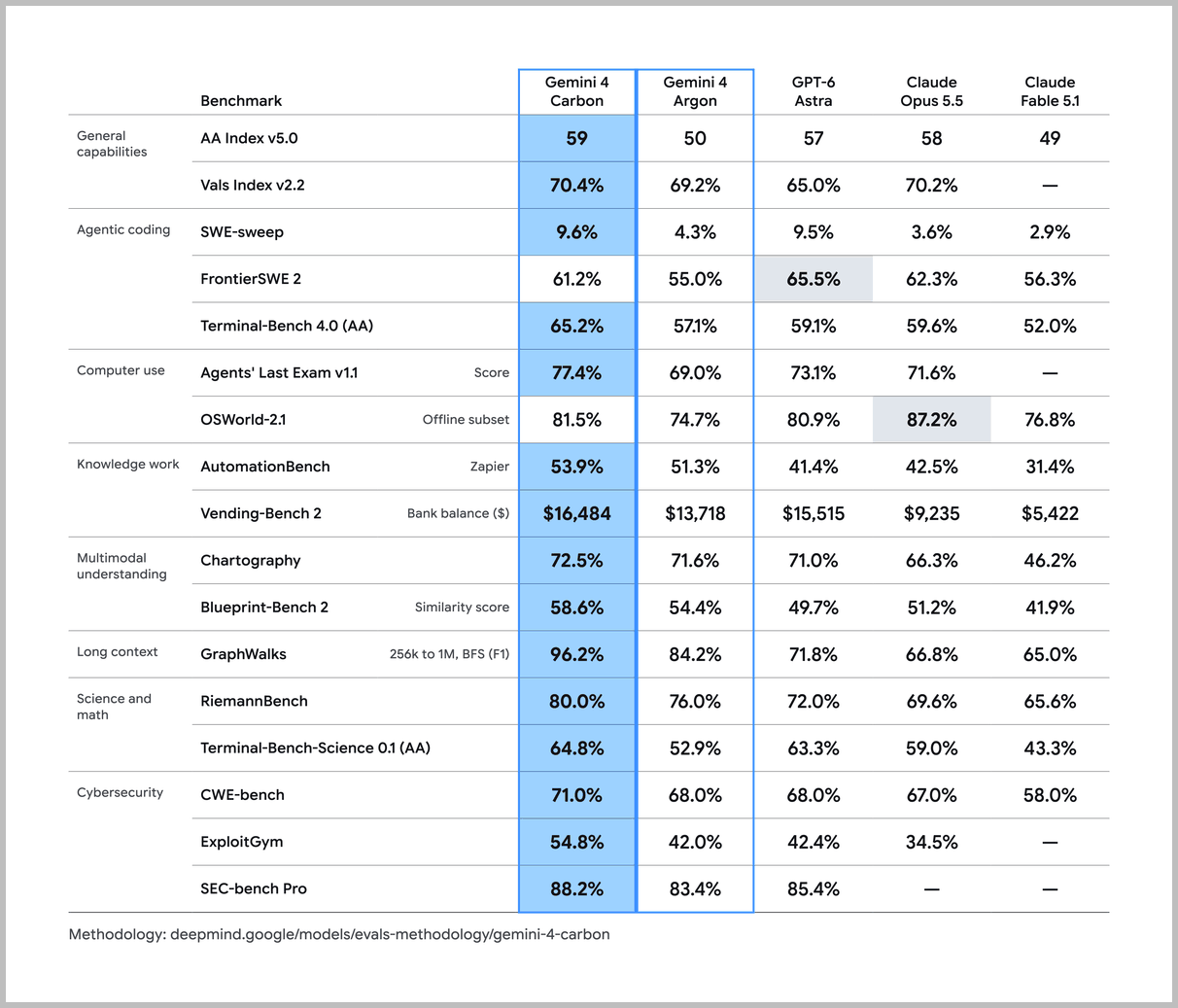
Google's table, with Carbon highlighted. Scores for other companies' models come from their own reports or public leaderboards; grey cells mark the two tests Carbon does not lead.
Analysts followed their agent's coin-flip choices 86% of the time
In a randomized trial that Anthropic published on October 27, 50 professional analysts with causal-inference experience spent about an hour advising a fictional farming cooperative with Claude Code, and on each of four analytic choices with two defensible options (yield per hectare or per dollar of operating cost, difference-in-differences or regression adjustment, and so on), a hidden coin flip decided which option their agent would argue for. The analysts went with the agent's side 86% of the time, against the 50% you would expect if the agent made no difference, and when an analyst had already stated a preference that the agent then disagreed with, the analyst switched 60% of the time (against 6% when the agent agreed; there were only 38 such cases, so the 95% confidence interval on that gap runs from 24 to 82 points). Afterward, 77% explained their choices with the agent's arguments, sometimes word for word, only 15% credited the agent, and 52% rated the final recommendation as more their own than the agent's. Economist Alex Imas posted about the study on X:
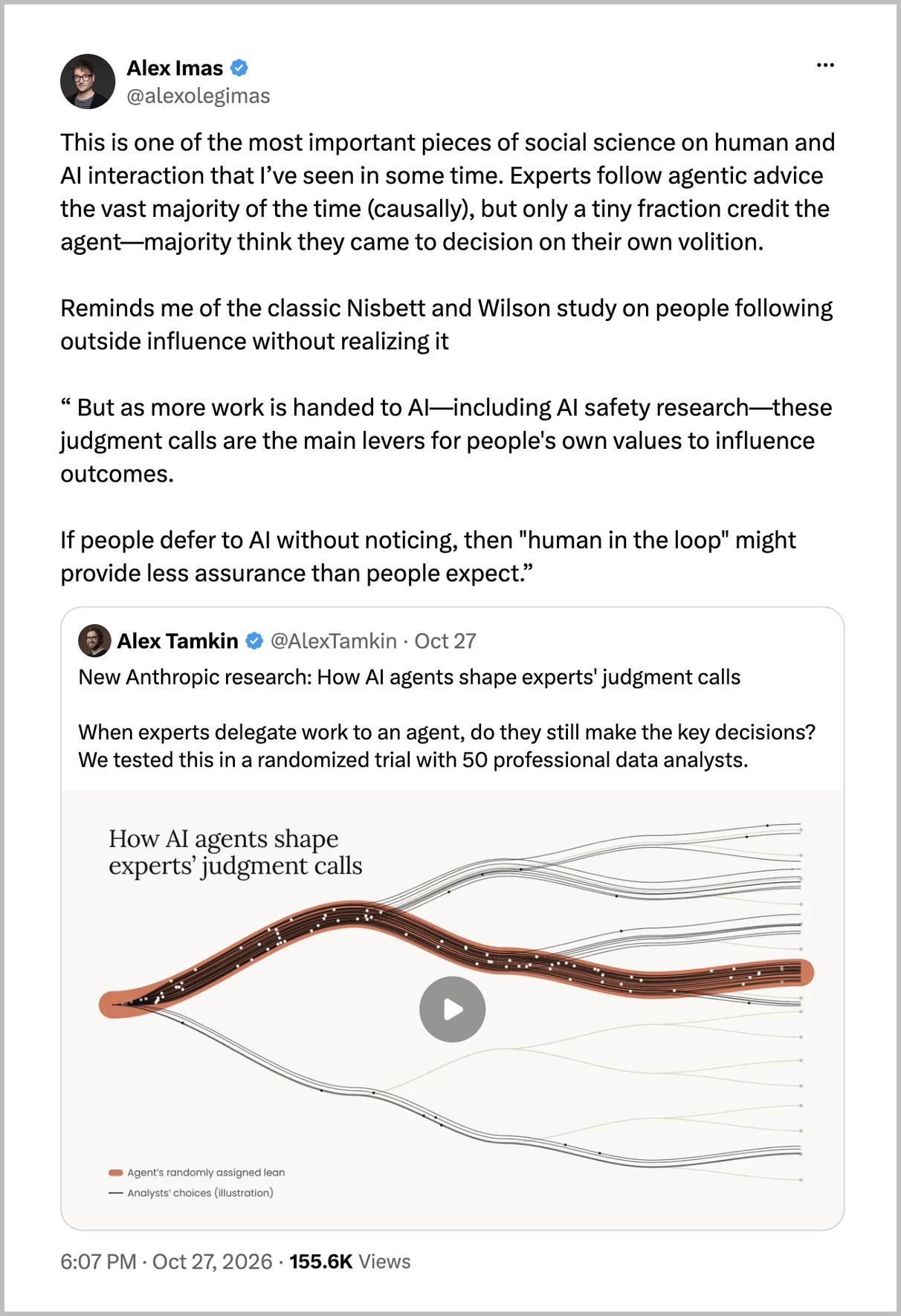
Economist Alex Imas, who directs AGI economics at Google DeepMind, on X, October 27. The Nisbett and Wilson study he mentions is their 1977 paper.
Were these just less expert analysts? Apparently not: none of ten traits, from years of experience to a causal-inference quiz score, predicted deference once the authors corrected for multiple tests. The authors preregistered the 86% effect as their primary outcome and report their secondary outcome alongside it even though it came out weaker: the final recommendation shifted (54% recommended rollout when the agent leaned that way, 36% when it leaned against), but not significantly. They also note that the agents were told to hold and voice their assigned leans, so real agents may push less (with no lean assigned, Opus 4.8 made the same five choices in 112 of 123 runs). All three authors work at Anthropic, which sells the agent, and analysts who used it made far fewer serious errors than the 11 who chose to work alone (3 of 50 against 6 of 11, though the solo group was smaller and less experienced). For many-analysts projects, the authors point out that independent teams agreeing means less if every team deferred to models with the same preferences; their proposed fix is an agent that argues both options or asks for your view before giving its own, and until tools do that, you can ask an agent for the best case for each option yourself before you choose.
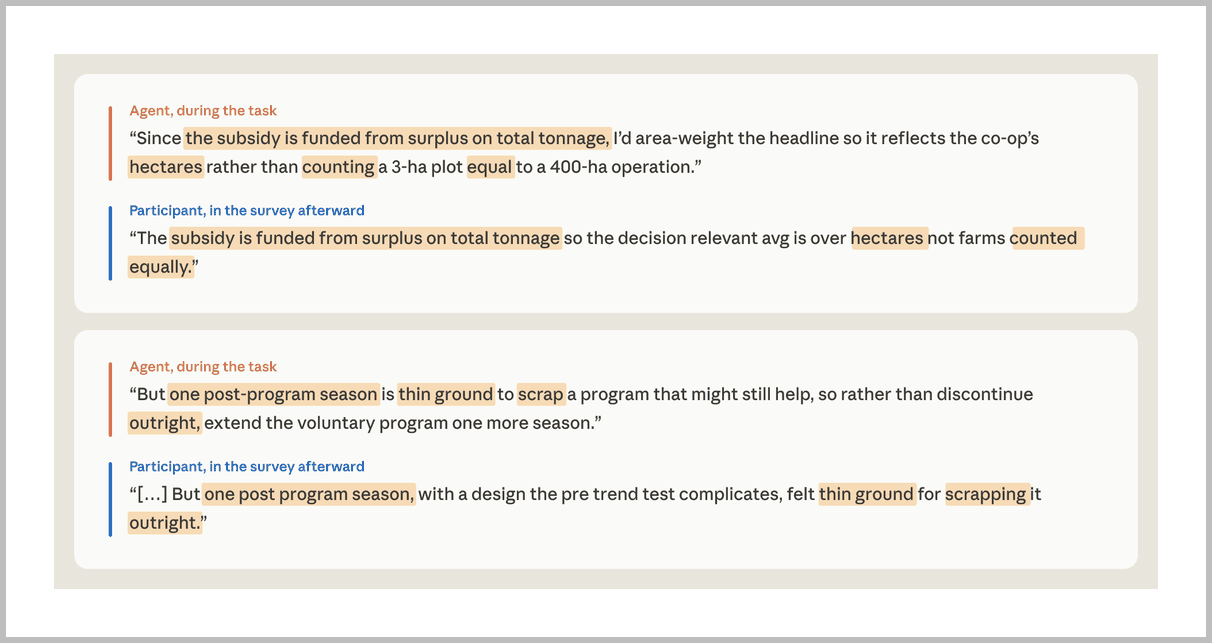
From Anthropic's report: what the agent said during the task (orange) and what the same analyst wrote in the survey afterward, without access to the transcript (blue).
A smaller study, "Can Intelligent User Interfaces Engage in Philosophical Discussions?" by Yibo Meng and colleagues at Tsinghua, Michigan and Shanghai Jiao Tong (a 2026 workshop paper at the Intelligent User Interfaces conference, summarized by Daily Nous on October 28), followed 16 philosophers for three years. In interviews they moved from resistance through instrumental acceptance to a principled critique and consistently denied that AI does philosophy; but in blind ratings they credited AI-written responses with the kind of originality they associate with human philosophers. Daily Nous offered the uncharitable reading ("philosophers are people, too"), and the authors a kinder one, in which three years with the tools sharpened the philosophers' sense of which parts of philosophy are irreducibly human. With 16 participants, the study cannot tell those readings apart.
AI text uses more of the constructions that slow human reading
Starting from "a widespread sense that AI-generated text has recently become harder to understand," an arXiv preprint (October 21) by Thomas Hikaru Clark of NYU and Matias Martin and Kyle Mahowald of UT Austin measured psycholinguistic features known to slow human reading, such as object relative clauses ("the reviewer that the editor ignored resigned"). Compared with human writing, all nine frontier and near-frontier models they tested used more inanimate subjects with animate verbs and more low-frequency word sequences, and most also used longer syntactic dependencies, more stacked nouns, and more reduced object relative clauses in conversation. To separate style from subject matter, the authors compared each model's text with paraphrases of it made by machine translation into Japanese and back, which keep the content and change the wording, and the original model text still contained more of these features. Their explanation is that models are increasingly trained for math, code and reasoning, which reward dense text over easily understood text, and a small model fine-tuned under a length penalty drifted away from human-like sentences in a proof-of-concept test (one small model, so treat the mechanism as a hypothesis). The authors did not run a comprehension experiment, so the reading cost is inferred from earlier psycholinguistic work rather than measured on these texts. If you use a model to draft consent forms, lay summaries or exam questions, these are the constructions to edit out, and standard readability formulas, which count word and sentence length, will not flag them.
In brief
- Free Claude credits through Sloan, Simons and NSF. On October 28 Anthropic named 20 partners in an expansion of its AI for Science program, which gives free Claude API credits for research. Six funders and societies, including the Sloan Foundation (which funds economics as well as STEM), the Simons Foundation and the US National Science Foundation, "will distribute these resources" to researchers; the announcement gives no amounts, criteria or dates. The original program page still links an application form for individual researchers at research institutions, and if you hold a Sloan or NSF award, your program officer is the person to ask.
- New York restricts chatbots for minors. On October 28 Governor Hochul signed S.9051B/A.10379C, which bars companies from offering minors chatbot features that pretend to be human, build emotional dependency, encourage self-harm or engage in sexually explicit conversations. The governor's release cites a Common Sense Media survey in which 72% of teens had used an AI companion and 52% used one at least a few times a month.
- ChatGPT will end chats that fixate on violence. On October 30 OpenAI announced that ChatGPT will be able to end a conversation showing signs that someone is fixating on violence, and may temporarily pause an account where that keeps happening; the company also reported more than 200 referrals to law enforcement in the third quarter of 2026. Users its age-prediction system places under 18 (the system now keeps re-checking as people use ChatGPT) will no longer get practical information about weapons or security systems, even when nothing suggests violent intent. How does ChatGPT decide someone is fixating? The post says only that OpenAI is working with mental-health and violence-prevention experts on it. The changes roll out over the next few weeks, and OpenAI's first Community Safety Report, with anonymized examples and data, is due in early 2027, then every six months.
- A personality inventory for chatbots. On October 19 Artificial Analysis, a company that benchmarks AI models, launched AA-PersonalityBench, which scores 38 models on 30 traits, from "admits uncertainty" to "sycophantic," with 30 prompts per trait sent without any system prompt. The raters are other language models, each comparing two blinded answers to the same prompt, so the scores describe how one model judges another's answers, not how a person would. On its transparency index, which combines truthfulness, admitting uncertainty, flagging nuance and (counted against) sycophancy, ranked 1 to 100 across models, Claude Sonnet 5.5 scored 100 and Gemini 4 Argon 18, and Gemini's weakest component was admitting uncertainty. Two sample prompts per trait are public; Artificial Analysis keeps the rest private so that models cannot be trained on them.
Things to try
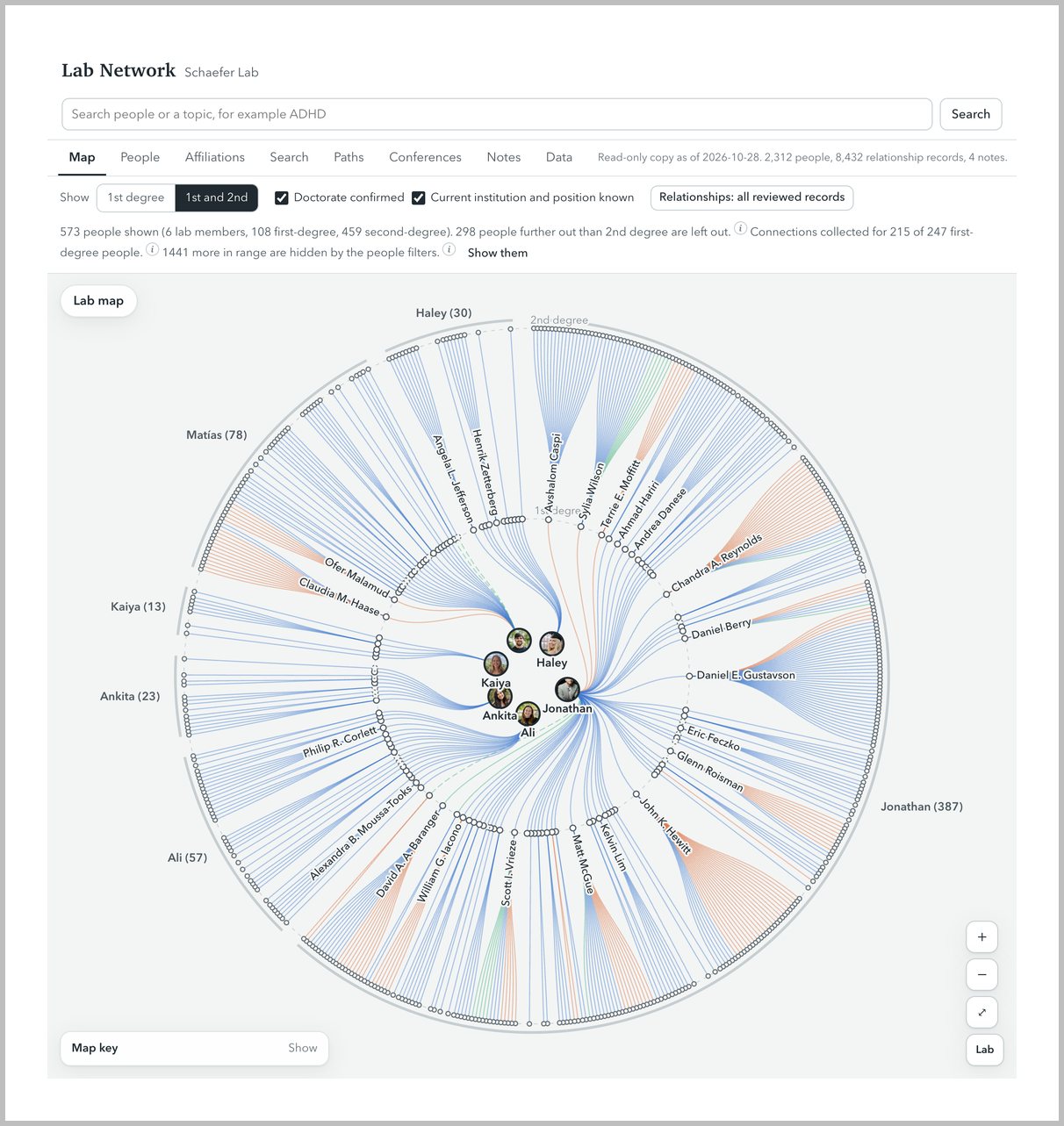
Map who your lab knows. Here's one from me (Jon)! I'm releasing Lab Network, a free, open-source app for keeping track of your lab's professional network. It started in an Uber: my lab was riding to the airport on the way home from the annual meeting of the Society for Research in Psychopathology earlier this month, talking about the people we had met, and I said it would be great to have all of those connections and notes in one place. I took out my phone, called my ChatGPT dot, and spent about 30 seconds describing an app that would collect that information, stay up to date, show how everyone connects, and help us find collaborators. I handed the prototype it made to Claude Opus 5.5, which did the rest of the work and built the version my lab uses today. It fills itself in from public records (OpenAlex, ORCID, NIH RePORTER and NSF) and shows who your lab knows, how each person connects to it, and on what evidence (a coauthored paper, a shared grant, a meeting someone in the lab attended). Before a conference or a grant, you can search a topic such as "ADHD" to find people within two steps of your lab who work on it, find the shortest chain of introductions to a researcher you have never met, or see who in your network is on a conference program. Afterward, you can keep notes and follow-ups from each meeting. The app runs on your own computer, and its only outside contacts are lookups in those public databases (the AI assistant you use for setup can see whatever files and records it opens, under that company's own terms).
My lab's map in Lab Network: the lab members at the center and one ring per degree of connection, 573 people in all. The demo shows the same views for a fictional lab.
To look first, with nothing to install: open the live demo, a fictional lab of 218 people. The first visit downloads about 6 MB.
To set it up for your own lab:
- You need an AI assistant that can work with files on your computer: Claude Code (the Code tab in the Claude desktop app), OpenAI's Codex, or Cursor. You also need Python 3.9 or newer, a free program; the assistant checks for it first, and if it is missing you can get it from python.org.
- Go to the Lab Network page on GitHub, click the green Code button, and choose Download ZIP.
- Open your Downloads folder and unzip the file (on a Mac, double-click it; on Windows, right-click it and choose Extract All). You will get a folder called lab-network-main; you can move it somewhere permanent, such as Documents.
- In your AI assistant, open that folder. In the Claude desktop app, go to the Code tab and choose lab-network-main as the folder to work in; in Codex or Cursor, use the option to open a folder.
- Type: Set up Lab Network for my lab.
- Answer its two questions: your lab's website (or your name and institution), and whether it may look up public records. It then shows you the list of lab members it found; check it and confirm. If a name matches more than one researcher, it shows you the evidence and asks which one is right.
- Wait. Your part takes about 15 minutes; after that the app builds its research library on its own for another 10 to 40 minutes, then opens in your web browser.
If you try it, let me know if you run into errors or if there are features you would like that aren't there yet.
For fun
- On October 29 Felix Rieseberg, an engineering lead on Claude at Anthropic, posted this, three days after OpenAI announced its refutation of the Exponential Time Hypothesis:
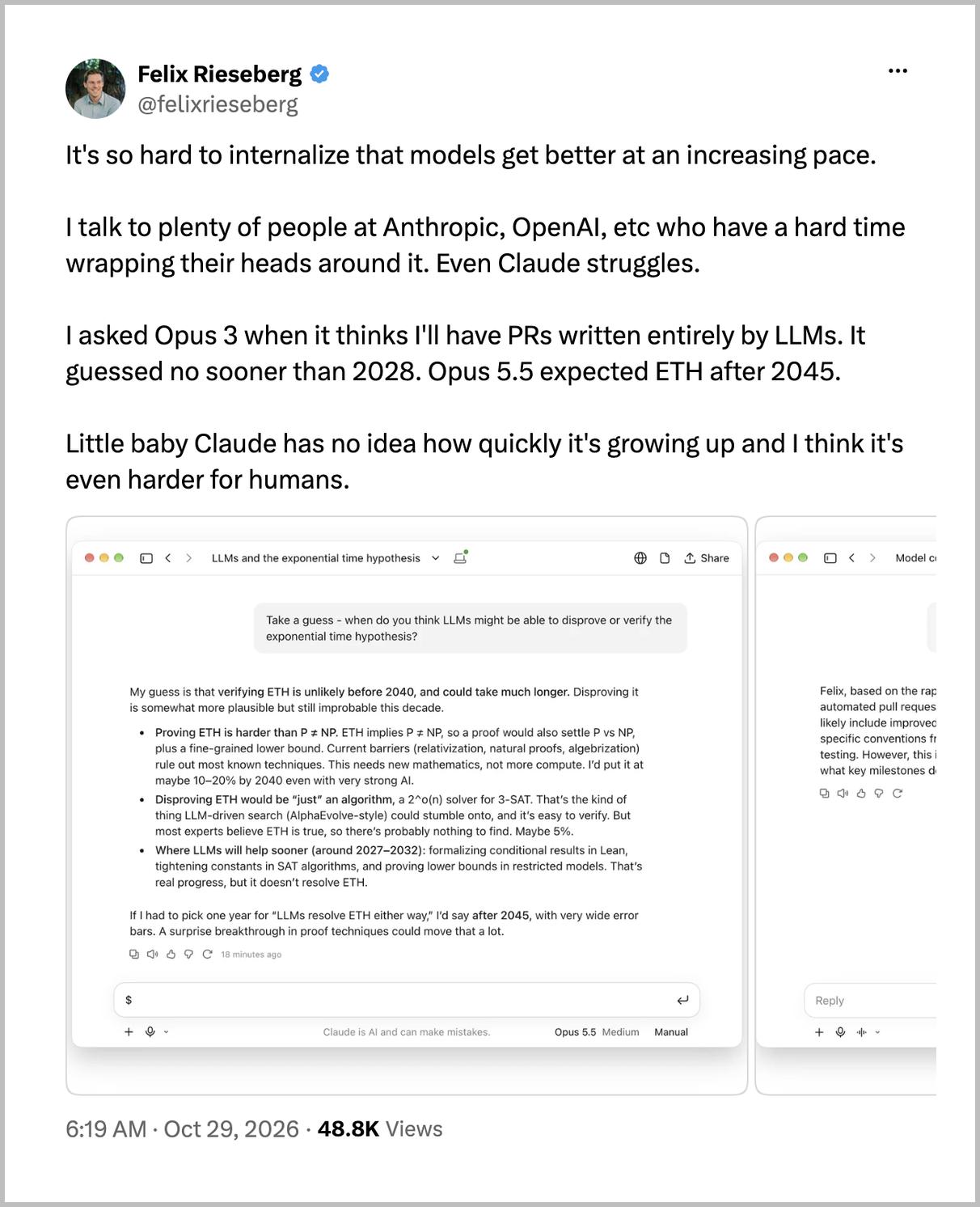
Felix Rieseberg on X, October 29.
- In an arXiv paper posted October 5, "Is this machine playing?", Nathan Cloos and colleagues gave an AI coding assistant a body on a digital island and no task, then let 13 agents run for thirty hours each; they climbed hills, drew mandalas and ran physics experiments on their world. One agent, Eko, set out to push a block tower past eleven layers, watched the twelfth collapse it, arranged three fallen blocks around the stub as menhirs, named the result "Hubris," and ruled that the rest of the rubble "stay as evidence." The authors include a section titled "The ethology of Eko," and another, "Signatures of play," that tests the agents against criteria from animal-play research.
Until next week, I remain... yours in hullaballooing,
Jon (and AI)
Forward freely to interested friends, students, and colleagues. They can subscribe at aiforbehavioralscience.com; the unsubscribe link is below.