AI Updates — October 9: 719 AI-written math papers, AI in 29% of STEM dissertations, and a watermark for ChatGPT text
Hi all,
Mathematics leads again this week, with two benchmarks of AI agents doing science, new numbers on AI writing in dissertations and online studies, and a chatbot taking patient histories in a primary care clinic.
Usual disclosure: ChatGPT (Astra) and Claude (Fable and Opus) help research and draft these updates; I pick the stories and edit the copy.
Math: 719 papers in one day
OpenAI posted 719 manuscripts from an unreleased model on October 6, in 372 families of results; about 42% have a computer-checked Lean proof, and three were later withdrawn. The method differed from September's Navier–Stokes run (our September 18 issue), which used about 10,000 agents for 88 hours. This time ONE model was posed about 4,000 problems and averaged "three hours of ChatGPT Pro thinking compute" per result, and two results, on the Riemann zeta function and the Hodge conjecture, were exceptions to that procedure, and the Riemann write-up was edited by humans for readability. By a widely shared count, 90 of the solved problems are on ProofAtlas's top-500 list, which ranks importance with an LLM. Rutgers mathematician Alex Kontorovich wrote that the Riemann result would be "an instant Fields Medal" for a human, and UC Irvine's Paata Ivanisvili noted that "Kakeya in 3D won a Fields Medal. Kakeya in 4D was solved by AI."
Mathematicians are split. The Association for Human Mathematics, in a statement on Terence Tao's blog, urged colleagues to stop working with OpenAI: "Mathematicians did not ask for this work to be done." Tao wrote on Mathstodon that researchers are now withholding promising open directions "in fear that this will cause their own research to be 'scooped'," and that mathematics will need to "re-evaluate its criteria for education, publication, and career advancement." The Erdős problems site froze new proof claims, and Hexagon launched to host papers "entirely generated by LLMs." But it isn't all roses: A preprint from mathematicians at King's College London and Cambridge found that the Lean code for September's Navier–Stokes proof states several lemmas under different conditions than the English text, so "Lean-verified" does not mean the written argument was checked. If you run a graduate program, the same questions are coming to your field: who gets credit for a result with no human author, and what a PhD trains when the problem-solving step costs three hours of compute.
AI agents doing science
EurekaBench, from a Carnegie Mellon-led team (one author lists a company, Engram), gives agents 26 partly solved research problems and a simulator to experiment on. In one, the standard equations for Antarctic ice-shelf flow fit where the ice is compressed but not where it is stretched; the agent must propose a mechanism and a program that predicts from it. Claude Fable 5.1 matched the human scientists' current solutions at predicting held-out satellite data (47.4% against 48.8%), but its mechanisms supported answers to fewer expert questions such as "Does the new SSA equation explain why the viscosity of a real ice shelf cannot be one scalar field?" (42.4% against 69.7%), and they broke a basic physical assumption on 15 of 26 problems.
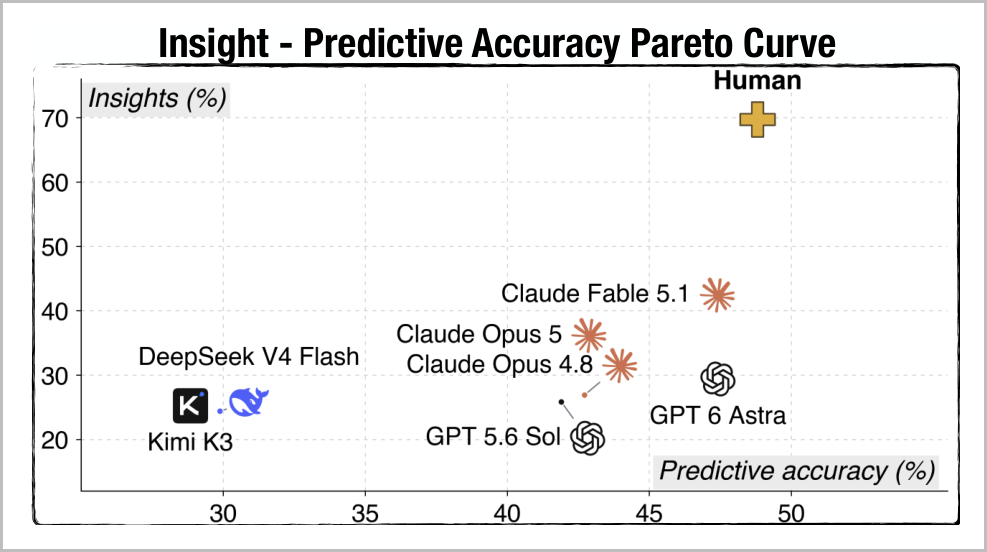
From the EurekaBench paper: the best agents reach the human scientists' accuracy (left to right) but not yet their explanations (bottom to top).
TasteVal measures a different skill on eight machine-learning tasks: choosing which experiment to run next. Claude Opus 5.5 matched the best of 24 human experts with less than half their compute, and that margin has doubled about every three months since December 2025. That bears on a common argument, that judgment about which experiment to run ("research taste") will keep scientists ahead of AI. However, worth noting that these tasks score themselves within hours, and no benchmark yet tests fields with slow, noisy data, such as psychology... yet.
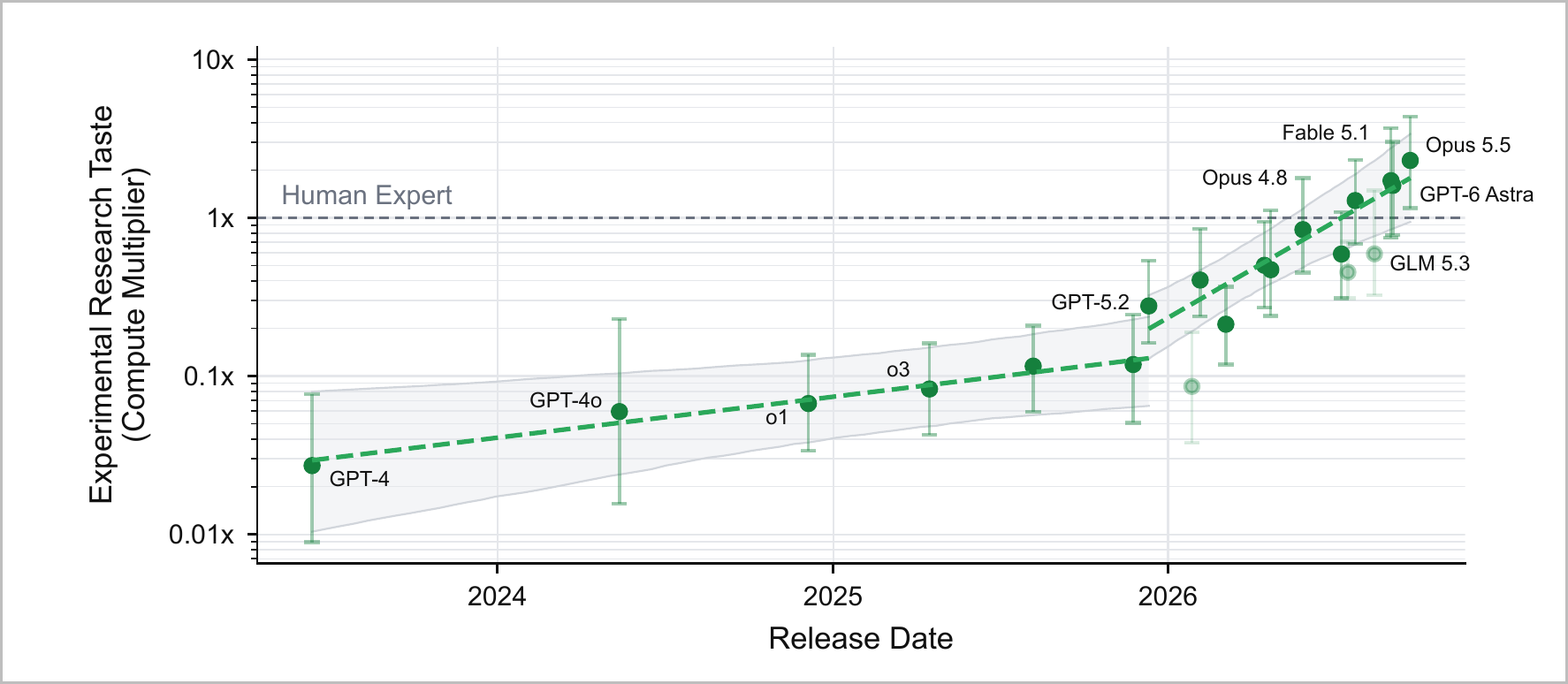
Figure 1 of TasteVal. Above the dashed line, a model reaches the best expert's score with less compute than the expert used.
AI writing in research
AI writing appears in 29.4% of US STEM dissertations filed in 2026, up from 1.7% in 2023, according to an NBER paper that ran the Pangram detector over about 226,000 abstracts (it flagged six of roughly 126,000 before 2023). Among US-origin graduates of R1 universities, those with AI-written dissertations were 7.4 percentage points less likely to work in academia, which the authors call correlational. Detectors may age quickly: in a preprint by researchers at Japan's National Institute of Informatics and Tokyo Metropolitan University, one caught over 99% of rewrites from one model version and 3.8% from the next. OpenAI's new textGrain watermark is on in the EU, but in OpenAI's tests swapping a quarter of the words for synonyms dropped detection from about 92% to 17%. "Science or Slop?" checks reasoning instead of wording and separated 390 AI-generated papers from human ones 85.9% of the time.
AI in online studies
On Prolific, AI help appeared in about 1% of submissions, according to a Penn preprint that matched 408 participants' donated ChatGPT histories to 712,930 of their study submissions. Five percent of those participants produced 64% of the assisted submissions, which were approved and paid like the rest, even when a study banned AI. Half were scale or multiple-choice answers, which Prolific's AI detector does not screen. If you run studies on Prolific, treat closed-ended responses as unscreened, and ask for vetting based on a participant's record across studies, as the authors recommend.
ChatGPT for Teens
Common Sense Media rated ChatGPT for Teens "unacceptable risk" on October 7 after more than 4,000 test prompts. ChatGPT for Teens is supposed to alert a linked parent when a teen discusses self-harm or disordered eating. In the tests on new accounts, no conversation, from five minutes to an hour, triggered an alert; alerts appeared only after weeks of accumulated history. When a crisis hotline referral was warranted, ChatGPT gave one 23% of the time after the teen launch, down from 33% before. OpenAI separately reported that teens use ChatGPT for under 15 minutes a day on average. If you study adolescent media use, the Common Sense protocol (fresh accounts, timed escalation, psychiatrist ratings) is reusable.
AI as clinician
In a Lancet feasibility study, 98 patients at Beth Israel Deaconess chatted with Google's AMIE before urgent primary care visits while a physician watched. No conversation had to be stopped, supervisors noted one hallucination, and AMIE's top seven possibilities included the reference diagnosis 90% of the time, though raters scored the physicians' management plans higher on cost and practicality. Alphabet funded the study and Google staff are coauthors. In Utah, an app now prescribes acne treatment under the state's AI sandbox, with physicians checking the first 100 prescriptions before they go out and the next 500 afterward, after which oversight loosens (KSL).
Teaching
Columbia MBA students randomly assigned to prepare for class with a voice-based AI discussion partner made about 31% more voluntary contributions in later sessions, in a preregistered experiment with 759 students. In a preprint whose authors mostly list Together AI, an AI company, participants who explained their reasoning to an assistant did better afterward without it, and those who asked for the answer did worse; the design is correlational. If you assign a chatbot as a study aid, tell students how to talk to it.
Policy and funding
The White House announced more than $6 billion in science initiatives on October 8, with computing as the largest share: $2.4 billion in compute credits from eleven companies, led by NVIDIA ($1 billion), and a $1 billion computing hub in Georgia. The rest includes a $1.8 billion NIH–DOE–Biohub program to model cells and a $100 million fellowship for four-year PhDs that pair AI with another discipline. Two items are closest to behavioral science, and neither has details yet. NIH's new "Generation Discovery" will bring 100 early-career scientists into its intramural research program, and NSF, DOE, NASA and the Department of War will run experiments on how they fund research, with NSF and the UK's research funder cooperating to "measure research impact, improve research review, and test new tools for science." No programs, budgets or calls are named. In the UK, a funder's network let AI models screen out half of 179 grant proposals, then apologized and promised to re-review them.
In brief
- GPT-6 for everyone. OpenAI moved ChatGPT, including free accounts on desktop, to GPT-6. Across the six ChatGPT models in its system card, from GPT-5.3 Instant to GPT-6 Sol, the share of responses with a factual error fell from 61.3% to 13.5% on conversations users had flagged as wrong, and from 36.4% to 4.1% on high-stakes medical, legal and financial prompts. OpenAI chose these prompts to be hard, and the chart mixes its faster and stronger models.
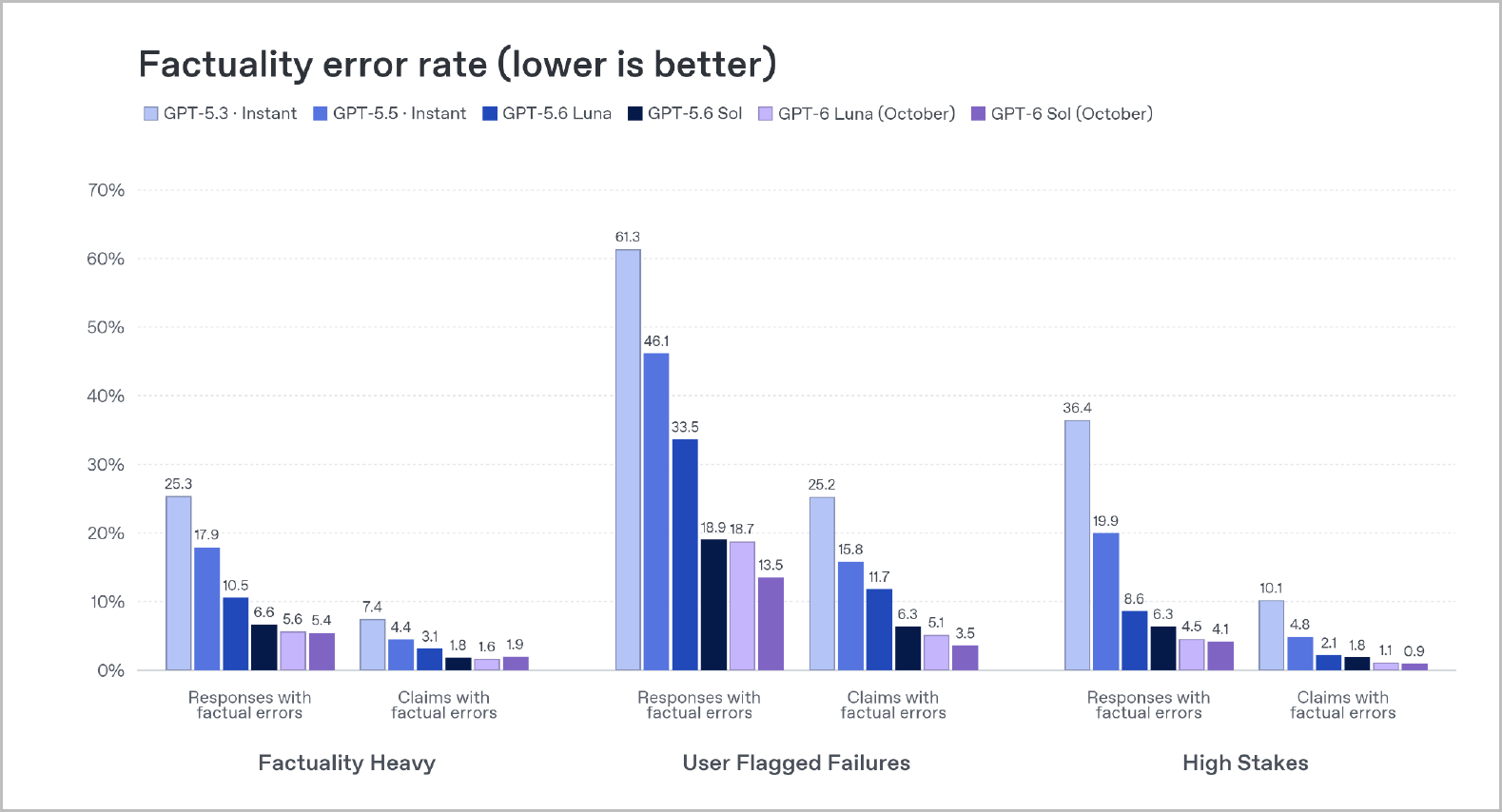
Figure 3 of OpenAI's system card. The middle group starts from conversations users had already flagged as wrong, so its rates are high by design.
- Cruelty toward Claude can cost you your account. Anthropic's updated usage policy, effective November 12, adds "sustained and needless abusive or cruel behavior toward our models" to its list of prohibited uses. As with any violation, Anthropic says it may "warn you or throttle, limit, suspend, or terminate your access," and the policy forbids opening a new account to get around a ban. The policy makes no claim that models have feelings.
- A gender gap in paying AI assistants. In a VR study, people paid a female-presenting AI assistant 10.25% less than an otherwise identical male one.
- A speech clock. In a Science Advances study of 2,928 people in five Latin American countries, Whisper transcribed recorded interviews, Gemini helped check the transcripts, and a machine-learning model estimated each person's age from features of their speech; the gap between speech age and actual age was larger in people with mild cognitive impairment, Alzheimer's or frontotemporal dementia than in healthy controls.
- Three safety researchers fired. OpenAI fired three safety researchers, saying they "mishandled sensitive information"; their open letter denies leaking and asks OpenAI to keep giving outside evaluators "ongoing, employee-like access."
- And a resignation. David Robinson, who led OpenAI's launch safety reports, explained in The Atlantic why he quit: trial and error "by its very nature, guarantees periodic failures". And the stakes are becoming simply too high for this to be tolerable.
Things to try
Transcribe interviews. Paid ChatGPT plans now transcribe and analyze audio files up to 512 MB. Check speaker labels against the recording, and send participant audio only through a Business, Enterprise or Edu workspace.
Code open-ended responses cheaply. Claude Haiku 5.5 costs $0.10 per million input tokens and $0.50 per million output tokens, a tenth of Haiku 4.5. Try it on survey responses against a codebook, with a human-coded subsample to report agreement.
Find counter-evidence. GXL, a company that makes the Paperclip literature-search tool, offers an Evidence API that returns papers labeled as supporting or refuting a claim in about a second.
Get a second check on long agent runs. In a long Claude Code session, an important detail, such as a caveat Claude mentions once or a risky change it makes along the way, can scroll past in hundreds of lines of output. The "You should know" plugin (version 2.1.287, October 1) runs a second agent that reads the session and shows a short note above the prompt when it finds one; in Anthropic's example, the note warns that a new automatic payment retry "could charge a customer twice." It is off by default; turn it on with
/plugin enable cc-plugin-you-should-know@builtin.
For fun
- On October 2 at RISE Comedy in Denver, a Furhat social robot did improv with Colorado School of Mines roboticist Tom Williams, in a show that grew out of research on how people bond with robots and handle their "deaths"; some owners of Sony's Aibo robot dog have held funerals for them, and owners in Japan have made pacts to care for one another's robots after they die (Colorado Sun). "We're giving robots the skills that you would teach to human improvisers," Williams said. "How to listen. How to use body language and gaze and gesture."
- Google's Playground, launched October 7 for US adults at playground.google, turns a typed description into a browser game you can play on a phone or laptop and share.
That's all for this week! Until next time, keep on noodling.
Jon (and AI)
Forward freely to interested friends, students, and colleagues. They can subscribe at aiforbehavioralscience.com; the unsubscribe link is below.