Tuesday, September 15, 2026 · Daily edition
St. Louis Fed task depth, IEA grid queues, and personalized pricing
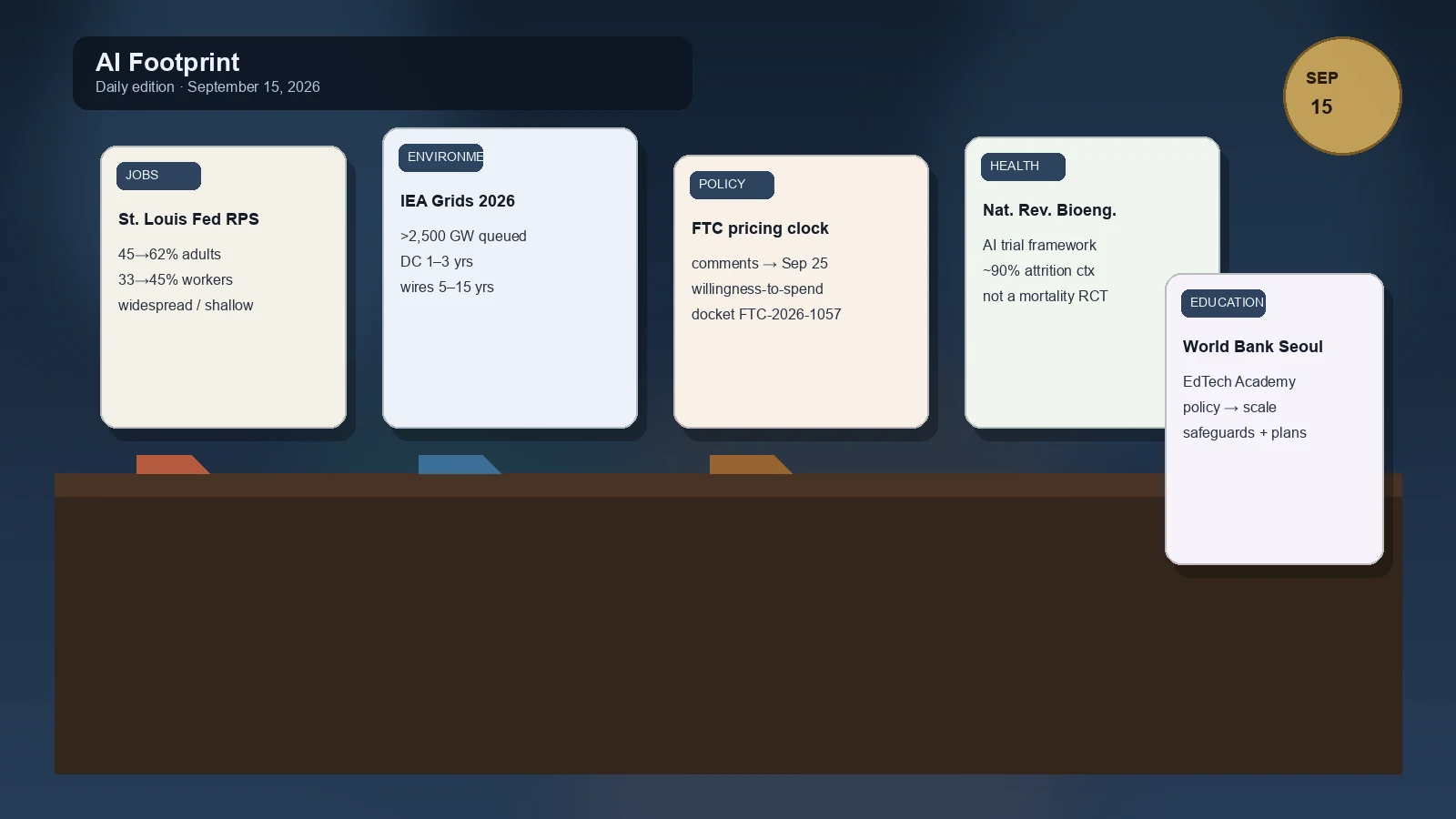
Today’s ledger follows the St. Louis Fed’s Real-Time Population Survey print on generative-AI occupation and task adoption (adult use 45%→62%; worker use 33%→45%), the IEA Electricity 2026 Grids chapter on more than 2,500 GW stalled in connection queues, the FTC’s personalized-pricing comment extension to 25 September, a Nature Reviews Bioengineering framework for AI-enabled clinical trials, and the World Bank’s Seoul EdTech Policy Academy on moving AI education policy into implementation.
St. Louis Fed: generative AI is widespread across occupations — still shallow on most tasks
What happened. The Federal Reserve Bank of St. Louis published What Work Does Generative AI Do? in its On the Economy series (authors Bick, Blandin, Deming, and Schumacher), summarizing working paper item 103693. The Real-Time Population Survey covers U.S. adults 18–64. Headline adoption locked: generative-AI use among adults rose from 45% to 62%, and on-the-job worker use rose from 33% to 45%, from August 2024 to May 2026. Occupation- and task-level indexes come from nearly 14,000 workers across four quarterly waves August 2025–May 2026; respondents see the 10 most important O*NET tasks in their occupation. Widespread-but-shallow pattern locked: in more than 80% of occupations, at least 1 in 5 workers uses AI on the job; more than 40% of tasks have adoption above 20%. Only 40% of occupations have adoption above 50%; 16% exceed 70%. On tasks, fewer than 3% have adoption above 50%, and none exceed 70%. Highest occupations locked: computer and information research scientists 87.3%; information security analysts 85.4%; network and computer systems administrators 82.4%. Highest tasks locked: reading documents for technical information 61.3%; preparing research reports 60.7%; analyzing data for trends 57.5%. Lowest occupations locked: animal caretakers 5.3%; receptionists and information clerks 7.6%; LPNs/LVNs 10.4%. Exposure scores explain roughly half of variation but miss cases — medical secretaries/admin assistants 16.8% versus a common exposure prediction near 61%. Explicit frame on the page: employment and wage effects depend on what work AI actually does, not only how many people use it.
What to watch. The near-term jobs print is diffusion depth — AI already shows up in most occupations and almost no majority-use tasks — not headcount destruction and not vendor task-time savings. Keep this nationally representative occupation/task survey separate from yesterday’s Anthropic Claude conversation-sample productivity note (80% / conditional 1.8 percent), Dallas Fed Texas posting notes, Chicago Fed AI-applicability work, Kiel profiles-not-headcount, ILO limited-displacement synthesis, Richmond Fed EB 26-27, Atlanta Fed WP 2026-4, Census CES packages, NY Fed firm-use shares, and any 2026 layoff census.
Read the St. Louis Fed On the Economy note →
Read Fed in Print working paper 103693 →
IEA Grids: >2,500 GW stalled in queues — data centres 1–3 years vs wires 5–15
What happened. The International Energy Agency’s Electricity 2026 Grids chapter frames capacity, congestion, and interconnection — not a 2030 data-centre TWh census — as the bottleneck for new generation, storage, and demand. Locked queue print: over 2,500 GW of renewable, large-load, and storage projects are stalled in grid connection queues worldwide. Timing mismatch locked: planning, permitting, and completing new grid infrastructure typically takes 5 to 15 years; data centres 1–3 years; solar/wind 1–5 years; EV charging 1–2 years. Investment path locked: meeting demand through 2030 requires annual grid investment to rise by about 50% by 2030 from today’s about USD 400 billion; key grid-component prices have nearly doubled over the past five years. Near-term hosting capacity locked: complementary grid-enhancing technologies and regulatory adjustments could free enough capacity to connect 1,200–1,600 GW of advanced-stage queued projects — about 750–900 GW via conditional non-firm connection agreements, with the remainder via dynamic line rating, advanced power-flow control, reconductoring, voltage uprating, and related options. GET rollout alone (holding other factors fixed): 450–700 GW. Benefits cannot be stacked additively. The 2,500 GW figure mixes renewables, large loads, and storage — not a data-centre-only queue.
What to watch. After a summer of TWh paths and a U.S. congestion-hours draft, the IEA names the missing global layer: AI and other large loads collide with multi-year wire timelines and record connection queues. Keep this grids/queue/hosting-capacity chapter separate from LBNL national-lab TWh paths, IEA Demand or Energy-and-AI bounds, EIA September STEO generation-record monthly, ERCOT megawatt prints, and yesterday’s DOE draft National Transmission Needs Study congestion in 5% of hours.
Read the IEA Electricity 2026 Grids chapter →
FTC extends personalized-pricing comments to 25 September
What happened. The U.S. Federal Trade Commission published a 3 September 2026 press release extending public comment on a proposed policy statement regarding personalized pricing. Comment period extended by seven days; new deadline 25 September 2026 (was 18 September 2026). Locked definition on the release: personalized pricing is the use of personal data to set prices according to the amount a company believes an individual consumer is willing to spend. Original invitation dated 19 August 2026. Electronic comments via regulations.gov docket FTC-2026-1057. This is a comment-clock extension on a proposed enforcement policy statement — not a final rule, not a ban invented from the extension alone, and not a measured drop in misinformation.
What to watch. The policy beat is pricing trust and personal-data willingness-to-pay — a consumer-protection clock sitting beside live transparency duties, not another model-documentation template. Keep this separate from the FTC accuracy/objectivity policy statement already covered on 4 September, NIST NCCoE agent-identity work covered yesterday, NIST AI 300-1 documentation comments (still due 16 September), FDA’s GenAI-device discussion paper, California SB 813 / AB 1405, and live EU Article 50 chatbot/mark duties.
Read the FTC personalized-pricing extension →
Open docket FTC-2026-1057 →
Nature Reviews Bioengineering: four-stage AI-enabled clinical-trial framework
What happened. Nature Reviews Bioengineering published AI-enabled clinical trials (DOI 10.1038/s44222-026-00487-7; online 10 September 2026). The Review proposes a four-stage trial-engineering framework: assemble and harmonize multimodal data and validate tools; match fit-for-purpose tools to the question and outcome; AI-supported conduct (patient-to-trial matching, surrogate end points, externally matched comparator arms, digital twins, automated collection/curation); and faster go/no-go that flags non-promising drugs early. Three principles run throughout: fit-for-purpose validation, continuous regulatory engagement, and human oversight. Locked trial-system context on the page (not an AI treatment effect): about 90% of drug candidates entering trials fail to reach approval; about 30,000 RCTs are published per year at roughly US$300 billion; less than half of trials meet pre-specified enrolment at completion. Named case illustrations include iBox surrogate (transplantation), annualized relapse rate (multiple sclerosis), heart digital twins for ventricular tachycardia, AIM-MASH AI-assisted histology, and an LLM for patient-to-trial matching. The Review maps EMA, FDA, and the EU AI Act as the evolving regulatory landscape — not a new FDA guidance. Ambition is faster identification of effective therapies and earlier elimination of futile or harmful ones — not a claimed mortality reduction from this Review.
What to watch. The clinical print is trial-system engineering — design, matching, surrogates, and go/no-go — with honest system failure rates, not a bedside outcome win. Keep this methods/framework Review separate from yesterday’s Nature Medicine I3LUNG retrospective (2,396 patients; TEST AUC up to 0.77), LungIMPACT’s pathway-timing null, breast-triage workload/CDR numbers, and any device clearance.
Read the Nature Reviews Bioengineering framework →
World Bank EdTech Policy Academy: Seoul on AI policy to implementation
What happened. The World Bank published the event page for the Global EdTech Policy Academy on AI, held in Seoul 31 August–4 September 2026 under the theme “AI and the Future of Education & Skills Development: From Policy to Implementation at Scale.” Convened by the World Bank Education and Skills Global Practice. Partners locked: Government of the Republic of Korea; UK FCDO; Mastercard Foundation. Audience locked: policymakers, World Bank teams, development partners, and industry — invitation only, intended for country teams enrolled in the AI in Education Policy Academy. Design locked: project-based mix of online prep, in-person convening, peer learning, field visits, and follow-up. Aims locked: AI strategies and policies in education; where AI adds value and what safeguards are needed; partnership models for scaling; country action plans / implementation blueprints. This is a completed invitation-only policy academy — no enrolment, learning-gain, or safeguard census is locked on the page.
What to watch. The education beat is government implementation capacity and safeguards for AI in schooling systems — a finished academy design, not proven learning gains. Keep this separate from yesterday’s UNESCO AI4EAC student challenge, UNESCO LAC Observatory, Ghana TVET scale-up aims, ICT Prize laureates, HEPI’s UK undergraduate survey, and multi-country learning-outcomes RCTs. Standing context only: Digital Learning Week ended 11 September; UNESCO global education-AI consultation comments still due 15 October.
Read the World Bank EdTech Policy Academy page →
Also in today’s ledger
• Widespread adoption is not deep task use — and not a layoff print.
• Queue gigawatts are not a TWh path — IEA’s 2,500 GW mixes renewables, large loads, and storage.
• A pricing comment clock is not a model-card rule — and a trial-engineering Review is not a mortality RCT.
|