Monday, September 14, 2026 · Daily edition
Anthropic task-time savings, DOE transmission congestion, and agent identity
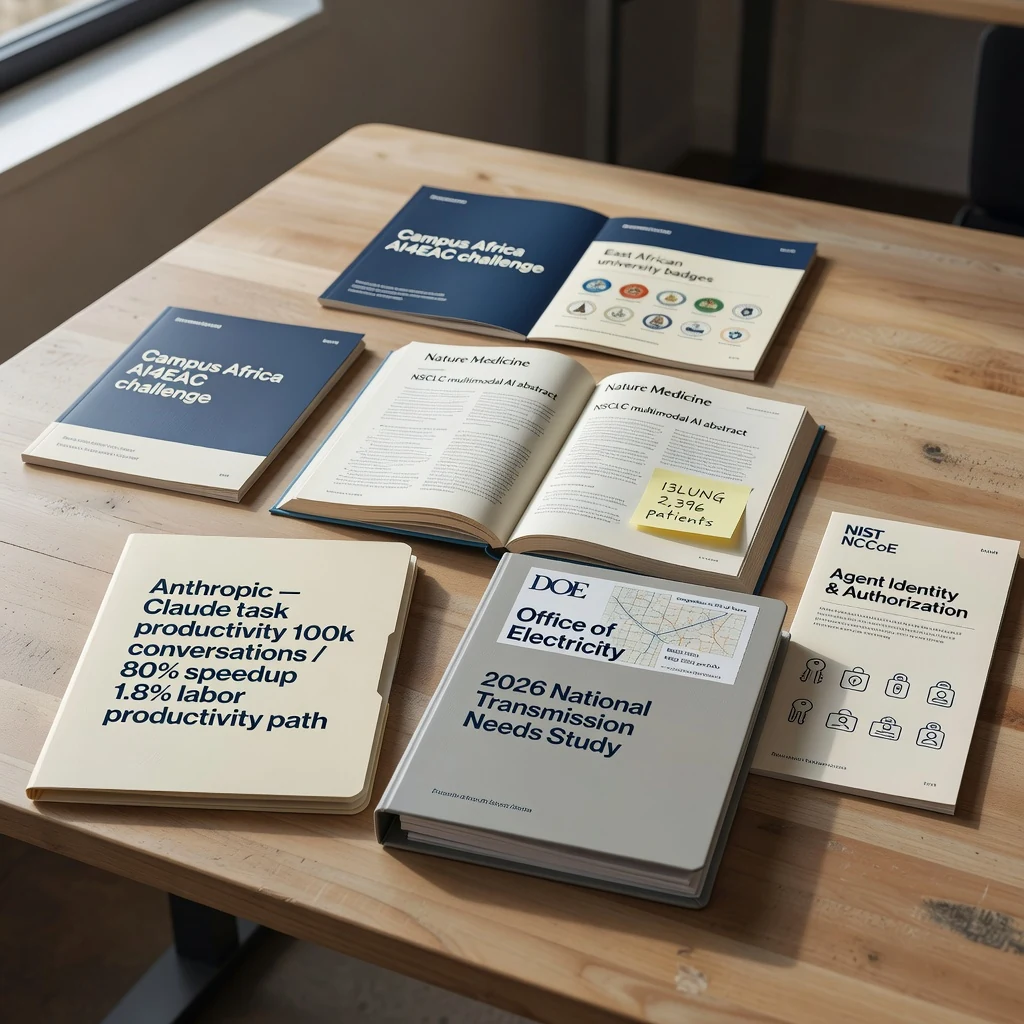
Today’s ledger follows Anthropic’s Economic Index note on Claude conversation task-time savings and a conditional 1.8 percent U.S. labor-productivity path, DOE’s draft 2026 National Transmission Needs Study on data-center load and congestion concentrated in 5% of hours, NIST NCCoE’s warning that agentic AI is repeating old identity failures, Nature Medicine’s I3LUNG multimodal study in advanced NSCLC, and UNESCO’s AI4EAC challenge where East African students built skills-to-job models.
Anthropic: Claude tasks show ~80% time savings — conditional 1.8% U.S. productivity path
What happened. Anthropic published Estimating AI productivity gains under its Economic Index line. Using a privacy-preserving method (Clio), the authors sample 100,000 real Claude.ai conversations, estimate how long the tasks would take with and without AI assistance, and map those tasks to O*NET occupations and BLS wage data. Locked task-level results: without AI, the sampled tasks would take about 90 minutes on average (about 1.4 hours); Claude speeds individual tasks by about 80%; the same tasks would otherwise cost about $55 in human labor. Occupational variation locked on the page: legal and management tasks near two hours without AI; food-preparation tasks about 30 minutes; healthcare-assistance tasks about 90% faster; hardware issues about 56% time savings. Economy-wide extrapolation locked: current-generation models could raise annual U.S. labor productivity growth by 1.8 percent over the next decade — roughly twice the recent run rate since 2019. Hard limits locked by the authors: this is not a future prediction because adoption rates are not modeled; validation and other work outside the Claude conversation is not counted and may mean current effects are overstated; future model improvements are out of scope for the 1.8 percent path. Bottleneck note locked: large speedups in some tasks and smaller ones in others can leave residual human steps as constraints.
What to watch. The near-term jobs print is task-time compression and a conditional productivity path — not headcount destruction — and the authors flag missing human-validation minutes as the reason not to treat 80% / 1.8 percent as already banked GDP. Keep this lab-vendor conversation-sample note separate from yesterday’s Chicago Fed occupational abstract, the Dallas Fed Texas posting note, Kiel profiles-not-headcount, ILO limited-displacement synthesis, Richmond Fed EB 26-27, Atlanta Fed WP 2026-4, Census CES packages, NY Fed firm-use shares, and any 2026 layoff census.
Read Anthropic — Estimating AI productivity gains →
DOE draft Needs Study: data-center load is a wires problem concentrated in 5% of hours
What happened. The U.S. Department of Energy’s Office of Electricity released a draft of the 2026 National Transmission Needs Study (formally the National Electric Transmission Congestion Study under the Federal Power Act). Locked drivers of transmission need: load growth from data centers, expanding domestic manufacturing, large industrial loads, electrification, and a growing economy. Transmission is needed for reliability across new generation interconnection, new load interconnection, and congestion relief. Locked congestion finding: the majority of transmission congestion is concentrated in 5% of hours — especially with day-ahead versus real-time price variance, high net load, cold weather, and high intermittent generation. Highest potential for new within-region transmission to relieve high congestion costs: NYISO, NorthernGrid South, and MISO. Interregional examples named: West Connect–SPP; NorthernGrid–WestConnect; ISO-NE–NYISO. Portfolio context locked: in 2024, MISO approved the largest transmission portfolio ever undertaken in the U.S. Comment window on the landing page: comments due 7 September 2026 — already closed as of this edition. Companion permitting note (separate agency): EPA guidance (27 July 2026) clarifies that the Clean Air Act Acid Rain Program does not apply to islanded (not grid-connected) power-generation facilities that neither sell electricity nor have required DOE generating-unit reporting — expanding a path for on-site generation serving data centers; later grid connection may bring ARP into scope.
What to watch. After a summer of TWh-path stories, the U.S. public document names the missing layer: AI and industrial load show up as transmission need and hour-concentrated congestion, not only as a national electricity share. Keep this draft wires/congestion study separate from LBNL national-lab TWh paths, IEA Demand or Energy-and-AI bounds, EIA September STEO generation-record monthly, ERCOT megawatt prints, and yesterday’s MIT / iScience flexible-load cost and emissions modeling.
Read the DOE OE Needs Study release →
Read the EPA islanded-generation ARP guidance →
NIST NCCoE: agentic AI is repeating old identity failures
What happened. NIST’s Cybersecurity Insights blog published Back to the Future: Why Agentic AI Needs a Strong Identity Foundation, drawing on public comments to the NCCoE concept paper on software and AI agent identity and authorization plus stakeholder engagement. Locked problem set (qualitative; no incident census on the page): people and enterprises are sharing personal and enterprise credentials with agents, breaking accountability and non-repudiation; teams stand up agents with static / long-lived API keys and bearer tokens that do not prove identity and often grant broad, unscoped access; local user-account agent deployments and overly broad entitlements amplify blast radius; over-reliance on human-in-the-loop approvals risks consent fatigue (MFA-bombing analogue) as agents request new tools and data. Locked direction: treat agents as first-class identities with unique IDs, credentials, and entitlements bound to the operating user or system; reuse enterprise patterns such as SPIFFE and OAuth 2.0; emerging work includes WIMSE, Identity Assertion JWT Authorization Grant, DPoP, RAR, Transaction Tokens, and AuthZen. Consumer path is harder than enterprise; FIDO work on agent authenticators bound to user identities is still early. Line locked for consumer settings: the “secure path” must also be the “easy path” or credential sharing continues. This is a blog plus concept-paper comment synthesis — not a final NIST standard.
What to watch. The policy beat is identity and authorization for agents — passwords and long-lived keys handed to software — not another model-card template. Keep this separate from NIST AI 300-1 documentation comments (still due 16 September), NIST SP 800-239, FDA’s GenAI-device discussion paper, California SB 813 / AB 1405, live EU Article 50 chatbot/mark duties, and any measured drop in deepfakes or breaches.
Read the NIST agent-identity blog →
Nature Medicine I3LUNG: multimodal AI for NSCLC immunotherapy selection
What happened. Nature Medicine published Clinical usability of an explainable AI decision support tool and evaluation of multimodal models in NSCLC (DOI 10.1038/s41591-026-04488-2; trial NCT05537922). Authors call I3LUNG the largest international real-world multimodal AI study in this setting: 2,396 patients with stage IIIC–IVB NSCLC treated with immunotherapy (IO) or IO/chemotherapy across six centers (Italy, Greece, Germany, Spain, USA, Israel); retrospective window September 2012–October 2023. Modalities locked: clinical+blood (CB) n=2,396; genomics n=1,723; CT n=1,705; digital pathology n=936. Performance locked: ML/DL CB-only models reached AUC up to 0.77 on the independent TEST set; external validation (EXVAL) AUCs 0.55–0.72, with the drop attributed to population differences. AI models significantly surpassed PD-L1, ECOG PS, NLR, LDH, and LIPI on TEST. Usability locked: lung expert and nonexpert physicians improved their prediction with the explainable ML CB-only tool — no numeric physician-delta is claimed here. Multimodal early-fusion was associated with higher performance in development, but incremental benefit remains uncertain and did not translate in TEST and EXVAL. Prospective validation of the decision-support system is undergoing in more than 2,000 patients — this paper is the retrospective arm, not that prospective outcome.
What to watch. The clinical print is better IO-response prediction than standard scores on a large real-world cohort — with an honest external-validation drop and an unfinished prospective arm still ahead. Keep this retrospective prediction + usability study separate from a patient-mortality RCT, LungIMPACT’s pathway-timing null, yesterday’s Nature Methods biology-standards editorial, breast-triage workload/CDR numbers, and any device clearance.
Read the Nature Medicine I3LUNG study →
UNESCO AI4EAC: East African students build skills-to-job AI
What happened. UNESCO reported on the completed AI4EAC Innovation Challenge under the East African Community AI Alliance (partners include UNESCO Campus Africa, Germany, Zindi, IUCEA, EASTECO, and JICA). The six-month programme mixed AI training, mentorship, and webinars with practical challenges in education, agriculture, health, and finance, culminating in a two-day innovation challenge in March 2026. Reach locked: close to 1,000 students from 57 universities across eight countries — Burundi, Democratic Republic of the Congo, Kenya, Rwanda, Somalia, South Sudan, Tanzania, and Uganda. Skills2Job track (UNESCO-led): build machine-learning systems that predict the five most relevant occupations from five skills, using real job-postings data from UNESCO’s Global Skills Tracker. Technical University of Mombasa “Team Adventurers” took second place, framing the problem as text classification rather than classic recommendation and arguing African labour markets often over-rely on formal credentials while overlooking transferable skills such as communication, management, and sales.
What to watch. The education beat is skills-based hiring infrastructure built by students in the region — programme reach and a design thesis, not a proven employment lift. Keep this regional student challenge separate from yesterday’s UNESCO LAC Observatory platform launch, Ghana TVET scale-up aims, ICT Prize laureates, HEPI’s UK undergraduate survey, NYC K–8 bans, and multi-country learning-outcomes or employment RCTs. Standing context only: Digital Learning Week ended 11 September; UNESCO global education-AI consultation comments still due 15 October.
Read the UNESCO AI4EAC Innovation Challenge report →
Also in today’s ledger
• Task-time savings are not a layoff print — Anthropic’s 80% / 1.8 percent path is conditional and excludes human validation minutes.
• Congestion hours are not a TWh path — DOE’s draft study puts AI load on the wires, not only on national electricity share.
• Agent IAM is not a model-card rule — NIST’s near-term problem set is credential sharing, static tokens, and consent fatigue.
|