Friday, September 4, 2026 · Daily edition
Global GenAI exposure, Texas load cuts, and AI accuracy rules
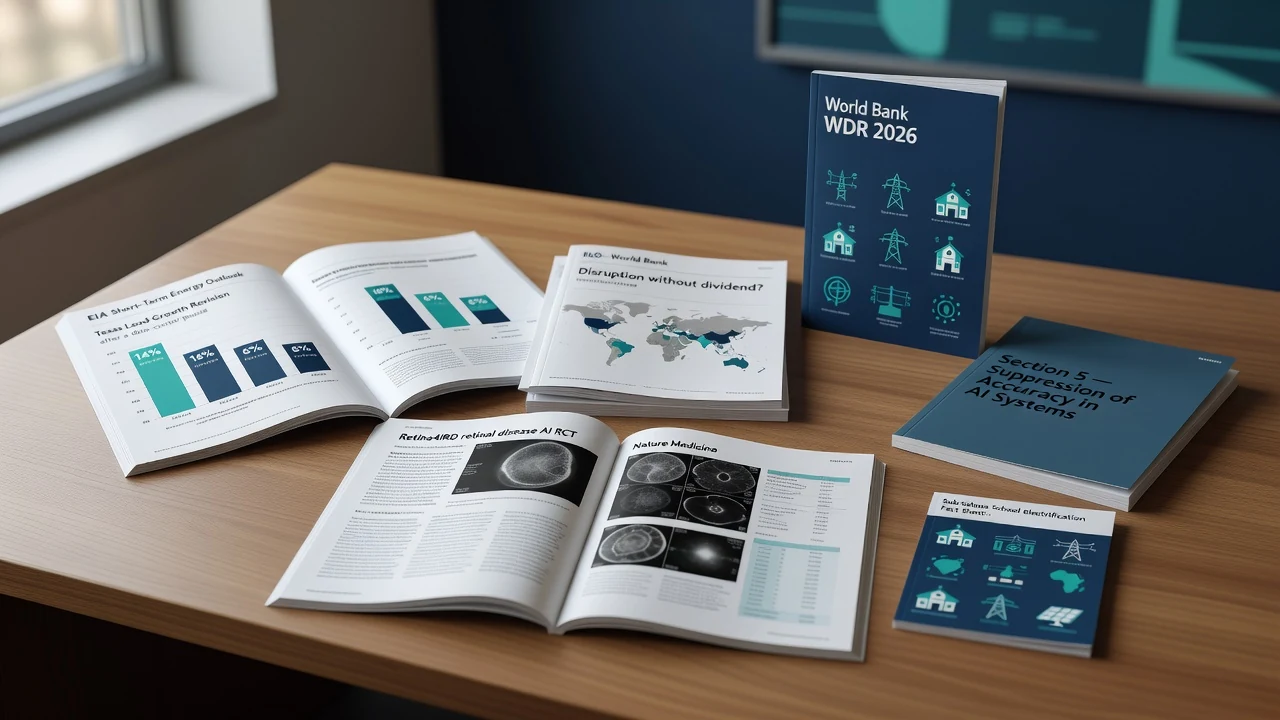
Today’s ledger follows an ILO–World Bank map of generative-AI exposure across 135 countries, EIA’s cut of Texas 2027 load growth after a data-center siting pause, a proposed FTC Section 5 statement on accuracy suppression in marketed AI, a Nature Medicine RCT that lifts specialist IRD genotype ranking, and World Bank figures on rural-school electricity and internet gaps that still gate classroom AI.
ILO–World Bank: GenAI disruption can arrive before the dividend
What happened. An ILO–World Bank working paper, Disruption without dividend? (background for WDR 2026), maps generative-AI exposure across 135 countries covering about two-thirds of global employment. Automation-vulnerable clerical and administrative pathways are often already online even in lower-income settings, while many workers with augmentation potential still lack reliable internet. Conventional occupational exposure scores overestimate GenAI impact in developing countries when they assume high-income task content inside the same job titles. World Bank press figures put automation risk at about 4.5% of existing jobs in LMICs versus 14.2% in high-income countries, with productivity-boost potential for about 16.2% versus 18.7%.
What to watch. Poorer countries can look less automation-exposed on paper and still face job disruption first if connectivity reaches replaceable tasks before it reaches the jobs AI would amplify. This is a cross-country digital-divide labor map — not a U.S. layoff census or firm-survey adoption share.
Read the ILO–World Bank paper →
EIA STEO: Texas 2027 load growth cut from 14% to 6%
What happened. EIA’s current Short-Term Energy Outlook electricity chapter revises the near-term Texas path after the governor announced a pause on new data-center development on 3 August. EIA now expects Texas electricity load to grow 6% in 2027, down from 14% in the previous STEO — a forecast cut, not a metered 2026 data-center kWh census. National context in the same chapter: U.S. electric-power-sector generation in 1H26 was about +37 BkWh, or roughly two percent versus 1H25, with solar +21% and wind +6%; natural-gas generation is expected +30 BkWh (2%) in 2026 and +44 BkWh (3%) in 2027, while coal generation fell about −39 BkWh (−11%) in 1H26.
What to watch. Near-term interconnection freezes change the forecast before they change the stock of halls. Keep this state-level STEO revision separate from national lab 2030 share-of-load paths and global vendor TWh headlines.
Read the EIA STEO electricity chapter →
FTC proposes Section 5 rules on AI accuracy suppression
What happened. The Federal Trade Commission posted a proposed Policy Statement Concerning the Suppression of Accuracy in Artificial Intelligence Systems (Document ID FTC-2026-0859-0013; Federal Register 2026-13628). The notice frames how Section 5 of the FTC Act — deceptive acts or practices — would apply to companies that market AI systems. Status is a Commission proposal into public comment, not a final rule and not an enforcement census.
What to watch. When accuracy suppression is treated as a deceptive-practices theory, product claims and output steering become a consumer-protection surface. Keep it separate from already-live EU Article 50 transparency duties and California AI Transparency Act media marks.
Read the FTC notice →
Retina4IRD RCT: specialist top-5 genotype accuracy 88.5% vs 67.3%
What happened. Nature Medicine reports a multicenter RCT of Retina4IRD, a Vision Transformer clinician decision-support system pretrained with RETFound that predicts 17 genotype categories from color fundus and OCT images. Training used 1,843 genetically confirmed patients (3,376 eyes) in China, South Korea, and Poland. In the trial, 295 participants with NGS reports entered analysis; the primary endpoint met top-5 genetic accuracy of 88.5% versus 67.3% (P<0.001). Top-1 was 37.8% versus 22.4%. Authors position the tool prior to genetic testing (ClinicalTrials.gov NCT06839170).
What to watch. Genotype shortlists before sequencing change referral labor and test choice — if the ranking stays inspectable against eventual NGS truth. This is a pre-NGS specialist-ranking CDSS RCT, not a screening-program rollout or visual-acuity outcome trial.
Read the Nature Medicine paper →
WDR 2026: rural-school power and internet still gate AI access
What happened. World Bank WDR 2026 press materials frame electricity and connectivity as AI complements, not classroom AI products. In Sub-Saharan Africa, nearly one-third of rural schools still lack reliable electricity and more than two-thirds lack dependable internet. Mission 300 aims to expand energy access for 300 million people across Sub-Saharan Africa by 2030. Design example: AI advice delivered by voice calls on basic mobile phones for people who cannot read or afford smartphones.
What to watch. Classroom AI tools do not reach students who lack power and bandwidth; the bottleneck is infrastructure before pedagogy. Product defaults that assume smartphones and broadband lock out the same students the report says need the gains most.
Read World Development Report 2026 →
Also in today’s ledger
• Same EIA STEO chapter: U.S. 1H26 generation up about two percent as solar and gas rise and coal falls — still not a data-center TWh census.
• Retina4IRD training footprint before the RCT: external top-5 accuracy 0.856 across the multinational set (1,843 patients / 3,376 eyes).
|