Monday, September 7, 2026 · Daily edition
Census BTOS diffusion, Savannah River AI power, and medical-AI evidence ladders
Today’s ledger follows Census CES-WP-26-25 on national BTOS AI adoption and rare firm-reported AI job cuts, NNSA’s selection of Amentum to negotiate a Savannah River AI campus with dedicated on-site generation, NIST IR 8615 putting AI hardware into next-gen secure-hardware standards work, an npj Digital Medicine five-phase evaluation ladder for diagnostic and predictive medical AI, and a Nature/HEPI package on near-universal UK undergraduate generative-AI use on assessed work.
Census CES-WP-26-25: AI diffusion rises — firm-reported AI job cuts stay rare
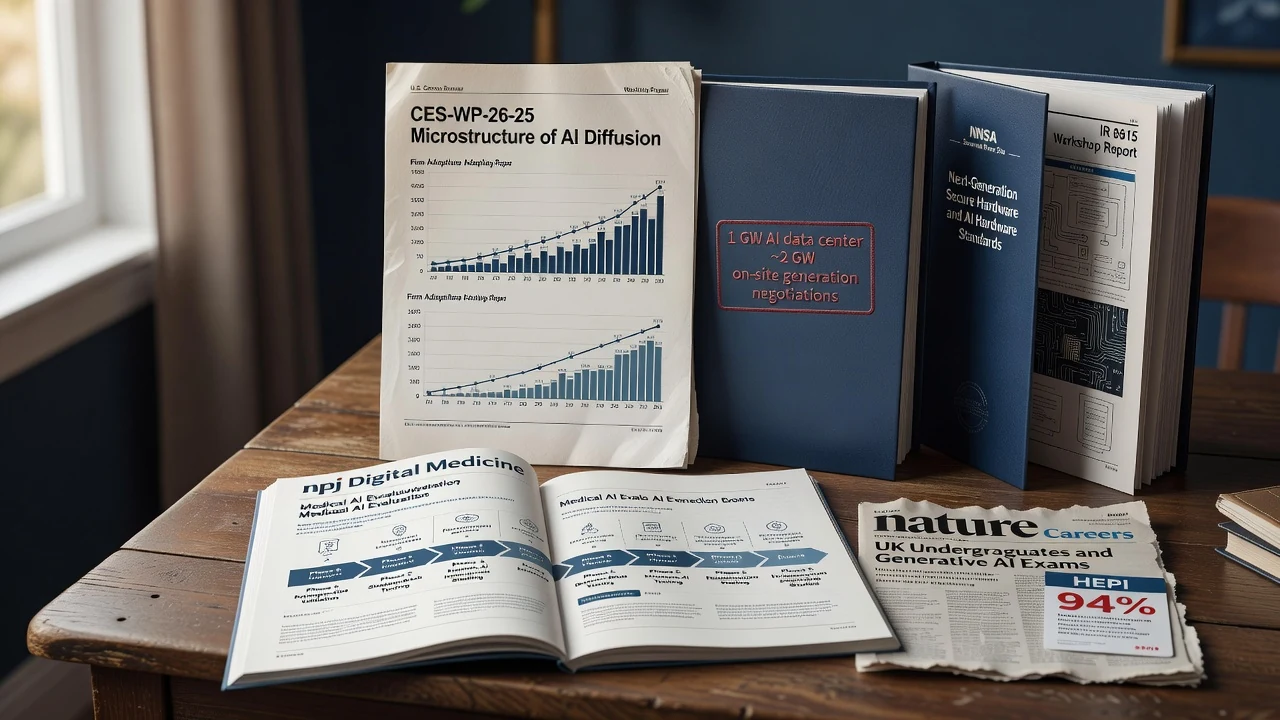
What happened. U.S. Census Bureau working paper CES-WP-26-25, The Microstructure of AI Diffusion: Evidence from Firms, Business Functions, and Worker Tasks, reports results from the 2026 AI supplement to the Business Trends and Outlook Survey for the November 2025–January 2026 window. Firm-function AI use reaches 18% of firms (32% employment-weighted), with expected use 22% within six months. Worker-task use is higher at 23% of firms (41% employment-weighted), led by writing, document analysis, and information search; 65% of firms limit AI to three or fewer tasks. Among adopters, 57% integrate AI in three or fewer business functions — Sales and Marketing 52%, Strategy and Business Development 45%, IT 41%. Very large firms in Information, Professional Services, and Finance show 50%–60% use (60%–70% employment-weighted). Most users (66%) rely on AI solely to augment tasks. AI-related employment decreases are rare: 2% of firms. Functional breadth and operational investment associate positively with employment decreases, while worker-task integration shows no significant link to headcount reduction once those controls are in.
What to watch. National firm microdata now separate broad task diffusion from rare firm-reported AI headcount cuts. Keep this paper distinct from CES-WP-26-27’s early-career QWI channel, PwC’s job-ad barometer, NY Fed regional-firm use shares, and SIEPR’s aggregate unemployment synthesis — it is not a CES payroll layoff census.
Read Census CES-WP-26-25 →
NNSA picks Amentum to negotiate a Savannah River AI campus with on-site power
What happened. The National Nuclear Security Administration announced selection of Amentum to enter negotiations for a phased lease for an AI data center plus dedicated on-site generation at the Savannah River Site in South Carolina. The page names a 1-gigawatt AI data center paired with approximately 2 gigawatts of on-site generation, with natural gas bridging to nuclear. DOE frames the design against a Ratepayer Protection Pledge: pair new AI load with dedicated on-site generation so electricity needs are not shifted onto existing utility customers. Context on the same page includes an April 2025 DOE list of 16 federal sites, with Savannah River and three other locations advanced for private-sector development. Selection for negotiations is not a final lease award; any agreement still needs negotiations, permitting, safety and security evaluation, and other federal approvals. No gallons, acres, or operating-load inventory appear on the page.
What to watch. A second federal-land AI campus with dedicated generation is a ratepayer-isolation design claim — still a negotiation, not operating megawatts. Do not mash the 1 GW / ~2 GW pair with DOE Paducah’s 1.8 / 2 / 2.6 GW campus plan, Virginia commercial-sales prints, FERC large-load tariff process, or global electricity-path forecasts.
Read the DOE/NNSA Savannah River announcement →
NIST IR 8615: secure-hardware standards put AI hardware on the priority list
What happened. NIST released IR 8615, Workshop Report on Rolling Next-Generation Secure Hardware into Standards, on 1 September 2026 (workshop held 26 January 2026). The report organizes five priority areas: unified standards and governance including AI hardware (with chiplets and post-quantum cryptography); provenance and traceability via cryptographic identities, SBOMs, and attestation; supply-chain security and procurement incentives; scalable verification including AI-assisted analysis; and workforce development. This is a hardware-security workshop report feeding standards processes — not a model-card mandate, not a transparency-labeling statute, and not a finished binding U.S. rule. Keep it separate from NIST AI 300-1 public-facing documentation templates, whose comments remain due 16 September.
What to watch. The standards fight is moving into chips, provenance, and verifiable supply chains — not only chatbot labels and model cards. IR 8615 is not EO 14409’s voluntary frontier-model access frame, not live EU Article 50 duties, not FTC’s proposed Section 5 accuracy statement, and not California’s live transparency packaging.
Read the NIST IR 8615 workshop report →
npj Digital Medicine: a five-phase ladder before bedside medical-AI claims
What happened. npj Digital Medicine published A five-phase evaluation framework for diagnostic and predictive medical artificial intelligence (DOI 10.1038/s41746-026-03155-7). Phase 1 calls for multi-center retrospective external validation on a frozen model — typically at least three centers — using STARD-AI for standalone diagnostic accuracy and TRIPOD+AI for prediction models, without post-hoc threshold tuning. Phase 2 is shadow-mode / silent trial on live hospital streams before outputs reach clinicians, tracking failure rate, latency, throughput, and calibration drift. Phase 3 is controlled human–AI interaction under DECIDE-AI (and STARD-AI if the endpoint is team diagnostic accuracy), including standalone benchmarking against seniority tiers and exploratory paired designs. Later clinical-evidence and post-market phases complete the ladder. This is a methods and reporting framework — not a patient-outcome RCT.
What to watch. Strong retrospective AUROCs are only the first rung; shadow-mode and human–AI interaction sit between paper performance and bedside claims. Keep this distinct from MoChiAgent obstetric AUROCs, ECG-CLIP, Retina4IRD genotype accuracy, breast-triage workload/CDR results, and LungIMPACT’s null pathway study.
Read the npj Digital Medicine framework →
Nature / HEPI: ~94% of surveyed UK undergrads used genAI on assessed work
What happened. A Nature careers feature on how professors are redesigning assessment under generative AI cites the Higher Education Policy Institute 2026 survey of 1,054 UK undergraduates: roughly 94% used generative AI to help with assessed work, and 12% directly inserted AI-generated text into coursework. A separate May study from survey data of more than 95,000 students at 20 U.S. universities estimated 9% used AI on coursework despite knowing it broke the rules. Practice examples named in the piece include critique-the-model assignments, in-class writing and orals, revision-history submission, and pass/fail take-homes paired with offline exams — no single institutional policy is crowned correct.
What to watch. Near-universal assessed-work use forces assessment redesign now. Keep HEPI’s UK 94%/12% package separate from the U.S. 9% “knew it broke rules” estimate, UNESCO Digital Learning Week, the ICT Prize ceremony calendar, Egypt’s teacher competency framework, and NYC’s K–8 student ban.
Read the Nature careers / HEPI package →
Also in today’s ledger
• Keep BTOS’s 66% augment-only / 2% AI-related employment-decrease split labeled — task diffusion can look broad while firm-reported AI separations stay rare.
• WHO/ITU/WIPO GI-AI4H meets in Hangzhou 16–18 September with a privacy-preserving Benchmarking Challenge — results are not regulatory approval.
|