Tuesday, September 8, 2026 · Daily edition
Adaptive capacity, computational-load rules, and public learning platforms
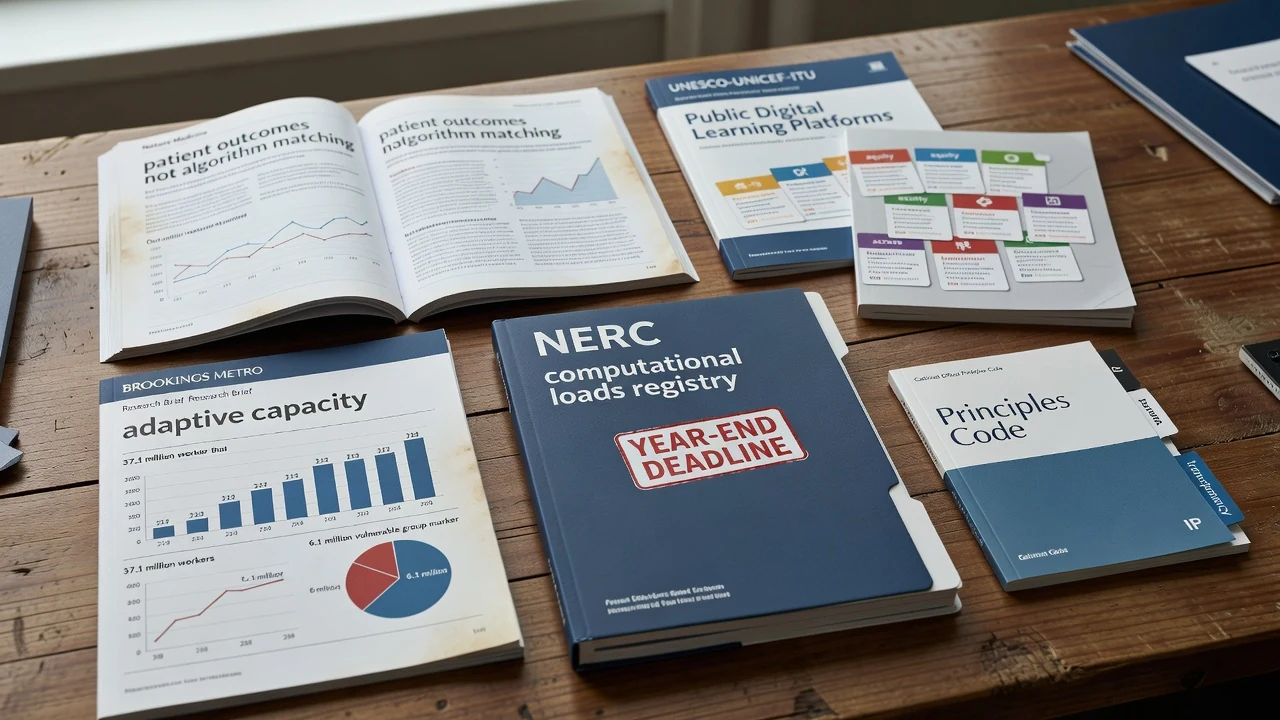
Today’s ledger follows Brookings Metro’s map of who among highly AI-exposed U.S. workers can adapt — and the 6.1 million who may not — FERC’s year-end clock for NERC computational-load registry criteria and Reliability Standards, Japan’s Cabinet Office Principles Code on generative-AI IP protection and transparency, a Nature Medicine comment that next-gen medical AI should be judged on patient outcomes of human–AI systems, and a UNESCO–UNICEF–ITU Charter that public digital learning platforms must stay public, inclusive, and trustworthy when AI is added.
Brookings Metro: most highly AI-exposed workers have adaptive capacity — 6.1 million do not
What happened. Brookings Metro’s Measuring US workers’ capacity to adapt to AI-driven job displacement (Manning, Aguirre, Muro, Methkupally; 21 January 2026) pairs occupational AI exposure with an adaptive-capacity index built from savings, age, labor-market density, and skill transferability, with a companion NBER paper. Of 37.1 million U.S. workers in the top quartile of occupational AI exposure, 26.5 million (~70%) also sit above the median on adaptive capacity. 6.1 million — about 4.2% of the sample workforce — face both high exposure and low adaptive capacity, concentrated in clerical and administrative roles; about 86% of that vulnerable group are women (Lightcast gender shares). High-exposure / low-capacity occupations are a larger employment share in college towns and state capitals, especially Mountain West and Midwest midsized markets. The brief states explicitly that exposure measures are not predictions of job displacement; the question is who can adapt if displacement occurs.
What to watch. The labor question shifts from “who is exposed” to “who can move,” with residual risk concentrated among women in clerical and administrative work. Keep this adaptive-capacity welfare map distinct from Census CES-WP-26-25’s BTOS adoption/tasks package, CES-WP-26-27’s early-career QWI channel, NY Fed regional use shares, PwC’s job-ad barometer, and SIEPR unemployment synthesis — and do not treat 6.1 million as jobs already lost.
Read the Brookings Metro adaptive-capacity brief →
FERC sets a year-end deadline for NERC computational-load registry criteria and standards
What happened. NERC’s newsroom announces that FERC has set a year-end deadline for NERC to finalize registry criteria and Reliability Standards for computational loads — the bulk-power-system reliability track that decides which large AI and data-center loads must register and under what obligations. This is a who-must-register / reliability-design beat, not a TWh demand path, not a named federal campus print, and not an interconnection-tariff show-cause order. No gallons, acres, operating megawatts, or emissions inventory appear in the locked title-level record used here.
What to watch. Grid governance for AI halls now has a second U.S. layer beside interconnection tariffs: reliability registration and standards before year-end. Keep the NERC computational-load clock separate from DOE Paducah’s 1.8 / 2 / 2.6 GW campus plan, NNSA Savannah River’s 1 GW / ~2 GW negotiation, FERC’s six large-load show-cause orders, and IEA or Gartner electricity-path forecasts.
Read the NERC computational-load deadline notice →
Japan’s Cabinet Office posts a Principles Code for generative-AI IP and transparency
What happened. Japan’s Cabinet Office released an English provisional translation of the Principles-Code for Protection of Intellectual Property … and Transparency for the Appropriate Use of Generative AI. The overview frames principles generative-AI businesses should implement for transparency and IP protection, drawing on the spirit of the Act on the Promotion of Research and Development and Practical Application of AI-Related Technologies (Act No. 53 of Reiwa 7) and on comply-or-explain corporate-governance practice. The stated aim is to balance generative-AI advancement with appropriate IP protection. This is soft-law principles guidance — not a measured drop in misinformation and not a finished labeling statute with extracted penalties.
What to watch. A major economy is testing comply-or-explain IP and transparency norms for generative-AI businesses outside the EU labeling model. Keep this distinct from NIST IR 8615’s secure-hardware workshop report, NIST AI 300-1 documentation templates, EO 14409’s voluntary frontier access frame, live EU Article 50 chatbot/mark/deepfake duties, and California’s live transparency packaging.
Read Japan’s Principles Code (provisional English translation) →
Nature Medicine: judge next-gen medical AI on patient outcomes of human–AI systems
What happened. Nature Medicine published a 7 September 2026 comment by Kristina Lång (Diagnostic Radiology / Translational Medicine, Lund University, Malmö), From algorithms to patient outcomes — lessons from one of the first randomized trials of AI in medicine (DOI 10.1038/s41591-026-04633-x). The locked thesis: first-generation medical AI was judged on whether algorithms could match clinicians; the next generation should be judged on whether carefully designed human–AI systems can improve patient outcomes. Competing interests are disclosed on the page. This is a methods/thesis comment — not a new patient-outcome RCT with locked interval-cancer rates.
What to watch. Matching a radiologist on a bench test is no longer the finish line; bedside claims need human–AI system outcomes. Pair Lång’s patient-outcomes standard with the recent npj five-phase evaluation ladder without collapsing them, and keep both distinct from MoChiAgent obstetric AUROCs, ECG-CLIP, Retina4IRD genotype accuracy, and LungIMPACT’s null pathway study.
Read the Nature Medicine Lång comment →
UNESCO–UNICEF–ITU Charter: public digital learning platforms must stay public, inclusive, and trustworthy
What happened. UNESCO, UNICEF, and ITU launched a Charter for Public Digital Learning Platforms with seven principles: PUBLIC (public-authority governance, finance, and control; education-system sovereignty); INCLUSIVE (multilingual support; accessibility for learners with disabilities; low-cost devices; intermittent connectivity); PEDAGOGICAL (teacher-led); COMPLEMENTARY (reinforce, not replace, in-person schools and teachers); OPEN (open standards, reuse, interoperability); FOCUSED (educational needs over technological novelty); and TRUSTWORTHY (accurate, age-appropriate, safe data stewardship — and when AI or other frontier technologies are integrated, they should be tested for safety and alignment with educational objectives). The launch article frames the problem from Helsinki / International Day for Digital Learning: in many contexts for-profit firms have become de facto hosts of digital education.
What to watch. On the opening day of UNESCO Digital Learning Week (8–11 September), the bar for education AI is public control, disability-inclusive design, and safety tests against learning goals — not vendor-default platforms. Keep Inclusive and Trustworthy as the AI clauses; do not restamp HEPI’s UK undergrad use package or treat the 9 September ICT Prize ceremony as a survey reprint.
Read the UNESCO Charter for Public Digital Learning Platforms →
Also in today’s ledger
• Brookings’ 6.1 million is high-exposure + low adaptive capacity, not a layoff census — keep the 37.1 million top-quartile and ~70% above-median capacity figures labeled.
• WHO/ITU/WIPO GI-AI4H Hangzhou meets 16–18 September — calendar context only; results are not regulatory approval.
|