|
|
MODEL
SEISMIC
Oct 28, 2026
Gemini 4 Carbon — Google's new frontier model, first for cyber defenders
Google's Gemini 4 Carbon tops the Artificial Analysis index and sets new security scores, but only cyber defenders get it at launch.
What is it?
Gemini 4 Carbon is Google's second Gemini 4 model, announced 28 October 2026. Google calls it its strongest model, with state-of-the-art cybersecurity capabilities and long-horizon coding skills for root-causing and patching bugs across large codebases.
How does it work?
On security tests, Carbon scores 88.2% on SEC-bench Pro for finding vulnerabilities and 71.0% on CWE-bench for patching. Google reports 0.0% attack success on the Gray Swan prompt-injection test, versus 0.7% for Gemini 4 Argon.
Why does it matter?
A model that finds and exploits bugs this well helps defenders and attackers alike, so Google is giving security teams a head start before any wide release. Carbon takes the #1 spot on the Artificial Analysis Intelligence Index v5.0 with a score of 59.
Who is it for?
Security teams, critical-infrastructure operators, and frontier-model watchers.
|
|
|
|
TOOL
MAJOR
Oct 28, 2026
GitHub Copilot Fusion — Copilot now picks and combines models for you
GitHub Copilot Fusion replaces the model picker with routing: one model, a cheap-first cascade, or a draft-and-review loop.
What is it?
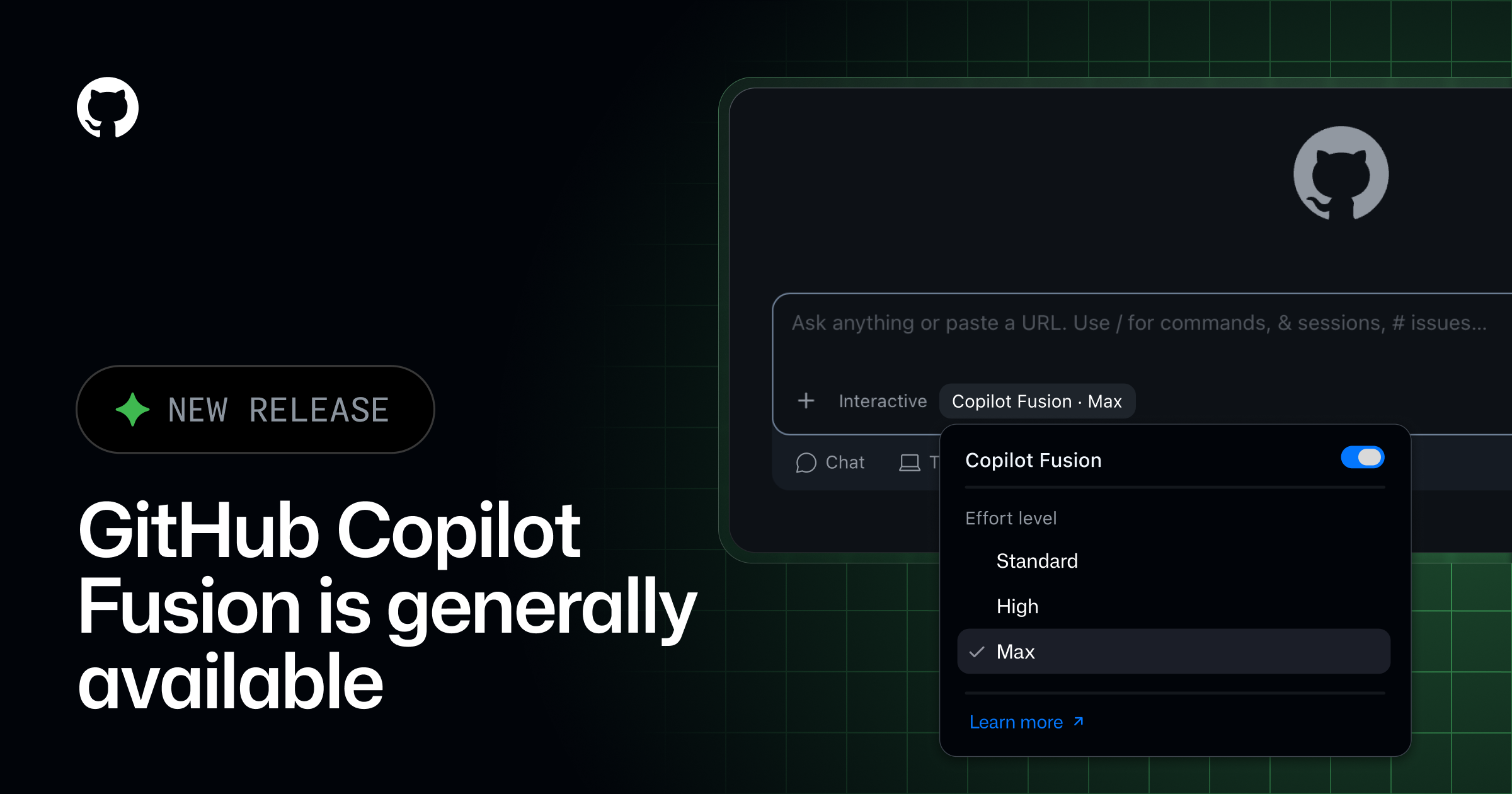
Copilot Fusion became generally available at GitHub Universe on 28 October 2026. Instead of picking a model, you pick Fusion and an effort level — Standard, High or Max — and Copilot routes your task to one or more models automatically.
How does it work?
Fusion runs tasks in one of three patterns: Single (one model), Cascade (cheap model first, escalates if quality fails), or Critique (one model drafts, another reviews, the first revises). An experimental opt-in lets it also route between on-device and cloud models.
Why does it matter?
GitHub says Fusion Max scored 60 on the Artificial Analysis Coding Agent Index at about half the API cost and tokens per task versus Claude Code with Opus 5.5 Max. Enterprise admins keep control: Fusion only uses models enabled by policy.
Who is it for?
Copilot users on any plan, and enterprise admins managing Copilot model policy.
|
|
|
|
TOOL
MAJOR
Oct 28, 2026
Google Connected Apps Platform — build one app for Search and Gemini
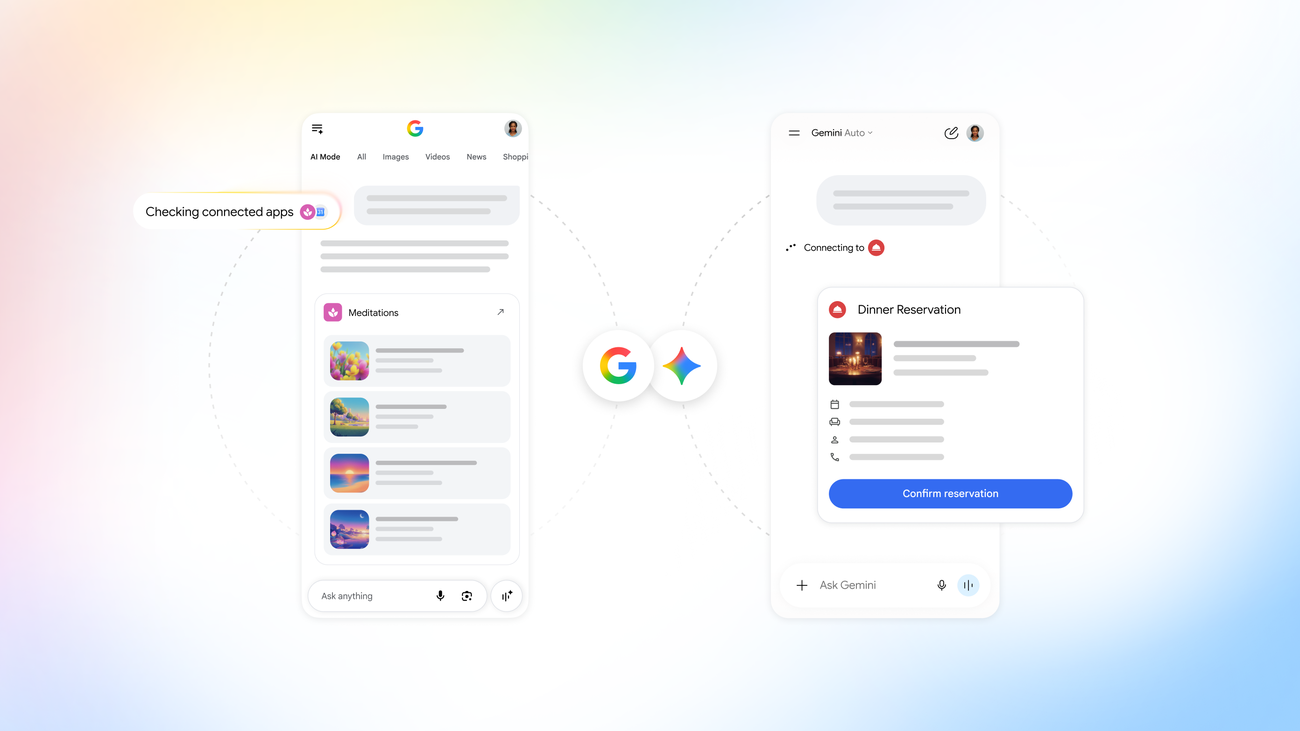
Google opens Search and the Gemini app to outside apps: connect over MCP once, then pick where your app goes live.
What is it?
Google's Connected Apps Platform, launched in preview on 28 October 2026, gives developers a single place to build and manage apps that run inside Google Search, the Gemini app, or both. More than 50 apps — including Canva and YouTube Music — are already live.
How does it work?
Developers expose their service as tools via a cloud-hosted MCP server with OAuth 2.1, or via Android AppFunctions for on-device tools. Google Connected Console handles registration, testing, review and publishing, including traffic and error-rate reporting after launch.
Why does it matter?
A team that already runs an MCP server can reuse it to reach billions of Search and Gemini users. The platform is MCP-native, so existing agent tooling slots straight in without a rewrite.
Who is it for?
App developers and businesses that already run, or plan to run, an MCP server.
|
|

|
|
BENCHMARK
MAJOR
Oct 27, 2026
DAYJOB: Tax — best AI agent passes only 10.8% of real tax assignments
Expert-built tax jobs, from a client's request to the finished work: no frontier agent passes more than about one in ten.
What is it?
DAYJOB: Tax is a benchmark from Surge AI that hands an AI agent a full professional tax assignment — including client files — and grades the finished work. Its 50 tasks cover eight practice areas, from individual returns to corporate transactions and tax disputes.
How does it work?
Tax experts wrote each assignment together with the client records and a grading rubric that checks calculations, supporting evidence and consequential issues. An attempt only counts as a pass when it meets at least 95% of that task's criteria.
Why does it matter?
Claude Sonnet 5.5 leads at 10.8%, GPT-6 Astra scores 4.8%, and Kimi K3 passes none. Surge AI's verdict: agents "haven't yet passed the audit." The failures are mostly about judgment — missing a deadline that ends a tax exclusion — not arithmetic.
Who is it for?
Teams building agents for finance, accounting and other professional work.
|
|

|
|
MODEL
MAJOR
Oct 28, 2026
Nemotron 3.5 Transcribe — NVIDIA's open speech model you steer with prompts
One open checkpoint for transcripts, translation, speaker labels and audio Q&A, controlled by plain-language prompts.
What is it?
Nemotron 3.5 Transcribe lets you ask for the transcript you need in plain words: label each speaker, translate into English, drop filler words, or watch for domain terms. It handles 40 languages, translates 31, and works on recordings up to 1 hour with up to 8 speakers.
How does it work?
A Transformer speech encoder and speaker encoder feed a hybrid Mamba-2–Transformer Mixture-of-Experts language model built on Nemotron 3.5 Lightning, so only about 4.3B of its 34B parameters run per token. It serves via vLLM with an OpenAI-compatible chat endpoint.
Why does it matter?
Teams sending meetings or clinical notes to paid speech APIs get an open alternative that runs on a single H100. NVIDIA ranks first among open-weight models on the Hugging Face Open ASR English leaderboard with a 5.33% average word error rate.
Who is it for?
Developers building transcription, meeting and medical speech applications.
|
|

|
|
MODEL
MAJOR
Oct 27, 2026
LFM3 — Liquid AI's 2B-class open models for text, vision, audio and omni
Six small open models from Liquid AI share one 1.7B backbone and cover text, images, video, speech and calibrated decisions.
What is it?
LFM3 is Liquid AI's new family of open-weight models built for phones, laptops and edge devices. Six models on one backbone cover text (LFM3-1.7B), vision (LFM3-VL-2B), audio (LFM3-Audio-2B), all modalities (LFM3-Omni-2B), and two decision models with calibrated outputs.
How does it work?
Every model branches from LFM3-1.7B-Base, a 24-layer hybrid mixing gated convolutions with sliding-window and global attention. Pre-trained on 22T tokens, with a final 3.5T-token stage extending context to 256K. Vision and audio encoders plug in to the same backbone.
Why does it matter?
LFM3-1.7B beats Qwen3.5 9B on long browser and business-app tasks with less than a fifth of the parameters, and fits in about 1 GB at 4-bit. Developers get one tested family for text, vision and voice that can be fine-tuned on a single GPU.
Who is it for?
On-device and edge AI developers who need private, offline agents on constrained hardware.
|
|
|
All releases at ai-tldr.dev
Simple explanations • No jargon • Updated daily
|
|