|
|
TOOL
MAJOR
2026-05-27
Cognition Raises $1B at $26B Valuation — Devin Maker More Than Doubles Its Price in Eight Months
Devin's maker takes a $1B Series D at $26B, more than doubling its September 2025 valuation in eight months.
What is it?
Cognition is the San Francisco lab behind Devin, an autonomous coding agent that takes tickets, opens PRs, and operates as a teammate inside enterprise engineering orgs. The Series D is led by Lux Capital, General Catalyst, and 8VC, bringing in over $1B at a $26B post-money valuation, with Citi, Mercedes-Benz, Goldman Sachs, the US Army, and the US Navy among enterprise customers.
How does it work?
Devin reads tickets, plans the work, edits the repo, runs tests, and lands the PR end-to-end. Cognition says 89% of code committed by its own engineers now comes from Devin, and a new SWE-1.6 in-house model runs at up to ~950 tokens/sec.
Why does it matter?
Cognition is the second AI coding company to hit a 10-figure raise in 2026 (after Cursor's $1B in May), and the $26B price tag puts Devin on the same playing field as Claude Code, OpenAI Codex, and Google Jules. Enterprise run-rate revenue of $492M and 10x growth in 2026 confirm autonomous coding agents have moved past pilot into multi-year deployments.
Who is it for?
Engineering leaders evaluating coding-agent vendors, AI infra investors, and founders building agent products.
|
|
|
|
TOOL
MAJOR
2026-05-26
OpenRouter Raises $113M Series B Led by Alphabet's CapitalG at a $1.3B Valuation
The multi-model gateway hits $1.3B as Alphabet's growth fund bets on the routing layer between agents and 400+ providers.
What is it?
OpenRouter is a hosted gateway that exposes 400+ AI models from Anthropic, OpenAI, Google, xAI, DeepSeek, and others behind a single API and unified billing. The Series B is led by Alphabet's CapitalG, with NVIDIA, ServiceNow, MongoDB, Snowflake, and Databricks Ventures all participating.
How does it work?
Apps point at OpenRouter's API, choose a model (or let OpenRouter route on price, latency, or capability), and the gateway handles failover, retries, spend caps, and a single invoice across providers. Weekly token volume jumped from 5T to 25T in six months, with 8M+ developers now on the platform.
Why does it matter?
Every major infra VC arm — NVIDIA, ServiceNow, MongoDB, Snowflake, Databricks, plus Alphabet — just bought into the same thesis: enterprises are done with single-vendor model lock-in. OpenRouter's 5x growth in six months is one of the clearest signals yet that production AI workloads are converging on multi-model architectures.
Who is it for?
Platform teams shipping production AI features and startups picking a model abstraction layer.
|
|
|
|
TOOL
MAJOR
2026-05-27
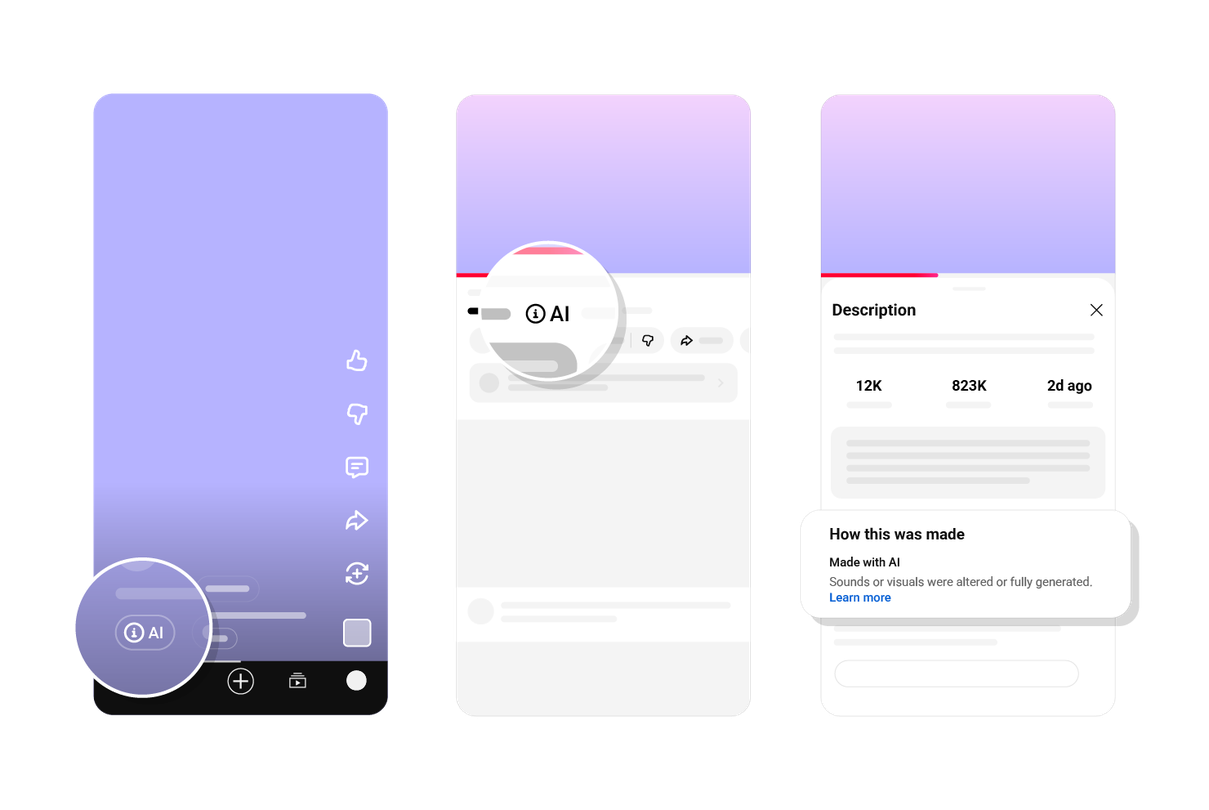
YouTube Starts Auto-Labeling Videos Made With Significant Photorealistic AI
YouTube no longer waits for creators to admit a video is AI — it now detects and labels significant photorealistic AI itself.
What is it?
YouTube will now use its own detection signals to apply an AI label even when the creator did not disclose it. Until now the platform relied entirely on creators to tick a box when uploading realistic synthetic video.
How does it work?
YouTube's internal systems flag videos containing significant photorealistic AI; content with C2PA metadata marking it as fully AI-generated gets a permanent label. The label now sits directly below the video player on long-form videos and appears as an overlay on Shorts.
Why does it matter?
It shifts the burden of AI disclosure from the creator's honesty to platform detection, on the largest video service in the world. Creators who skip disclosure can no longer stay unlabeled, and the labels do not affect recommendations or monetization.
Who is it for?
Video creators, viewers, and trust-and-safety teams.
|
|

|
|
MODEL
MAJOR
2026-05-26
ElevenLabs Music v2 — Switches Genres Mid-Track, Adds Section-Level Inpainting, Cuts API Prices Up to 50%
A music model that swaps genres mid-track and regenerates just one section of a song.
What is it?
Music v2 is ElevenLabs' latest text-to-music model that generates full tracks with vocals, instrumentation, and arrangement from plain-language descriptions. It powers the ElevenMusic app, ElevenCreative tool, and the music API, with prices cut up to 50%.
How does it work?
The model builds songs section by section (intro, verse, chorus) while keeping the whole track coherent, so a single song can move from opera to heavy metal. An inpainting mode lets you select any segment and regenerate just that part from a prompt, leaving the rest untouched.
Why does it matter?
Mid-track control and section-level inpainting let creators revise part of a song without regenerating the whole thing. Training only on licensed data cleared for commercial use gives commercial users clearer legal footing, and API price cuts of up to 50% lower the cost of generating audio at scale.
Who is it for?
Musicians, content creators, and marketing teams building audio-first experiences.
|
|

|
|
ECOSYSTEM
MAJOR
2026-05-26
Beijing Expands Overseas Travel Curbs to Top AI Talent at Alibaba and DeepSeek
China treats top AI engineers like nuclear scientists — they now need state approval before any overseas trip.
What is it?
Bloomberg reported that Chinese government agencies have begun requiring select startup founders, researchers, and senior executives at private AI firms — including Alibaba and DeepSeek — to obtain prior government approval before traveling abroad. The policy reuses controls historically reserved for academics, nuclear scientists, and state-owned enterprise executives.
How does it work?
The restrictions are applied case-by-case to individuals working on advanced AI considered strategically important. Bloomberg previously reported similar curbs on DeepSeek executives in December 2025; two Manus co-founders were also barred from overseas travel last year.
Why does it matter?
Beijing is now treating private AI talent as a national-security asset, changing the calculus for any Chinese AI lab trying to attract overseas talent, partner with foreign companies, or send researchers to US conferences. It also raises the bar for what counts as a credible US export-control retaliation.
Who is it for?
China-watchers, policy analysts, frontier-lab hiring managers, and anyone tracking the human-capital dimension of the US–China AI race.
|
|
|
|
SECURITY
MAJOR
2026-05-25
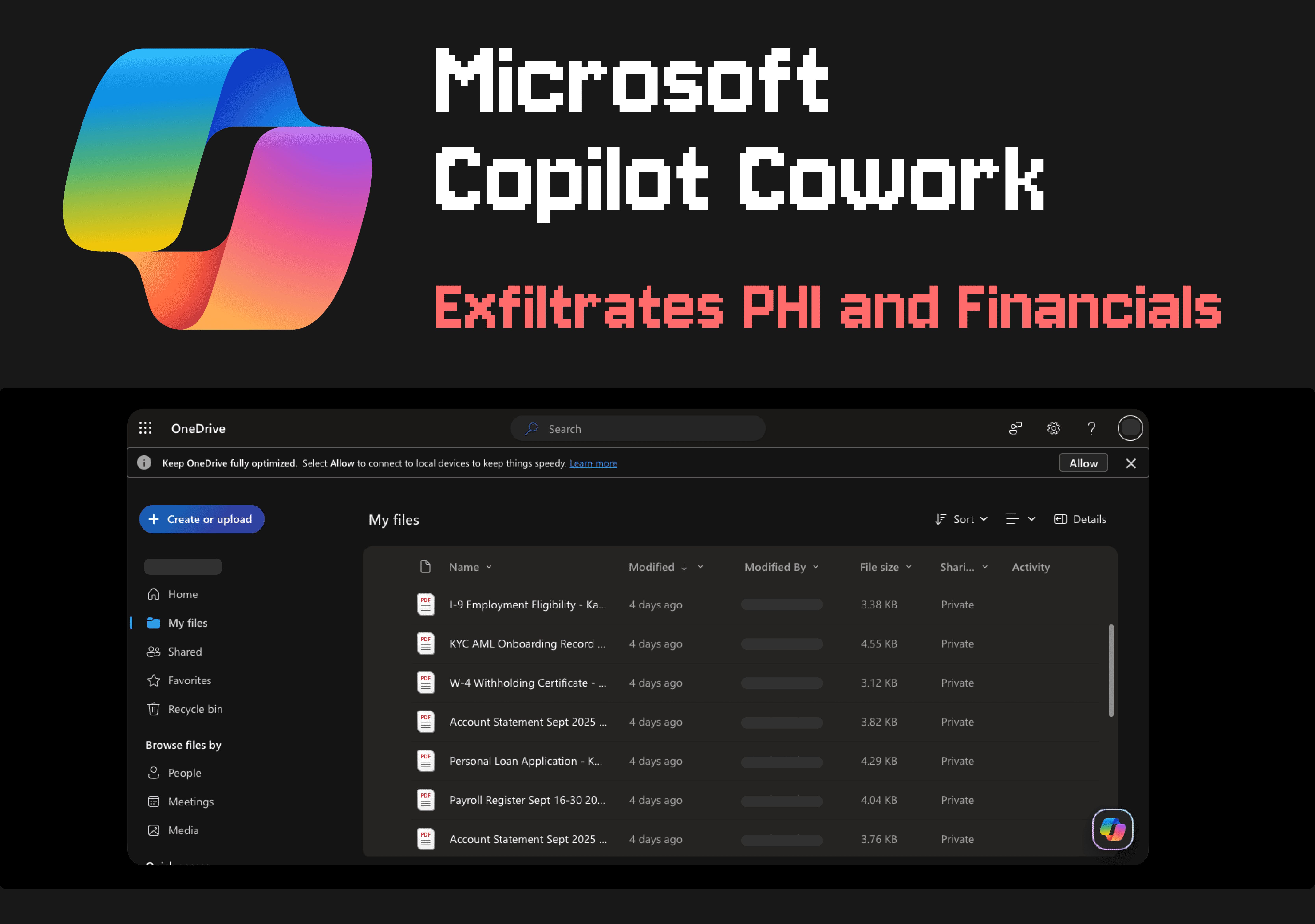
PromptArmor: Microsoft Copilot Cowork Exfiltrates Files via Poisoned Skills — 100% Success Rate Against Claude Opus 4.7 and Sonnet 4.6
A poisoned skill turns Microsoft's M365 agent into a file thief with no user approval step.
What is it?
PromptArmor disclosed a data-exfiltration flaw in Microsoft Copilot Cowork, the M365 agent that acts with the user's permissions and reads tenant data through Microsoft Graph. A booby-trapped skill file is enough to make the agent leak files, with a 100% success rate across 5 trials.
How does it work?
An indirect prompt injection hidden in a skill instructs the agent to send a Teams message containing an external image tag pointing at an attacker domain. Sending messages to the active user runs without human approval, so when the target opens the message the image request fires and carries pre-authenticated download links for sensitive files out to the attacker.
Why does it matter?
It is a concrete example of the auto-approval gap in agentic enterprise assistants: the agent inherits the user's full Graph access, and one un-gated action becomes the whole exfiltration channel. The same pattern threatens any agent that can message users without confirmation.
Who is it for?
Security teams and M365 admins — mitigation: restrict file download policies via SharePoint admin controls.
|
|

|
|
SECURITY
MAJOR
2026-05-25
Heretic Strips Safety Guardrails From Meta's Llama 3.3 and Google's Gemma 3 in Under 10 Minutes — 3,500 'Decensored' Models With 13M Downloads
A free, fully automatic GitHub tool removes the refusal mechanisms baked into open-weight models in minutes.
What is it?
Heretic is open-source software that decensors downloadable language models by stripping out their safety refusals. The Financial Times and AI safety group Alice tested it on Meta's Llama 3.3 and Google's Gemma 3 and reported that guardrails came off in under ten minutes with no specialist hardware.
How does it work?
The tool uses abliteration: it locates the internal directions a transformer uses to refuse a request and removes them, leaving the rest of the model intact. The process runs automatically end to end — a user only needs to run a command-line program on any open-weight model they can download locally.
Why does it matter?
It shows that safety tuning on open-weight models is reversible by anyone, not just experts. The stripped Gemma 3 returned instructions for dispersing chlorine gas in a crowd, credit-card theft code, and child-exploitation text — sharpening the policy fight over open-weight releases.
Who is it for?
AI safety researchers, policymakers, and model providers weighing the risks of open-weight releases.
| Financial Times / Alice Safety Group |
DETAILS → |
|
|
|
All releases at ai-tldr.dev
Simple explanations • No jargon • Updated daily
|
|