|
|
TOOL
MAJOR
2026-06-23
Claude Tag — Anthropic's @Claude Slack agent for shared teamwork
Anthropic's new Slack agent that any teammate can summon with @Claude and hand work between.
What is it?
Claude Tag is a Slack bot from Anthropic with the @Claude identity — anyone in a channel can mention it with a request, and the bot stays as a shared assistant for the whole team. The first version targets Claude Enterprise and Claude Team customers.
How does it work?
Tagging @Claude sends the request to Claude, which breaks the work into stages and runs them using only the tools the admin scoped to that channel. Context is held per channel so several teammates can hand off the same task, while admins set token-spend caps and can read a full audit log.
Why does it matter?
Claude Tag puts an agent inside the room where teams already work, rather than a separate chat tab. A shared identity makes work visible and easy to continue together, while per-channel scoping caps how much data and tokens any single conversation can burn.
Who is it for?
Enterprise and Team Slack workspaces already on Claude — beta access is rolling out now with introductory credits.
|
|
|
|
MODEL
MAJOR
2026-06-23
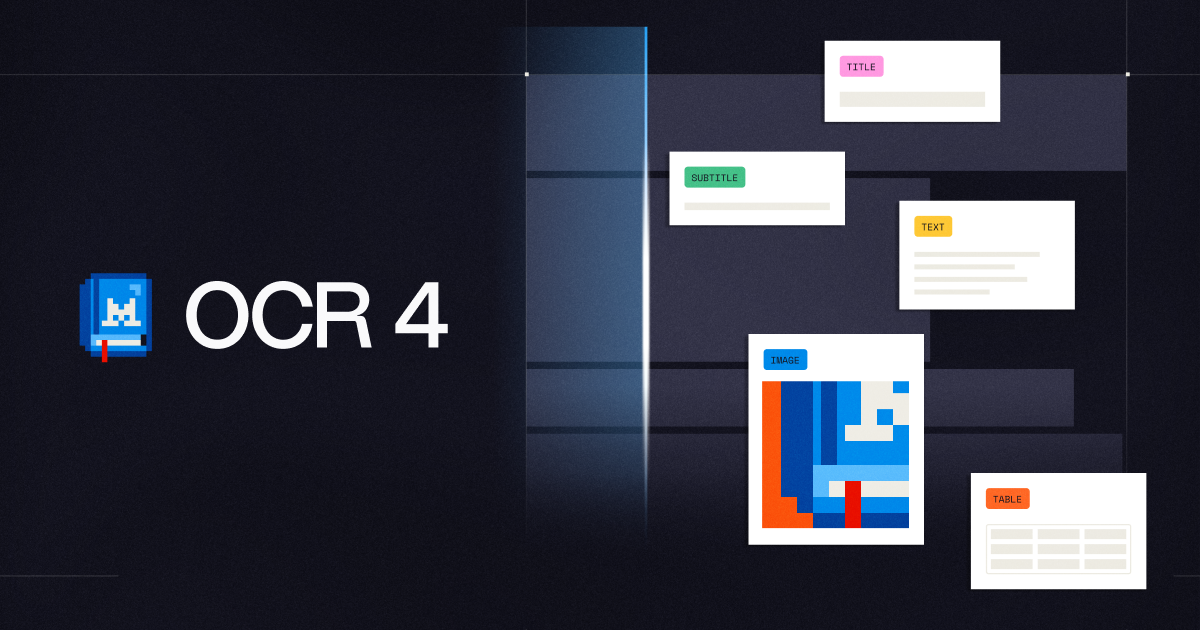
Mistral OCR 4 — 170-language document model with bounding boxes and confidence scores
Mistral's new document model returns structured pages with boxes, block types, and per-word confidence at $4 per 1,000.
What is it?
Mistral OCR 4 turns a scanned page into a structured object — each detected block ships with a bounding box, a type label (title, table, equation, signature), and confidence scores at the page and word level. The same model covers 170 languages in one container.
How does it work?
A single model processes the page in one pass, emitting paragraph-level boxes alongside the classified block tree. Confidence scores are exposed inline so downstream agents can route low-score regions to a human or a second-pass model.
Why does it matter?
Teams building RAG, claim processing, or contract workflows can collapse OCR + layout detection + table parsing into one model at $4 per 1,000 pages. OlmOCRBench 85.20 and OmniDocBench 93.07 put it at the top of public leaderboards.
Who is it for?
Document automation, RAG, and AI-agent teams — available via Mistral Studio API, Amazon SageMaker, Microsoft Foundry, or self-hosted.
|
|
|
|
SECURITY
MAJOR
2026-06-22
OpenAI Daybreak — GPT-5.5-Cyber and Patch the Planet go live
GPT-5.5-Cyber, Codex Security, and Patch the Planet — OpenAI bets the bottleneck has moved from finding flaws to shipping fixes.
What is it?
Daybreak adds three new pieces: GPT-5.5-Cyber moves from preview to a limited full release for verified defenders, the Codex Security plugin gets an upgrade for validating and patching production flaws, and Patch the Planet funds open-source maintainers — cURL, Go, Python — to actually ship those fixes.
How does it work?
Codex Security scans a repo, checks whether a flagged vulnerability is reachable from real entry points, writes a patch, and runs tests before a human reviewer signs off. GPT-5.5-Cyber scores 85.6% on CyberGym vs. 81.8% for standard GPT-5.5, and nearly 40% on ExploitGym (up from ~26%).
Why does it matter?
Five Eyes agencies warned on the same day that frontier AI will reshape offensive cyber in months. OpenAI's argument: make patching as cheap as finding bugs — the long-standing bottleneck for open-source projects everyone depends on. Codex Security has already closed 500K+ findings across 30M+ commits.
Who is it for?
Security teams, OSS maintainers, and platform vendors — partner program includes CrowdStrike, Sophos, Fortinet, Palo Alto, Cisco, and Cloudflare.
|
|

|
|
MODEL
MAJOR
2026-06-23
Qwen-AgentWorld — language world models that simulate seven agent domains
Open-weight world models from Qwen that simulate seven agent environments in a single 262K-context backbone.
What is it?
Qwen-AgentWorld is a pair of mixture-of-experts world models — 35B-A3B and 397B-A17B — that simulate seven distinct agent environments: MCP tool calls, web search, terminal, software engineering, Android UIs, web browsing, and full OS. Both share a 262K context window and are Apache-2.0 licensed.
How does it work?
Training runs in three stages: continued pretraining absorbs state-transition data, supervised fine-tuning activates next-state reasoning, then RL with hybrid rubric-and-rule rewards tunes simulation fidelity. The training set is 10M+ real interaction trajectories from five frontier models across nine benchmarks.
Why does it matter?
Training agents normally means standing up real terminals, browsers, and Android emulators — slow, flaky, and expensive. A world model lets the agent loop run entirely in language. Qwen-AgentWorld is the first open-weight version spanning more than one domain.
Who is it for?
Agent researchers and reinforcement-learning engineers — weights on Hugging Face under Apache-2.0.
|
|
|
|
REPO
MAJOR
2026-06-22
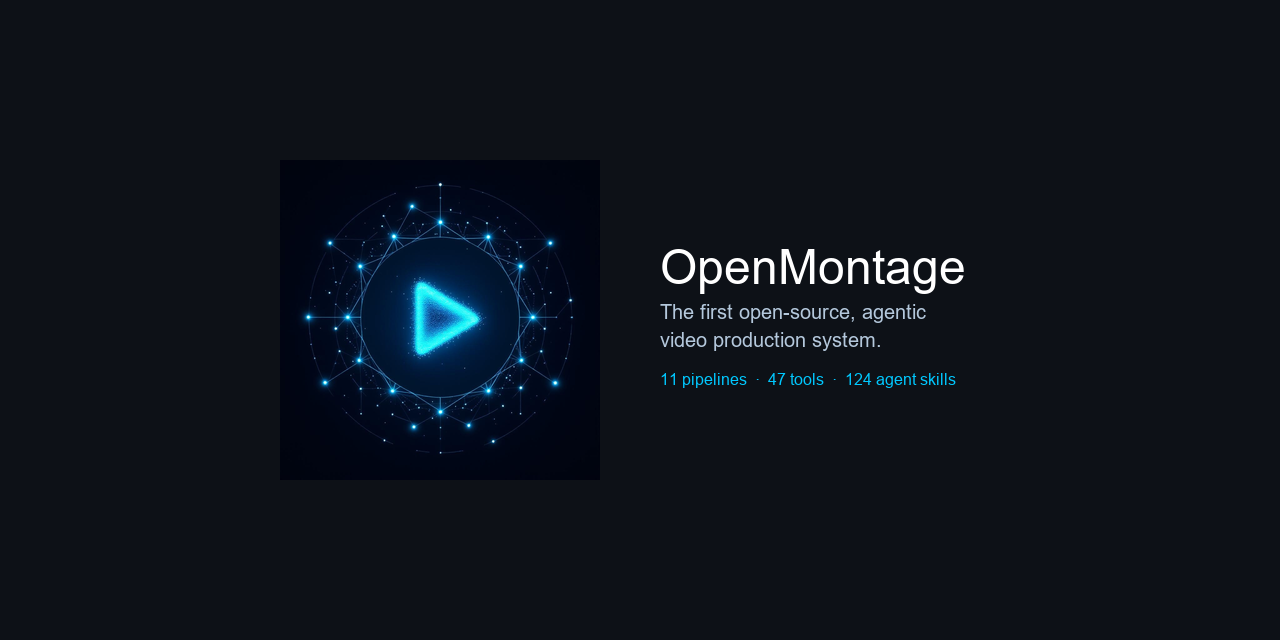
OpenMontage — AGPL agentic video studio for AI coding assistants
An agentic video studio that turns any AI coding assistant into a producer, editor, and renderer.
What is it?
OpenMontage ships 12 production pipelines, 52 tools, and 500+ agent skills as a single AGPL-3.0 framework that AI coding assistants — Claude Code, Codex, Cursor — can call to make videos. The assistant takes a plain-text concept and walks each pipeline without paid APIs.
How does it work?
Each pipeline is a graph of skills the agent invokes through tool calls, with a scoring engine ranking providers per step. Local models like WAN 2.1, Hunyuan, and CogVideo handle generation; Piper does offline text-to-speech; self-review stages check frame integrity and audio levels before final render.
Why does it matter?
OpenMontage breaks the link between agentic video and subscription generators. The same coding assistant developers already pay for can produce a finished, narrated, captioned video on local hardware — the repo hit 16.9K GitHub stars in three days.
Who is it for?
Indie creators, agentic-app builders, and AGPL-friendly studios — git clone https://github.com/calesthio/OpenMontage.
|
|
|
|
ARTICLE
MAJOR
2026-06-22
Nathan Lambert: GLM-5.2 — the step change for open agents
Lambert says GLM-5.2 is the first open-weight model that works as a general coding agent, not just a benchmark winner.
What is it?
Nathan Lambert's June 22 essay on Interconnects argues GLM-5.2 from Z.ai is the first open-weight model that clears the 'general coding agent' bar inside real harnesses. He positions it next to Claude Opus 4.8, and quotes Vercel's CEO as "genuinely impressed, almost shocked" at its coding quality.
How does it work?
Lambert's argument is behavioral, not just benchmark-driven: GLM-5.2 holds up across coding workflows the way closed models do. He times it roughly seven months after Claude Opus 4.5 (November 2025) — matching the predicted closed-to-open capability lag.
Why does it matter?
GLM-5.2 lands while Claude Fable faces fresh U.S. export controls — so the open-weight backstop is now a Chinese model just as Western closed capability gets gated. Lambert frames it as the open ecosystem's DeepSeek R1 moment, but for agents rather than reasoning chains.
Who is it for?
Agent builders, AI policy watchers, and open-weight ML teams deciding whether to keep relying on closed APIs.
|
|

|
|
ARTICLE
NOTABLE
2026-06-23
David Rosenthal: 'AI's Affordability Crisis' — the 70x subsidy that can't hold
David Rosenthal argues AI providers sell tokens at up to 70x below cost — a gap he says can't close without massive job losses.
What is it?
A June 23 blog post gathering SemiAnalysis and Ed Zitron data to argue the AI economy runs on structural token-price subsidies — Anthropic up to 40x below cost, OpenAI up to 70x. Rosenthal walks through what users pay versus what each query actually costs the provider.
How does it work?
The post cites SemiAnalysis enterprise subsidy figures and pairs them with OpenAI's 2025 financials: $13.07B in revenue against $34B in costs and $20.92B in losses — a gap Rosenthal frames as structural, not a short-term land grab.
Why does it matter?
Once true token billing arrives, a $200 ChatGPT plan could run up $14,000 in compute and a $200 Claude plan up to $8,000. Rosenthal calculates AI firms would need to replace roughly 32.5 million US jobs to service their projected $3T debt — a scale he calls implausible.
Who is it for?
AI buyers, infra planners, and anyone building cost models for AI-dependent products.
|
|
|
All releases at ai-tldr.dev
Simple explanations • No jargon • Updated daily
|
|