|
|
SECURITY
MAJOR
2026-07-10
Grok Build CLI ships whole repos and .env secrets to xAI — wire-level teardown
A wire trace of Grok Build CLI shows secrets and full repos leaving your machine even after you opt out.
What is it?
Cereblab's wire-level packet capture of Grok Build CLI 0.2.93 shows the tool posting file contents — including .env files with API keys and passwords — to two channels: a live model endpoint and a session-state archive that routes to a Google Cloud bucket called grok-code-session-traces.
How does it work?
Beyond the files the agent reads, Grok Build CLI packages the entire repository as a git bundle and streams it up in ~75 MB chunks — in one 12 GB test repo, the storage channel uploaded 5.10 GiB across 73 chunks while the model-turn channel moved only 192 KB, a ~27,800× disparity.
Why does it matter?
Toggling "Improve the model" off did not disable the upload — the server kept returning trace_upload_enabled: true — so the standard opt-out path is ineffective, and xAI has not published a Data Processing Agreement covering the bucket.
Who is it for?
Any developer or org using Grok Build CLI on private repos — stop and read this first.
|
|

|
|
TOOL
MAJOR
2026-07-11
Mesh LLM — distributed inference on iroh's peer-to-peer network
Pool GPUs across your machines and serve any of 40+ models through one OpenAI-compatible endpoint at localhost:9337.
What is it?
Mesh LLM is an Apache-2.0 Rust binary that turns whatever mix of GPU and CPU boxes you already own into one shared inference cluster, exposing an OpenAI-compatible API at localhost:9337/v1. The install is about 18 MB and supports 40+ models from 500M to 235B parameters.
How does it work?
Every request routes through local GPU, peer forwarding to another mesh node, or "Skippy" split mode — which partitions a model too big for one box by layer ranges across several machines. iroh handles QUIC transport, NAT traversal, and authenticated peer identity underneath.
Why does it matter?
For teams that already own idle GPUs, Mesh LLM replaces the pay-per-token bill with a p2p pool that speaks the same OpenAI SDK — and Skippy makes a 4-machine setup a viable alternative to a rented H100.
Who is it for?
Self-hosters, small labs, and startups with unused GPU capacity.
|
|

|
|
TOOL
MAJOR
2026-07-11
OpenClaw 2026.7.1-beta.5 — conversational setup and GPT-5.6 support land
OpenClaw's beta.5 turns first-run setup into a live agent conversation and wires GPT-5.6 into the whole stack.
What is it?
OpenClaw 2026.7.1-beta.5 introduces Crestodian — an agent-loop onboarding flow that walks new users through provider setup on the CLI, web installer, and macOS app with masked credential prompts. The same build adds the bundled ClawRouter provider, offline mobile chat, and OpenAI's GPT-5.6 Sol, Terra, and Luna models across the stack.
How does it work?
Crestodian runs a real OpenClaw agent loop to gather keys, pick a default model, and verify the pipeline before writing config. ClawRouter then handles per-request routing with credential-scoped dynamic model discovery, and a new openclaw attach command hands an existing Gateway session to Claude Code with scoped, revocable MCP grants.
Why does it matter?
First-time setup was the biggest wall for OpenClaw's 382k-star audience — beta.5 replaces long config files with a chat that installs itself, and ClawRouter makes it practical to run one OpenClaw install as the hub for Claude Code, Codex, and multiple provider accounts side by side.
Who is it for?
Self-hosters, coding-agent power users, and teams standardizing on one Gateway.
|
|

|
|
TOOL
MAJOR
2026-07-10
Claude Code Desktop — in-app browser lands and /doctor gains a repair mode
Claude Code Week 28 gives the desktop app a real browser and turns /doctor from a report into a fixer.
What is it?
Claude Code v2.1.202–v2.1.206 ships two headline features: a built-in sandboxed browser in the desktop app so Claude can open external sites and interact with them, and a rebuilt /doctor command that can actually fix what it finds.
How does it work?
The in-app browser is a sandboxed webview with a safety classifier that reviews every action before Claude takes it on an external page. The rebuilt /doctor (alias /checkup) checks install health, unused skills, slow hooks, and duplicate CLAUDE.md content — then confirms before applying each fix.
Why does it matter?
The browser removes a common workaround where developers had to paste external docs into the terminal by hand. The auto mode rule blocking transcript-file tampering also closes a known way agentic mode could rewrite its own audit trail.
Who is it for?
Claude Code Desktop users on macOS, Windows, and Linux.
|
|
|
|
TOOL
MAJOR
2026-07-10
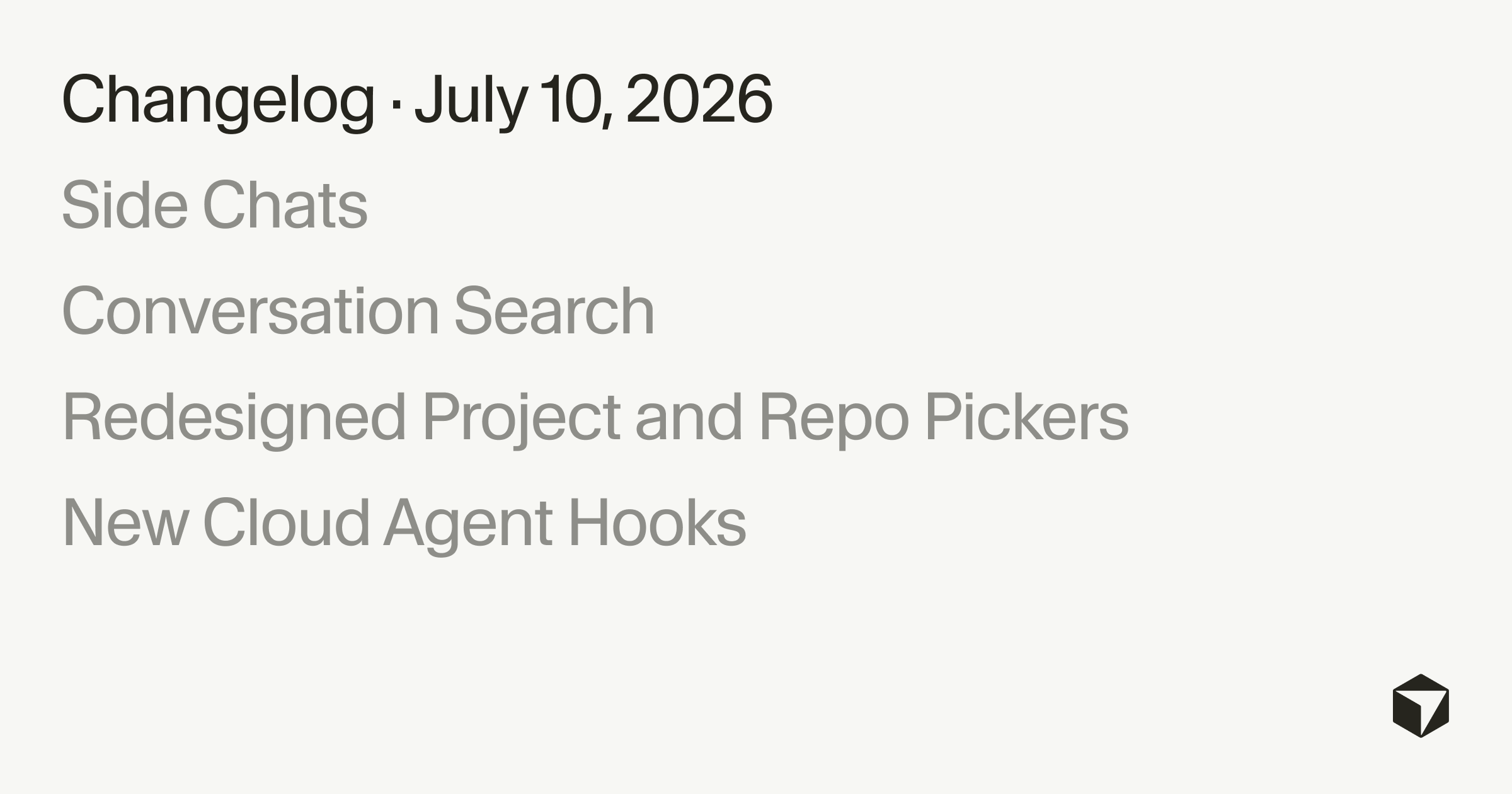
Cursor 3.11 — side chats and conversation search land in the coding editor
Cursor 3.11 spins up parallel Side Chats and makes every past agent transcript searchable.
What is it?
Cursor 3.11 adds Side Chats — full agent conversations that run alongside your main thread via /side, /btw, or a plus button — plus a local index that makes Cmd+K search across thousands of past agent transcripts.
How does it work?
Side chats are durable and @-mentionable, so you can pull their conclusions back into the main thread without copy-pasting. Five new cloud agent hooks — beforeSubmitPrompt, afterAgentResponse, afterAgentThought, stop, subagentStart — let scripts observe and steer long-running agents.
Why does it matter?
The main gripe with agentic IDEs was context loss: a side question derailed the multi-file refactor already in flight. Side Chats split tangents into their own durable thread, and weeks of prior work are now instantly searchable.
Who is it for?
Coding-agent power users and teams running long-horizon agentic tasks in Cursor.
|
|

|
|
TOOL
MAJOR
2026-07-09
LiteRT.js — Google brings its on-device AI runtime to the browser
LiteRT.js runs Google's on-device inference stack inside the browser, so web apps can execute .tflite models with WebGPU and WebNN acceleration.
What is it?
LiteRT.js is a new JavaScript library from Google (npm: @litertjs/core) that runs .tflite machine-learning models inside a web page with no server call, and works with PyTorch, JAX, and TensorFlow after conversion.
How does it work?
The library compiles Google's native LiteRT C++ runtime to WebAssembly and swaps in three backends: XNNPACK for CPU, ML Drift over WebGPU for GPU, and the experimental WebNN API for NPUs. A companion @litertjs/tfjs-interop package lets existing TensorFlow.js apps adopt it incrementally.
Why does it matter?
Google's M4 MacBook Pro benchmarks show up to 3x speedups over prior web runtimes on CPU and 5–60x moving from CPU to GPU or NPU — making on-device voice, translation, and image editing viable in a normal web app without a server bill.
Who is it for?
Web and browser developers who want on-device AI inference without a backend (Apache-2.0, free to use commercially).
|
|

|
|
ARTICLE
NOTABLE
2026-07-11
AI 2040 and the Cult of Intelligence — Hotz argues fast takeoff ignores physics
George Hotz answers the AI 2040 Plan A scenario — arguing that physics, not policy, is what bounds how fast AI can transform the world.
What is it?
A July 11 blog post by George Hotz (tinygrad, ex-Comma.ai) responding to Daniel Kokotajlo's AI 2040 Plan A, calling the hard-takeoff picture a "cult of intelligence" — the belief that a smart-enough model can rewrite physical reality.
How does it work?
The essay uses concrete constraints to bound AI's speed of impact: chip fabs run on 3-month physical cycles, ocean data centers still ship components on 3-week boat rides, and "no matter how high quality your tokens are, they cannot turn lead into gold."
Why does it matter?
Hotz is one of the few well-known engineers publicly rejecting the hard-takeoff frame from the inside — the post hit the HN front page at 163 points and 187 comments within hours, giving safety and open-source-AI advocates a shared reference.
Who is it for?
AI safety researchers, open-source-AI advocates, and anyone weighing centralized vs. local model deployment.
|
|
|
All releases at ai-tldr.dev
Simple explanations • No jargon • Updated daily
|
|