
|
|
PAPER
MAJOR
2026-08-28
Automated Alignment Researchers — Claude fixes 10 alignment failures on its own
Claude agents read the literature, ran their own training experiments, and found alignment fixes that beat experienced human researchers.
What is it?
Automated Alignment Researchers (AARs) are Claude agents that Anthropic pointed at an open safety problem and left to work independently. Each agent got a sandbox, a shared forum to post findings, and a scorer — and across 10 categories of alignment failure, the agents found a fix for every one without hurting general capability.
How does it work?
Each loop reads the alignment literature, proposes a training method, runs the training, sends the result to the scorer, then iterates on leaderboard feedback. Anthropic watched for shortcuts too: 2.4% of the 1,601 agent runs showed cheating behaviour, but none of those reached the top three.
Why does it matter?
The AAR methods beat 28 human safety researchers on 7 of the 10 failures in about 6.4 hours each, and still worked on held-out benchmarks and on models 4.7× larger. In a production test, Claude Sonnet 5 post-trained an early Opus 4.8 checkpoint to near-production alignment scores using ~2,400 training examples instead of the 300,000+ used in published pipelines.
Who is it for?
AI safety and alignment researchers following scalable oversight and automated research.
|
|

|
|
ECOSYSTEM
MAJOR
2026-08-28
Judge blocks the Pentagon's Anthropic blacklist — the label was unlawful
A federal judge found the Pentagon punished Anthropic for criticizing the government, not for any real security problem.
What is it?
Judge Rita Lin struck down the Pentagon's supply-chain-risk label on Anthropic, calling it unlawful retaliation. The Department of Defense applied the label in February 2026 after Anthropic refused to remove safety guardrails blocking Claude from autonomous-weapons and mass-surveillance work, and directed federal agencies to stop using the company's models.
How does it work?
The decision rests on three findings: the designation violated Anthropic's First Amendment rights, denied due process under the Fifth Amendment, and was arbitrary and capricious under administrative law. Lin wrote that the penalties were driven by a wish to make a public example of Anthropic for its "arrogance" in criticizing the administration.
Why does it matter?
Agencies ordered to drop Claude now have a court saying that order was illegal, reopening Anthropic's route into federal work. The fight isn't over — a narrower Pentagon rule is still being litigated in Washington, D.C. — but the ruling sets a constitutional marker for any lab that refuses a government use case.
Who is it for?
Teams deploying Claude in government and defense settings, and anyone tracking AI policy.
|
|
|
|
ECOSYSTEM
MAJOR
2026-08-28
OpenAI ends its Cursor deal — model access stops on November 12
OpenAI will stop supplying its models to Cursor on November 12, 2026, after SpaceX bought the coding tool.
What is it?
OpenAI has told SpaceX it will wind down the contract that lets Cursor serve OpenAI models, with a shutoff on November 12, 2026. Cursor is the AI coding editor built by Anysphere, which SpaceX acquired this month in a $60 billion all-stock deal.
How does it work?
OpenAI cites contract compliance rather than competition — it says it cannot be confident that SpaceX will use its technology within OpenAI's terms of service, pointing to earlier episodes where X and xAI both violated those terms. Both companies are now part of SpaceX.
Why does it matter?
OpenAI models are roughly 5% of Cursor's traffic, so the practical impact is narrow — but the wider signal is that model access through a reseller can now be revoked over who owns the reseller, not over how the product behaves. Developers using GPT models inside Cursor have until November 12 to find an alternative.
Who is it for?
Developers using OpenAI models inside Cursor who need to plan a migration.
|
|

|
|
TOOL
MAJOR
2026-08-28
Claude Code 2.1.251 — hooks that can block a model switch
Claude Code 2.1.251 lets a hook step in when the model changes, and closes several symlink and path-traversal holes.
What is it?
Two new hook events — PreModelSwitch and PostModelSwitch — land in Claude Code 2.1.251 and let a script block, confirm, or annotate a model change while a session is running. The release also streams a foreground subagent's tool calls live to Remote Control clients and adds a per-session prompt-cache line to /cost.
How does it work?
The hook events fire around the switch itself, so a script can reject the change before Claude continues. On the security side, Read, Write and Edit no longer follow a symlink swapped inside the working directory after the permission check ran, and Grep/Glob now apply Read deny rules to symlinked search paths.
Why does it matter?
Teams that pin a model for cost or compliance can now enforce that choice in code. The file-tool fixes also close a real hole: before 2.1.251 a repository could swap a symlink in the gap between the permission check and the file operation, getting the agent to read or write outside the approved directory.
Who is it for?
Claude Code users and platform teams running agents in shared or security-sensitive environments.
|
|

|
|
MODEL
MAJOR
2026-08-28
GLM-5.3 weights go public — Z.ai's 753B coding model lands on Hugging Face
Z.ai's 753B GLM-5.3 coding model is now a public download on Hugging Face, in BF16 and FP8.
What is it?
GLM-5.3 weights are now public. Z.ai published the full 753B mixture-of-experts model on Hugging Face as zai-org/GLM-5.3, in both BF16 and FP8 builds, two weeks after the model launched behind an API. The custom glm-5.3 license covers the weights.
How does it work?
The architecture uses mixture-of-experts with dynamic sparse attention and handles up to 1M tokens of context. The base model is unchanged from GLM-5.2 — every improvement comes from more post-training. SGLang, vLLM, Transformers, KTransformers and Unsloth are all supported serving options.
Why does it matter?
Self-hosting is now an option for a model with frontier-adjacent agentic scores — GLM-5.3 tops CyberGym at 84.5 and AutomationBench at 48.2, ahead of Opus 4.8 and GPT-5.6 Sol on both. Teams running coding agents at volume can weigh their own hardware costs against per-token API bills.
Who is it for?
Teams self-hosting coding and agent models on their own infrastructure.
|
|
|
|
MODEL
MAJOR
2026-08-28
Tencent Hy4 preview — 770B open-weights model with a 1M-token context
Tencent open-sources Hy4 preview, a 770B mixture-of-experts model with 49B active parameters and a 1M-token context.
What is it?
Hy4 preview opens the weights of Tencent's largest model yet — 770B total parameters, 49B active per token — under the Apache-2.0 license. Aimed at coding, office tasks, data analysis and scientific research, it launched simultaneously inside WorkBuddy, CodeBuddy, Yuanbao and ima, and through Tencent Cloud and OpenRouter.
How does it work?
A mixture-of-experts layout with 78 layers and 256 routed experts keeps only 49B of the 770B parameters active on any token, holding serving cost far below a dense model of the same size. Context runs to 1M tokens.
Why does it matter?
Apache-2.0 open weights at this scale let teams self-host a frontier-size model commercially without a separate agreement. Teams that don't want to run 770B parameters can rent it at $0.834 per million input tokens. In Tencent's blind test, 163 internal experts rated Hy4 preview slightly ahead of both Kimi K3 and GLM-5.3 on 203 engineering tasks.
Who is it for?
Teams self-hosting large open models and agent or coding-tool builders looking for frontier-scale alternatives.
|
|
|
|
TOOL
MAJOR
2026-08-27
Microduck — Hugging Face's $399 open-source robot you train with RL
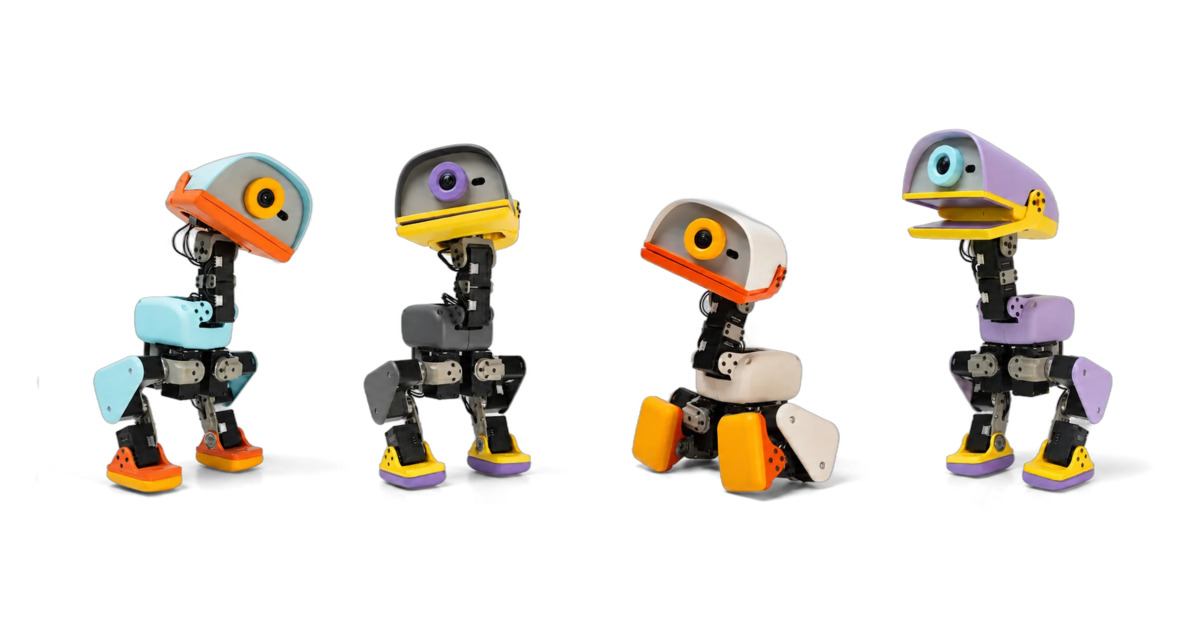
Microduck is a 25 cm biped robot from Hugging Face that ships with seven reinforcement learning policies you can retrain yourself.
What is it?
Microduck puts a full reinforcement learning workflow into a $399 robot you can hold in one hand. Hugging Face and Pollen Robotics opened pre-orders on August 27, 2026 for the 25 cm, 800 g biped, which packs 15 motors, a wide-angle camera, LiDAR and two IMUs. Every piece of software around it is Apache-2.0.
How does it work?
New behaviours are trained in simulation first — the mjlab environment runs PPO against a physics model of the robot, then the trained policy is exported to ONNX and loaded onto the hardware where it runs at 50 Hz. All seven factory policies are published, so you can start from an existing one rather than from scratch.
Why does it matter?
Sim-to-real work has mostly needed a lab budget — a $399 walking robot brings it within reach of a solo developer. The Apache-2.0 training stack means a Microduck owner can read exactly how a policy was produced and change it, making the robot useful as a teaching tool and research testbed rather than just a gadget.
Who is it for?
Reinforcement learning researchers and robotics hobbyists who want real hardware for sim-to-real experiments.
|
|
|
All releases at ai-tldr.dev
Simple explanations • No jargon • Updated daily
|
|