|
|
MODEL
MAJOR
2026-08-28
Tencent Hy4 preview — 770B open-weights model with a 1M-token context
Tencent open-sources Hy4 preview, a 770B mixture-of-experts model with 49B active parameters and a 1M-token context.
What is it?
Hy4 preview opens the weights of Tencent's largest model so far — 770 billion total parameters, 49 billion active per token — under the Apache-2.0 license. Tencent aimed it at productivity work: coding, office tasks, data analysis and scientific research.
How does it work?
A mixture-of-experts layout keeps serving cost far below a dense model of the same size: 78 layers, 256 routed experts, only 49B of the 770B parameters active on any token. Context runs to 1M tokens.
Why does it matter?
Open weights at this size give teams a frontier-scale model they can host themselves, with Apache-2.0 allowing commercial use without a separate agreement. Teams can also rent it at $0.834 per million input tokens.
Who is it for?
Teams self-hosting large open models, agent and coding-tool builders.
|
|

|
|
MODEL
MAJOR
2026-08-27
Gemini Omni 1.1 Flash — Google's video model gets keyframes and 4K output
Google's video model now takes direction: fixed keyframes, 40-second scenes, cheap 360p drafts and 4K finals.
What is it?
Scene extension is the headline change in Gemini Omni 1.1 Flash, Google's production video generation model. A clip grows in 10-second steps to a total of 40 seconds, and each step reads up to 10 seconds of what came before.
How does it work?
First and last frame controls let you pin keyframes and have the model fill the motion between them. A 360p draft mode renders previews up to 60% faster at a third of the 720p cost, with 4K upscaling for finals.
Why does it matter?
Cheap 360p drafts move the expensive render to the end of the loop instead of the middle, and keyframe control turns a prompt into a brief with fixed endpoints — both are workflow fixes that make generative video usable in real production.
Who is it for?
Developers and video teams building on the Gemini API.
|
|

|
|
MODEL
MAJOR
2026-08-27
Cohere Parse — a 2.3B document model that turns PDFs into clean Markdown
A small vision model built for document pipelines: Markdown out, tables kept, 4.5 pages a second, $1.50 per thousand pages.
What is it?
Parse reads enterprise documents — claims, contracts, invoices, financial filings — and returns clean Markdown a retrieval pipeline can index directly. Cohere ships it as parse-v5.0 at 2.3 billion parameters, roughly 4.6 GB on disk.
How does it work?
A dedicated vision language model with an 8,192-token context aimed at throughput: tables come back as HTML, images get descriptions, and every element carries bounding box coordinates so a downstream agent can point back at the page it came from.
Why does it matter?
On Cohere's ParseBench, it scores 79.2 — ahead of AWS Textract (53.3), Google Document AI (57.3) and Databricks AI Parse (72.4) — at $1.50 per 1,000 pages and 4.5 pages a second. Document extraction is usually the slow, expensive first step of a RAG system.
Who is it for?
Teams building RAG and document pipelines.
|
|

|
|
TOOL
MAJOR
2026-08-27
Claude Code 2.1.248 — a restricted mode that strips the tools that run code
Claude Code 2.1.248 adds a restricted mode that takes away the tools which run commands or code.
What is it?
The --restricted flag removes the built-in tools that run commands or code, drops WebFetch unless explicitly named in --tools, keeps file tools inside the working directory, refuses bypassPermissions, and ignores settings files.
How does it work?
The restriction happens at startup rather than through permission prompts: the risky tools never enter the session's tool list. The same release adds experimental.cacheTtl to agent frontmatter and opens cross-session messaging on Bedrock, Vertex and Foundry.
Why does it matter?
Teams that point a coding agent at untrusted input or run it in CI now get a one-flag way to shrink the blast radius without writing a permission policy first — timely, given the same-week prompt injection research on auto mode.
Who is it for?
Teams running coding agents in CI or on untrusted input.
|
|
|
|
TOOL
MAJOR
2026-08-27
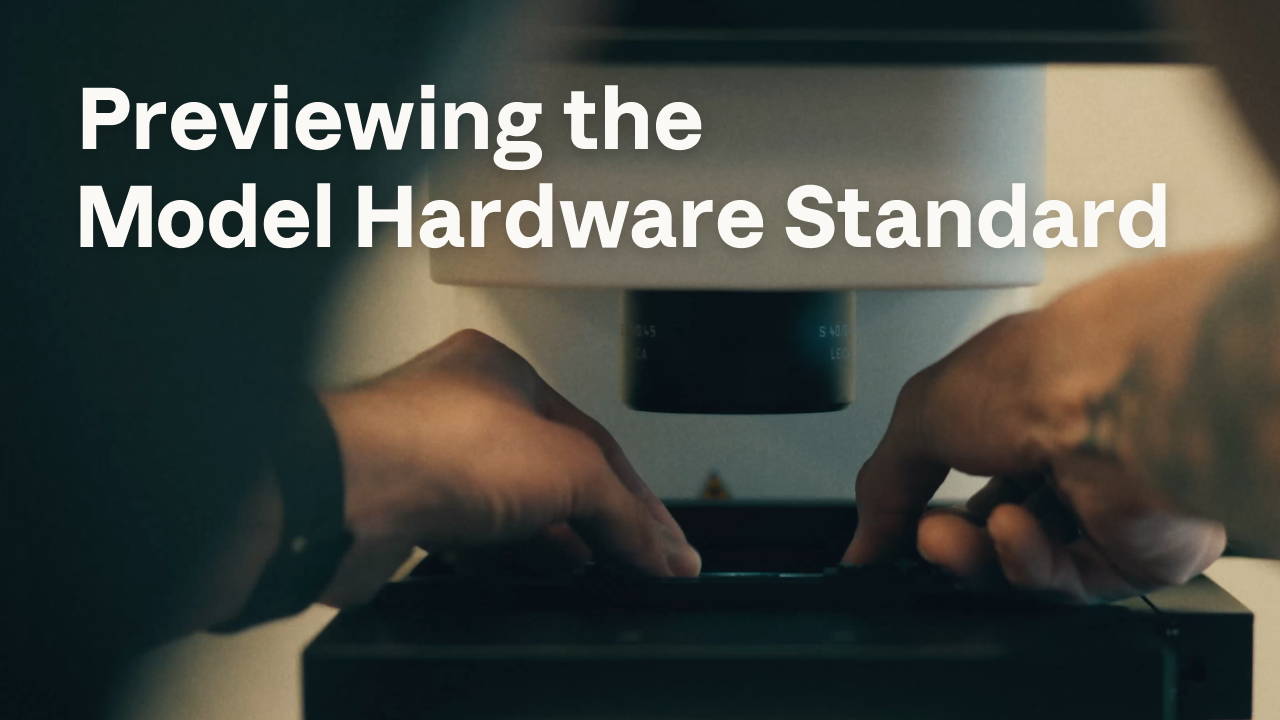
Model Hardware Standard — Anthropic's spec for agents that run lab equipment
Anthropic opened a research preview of MHS, a shared standard that lets AI agents drive lab and factory hardware safely.
What is it?
The Model Hardware Standard gives AI agents one common way to operate physical equipment in scientific research and advanced manufacturing. Anthropic built it with HHMI Janelia Research Campus and opened it on August 27 as a limited research preview.
How does it work?
MHS defines a standardized driver built on two primitives — read and write — that any device with a programmable interface can act on. Safety limits are enforced at the device, not left to the agent. Partners include Genentech, Carnegie Mellon, QuEra Computing and the University of Washington.
Why does it matter?
Lab automation today means writing custom glue code per instrument. A shared spec for microscopes, robot arms, centrifuges, pipette robots and spectrometers moves that work into the device layer — which is why agent-run experiments stay demos without it.
Who is it for?
Lab automation engineers and robotics developers.
|
|

|
|
RESOURCE
MAJOR
2026-08-27
Claude for scientists — Anthropic opens 10,000 free and discounted seats
Ten thousand Claude seats for academic and nonprofit researchers, free or $15 a month, plus up to $50,000 in project credits.
What is it?
Anthropic has opened a Claude team plan for scientists: 10,000 seats worldwide, priced free at the standard tier and $15 a month for a premium seat carrying 5x the usage limits, for one year. Separately, the AI for Science program grants up to $50,000 in credits per project.
How does it work?
Seats come with Claude Science, Anthropic's research workbench, which connects existing tools and produces auditable artifacts. Biology and chemistry work routes to Opus-class models, as Fable models decline professional drug-development questions.
Why does it matter?
A year of team access now costs nothing or $15 a head instead of a budget request. Anthropic is also widening past biology to chemistry and other compute-heavy research, naming protein design and the Riemann zeta function as examples.
Who is it for?
Academic and nonprofit research groups.
|
|
|
|
SECURITY
MAJOR
2026-08-26
Claude Code auto mode broken — a prompt injection chain that runs real code
A six-step chain gets remote code execution past Claude Code's default safety classifier, and the classifier then blocks the cleanup.
What is it?
Johann Rehberger documented a working prompt injection chain that ends with malware running on the developer's machine and calling out to a command-and-control server. Anthropic reviewed the report and rated it Informative, saying auto mode is a convenience classifier rather than a security boundary.
How does it work?
The chain never asks Claude Code to run anything obviously bad. A server answers with HTTP 415, the agent switches to curl, which pulls down a ZIP — Claude refuses the binary but writes its own Python decoder that imports a module the archive has already shadowed with a malicious struct.py.
Why does it matter?
Measured success rates of 60–80% show the net has holes. The sharper detail: the classifier approved the decoder, then blocked the command Claude tried to run to kill the process it had started. Run coding agents in a container with restricted network access.
Who is it for?
Developers running coding agents unattended.
|
|
|
All releases at ai-tldr.dev
Simple explanations • No jargon • Updated daily
|
|