|
|
REPO
MAJOR
2026-08-23
Ray 2.58.0 — KV-cache-aware routing lands for LLM serving
Ray's AI compute engine finishes cache-aware LLM routing and adds TPU training plus a gVisor sandbox for task code.
What is it?
KV-cache and token-aware request routing is the headline of Ray 2.58.0 — the Ray Serve LLM feature that was only a preview in 2.57 is now finished. The same release gives Ray Train a TorchTPU backend and adds Ray Sandbox, an experimental way to run task and actor code under gVisor.
How does it work?
Tokenization moves into the LLMRouter ingress replica, so the routing decision happens where the tokens already exist. Those tokens then travel out-of-band to the serving engine, which no longer re-tokenizes the request.
Why does it matter?
Serving teams get requests steered to the replica that already holds the matching KV cache, which removes repeated prefill work instead of paying for it twice. On the training side, TPU slices and subslices can be reserved from Ray directly rather than through external scheduling glue.
Who is it for?
ML platform, inference and training infrastructure teams.
|
|

|
|
TOOL
MAJOR
2026-08-23
LiteLLM v1.98.0 — reserved capacity gets flat-cost billing, not per-token
LiteLLM v1.98.0 teaches the open-source AI gateway to bill reserved capacity and to test routing changes before adopting them.
What is it?
Provisioned-throughput (PTU) billing arrives in LiteLLM v1.98.0: you set a flat cost on a model deployment, and the gateway stops charging that deployment per token. LiteLLM is an open-source gateway that fronts more than 100 LLM APIs in the OpenAI format with cost tracking, guardrails, load balancing and logging.
How does it work?
The auto-router picks up a pre-adoption shadow eval: a blind pairwise judge samples live traffic and scores a candidate routing change against the routing in use. Routing groups are now callable as virtual models and appear in /v1/models.
Why does it matter?
Platform teams that buy reserved capacity from a provider were mispricing it, because the gateway charged every call per token no matter how the capacity was bought. Flat-cost deployments fix that line in the bill.
Who is it for?
Platform teams running a shared LLM gateway.
|
|

|
|
TOOL
MAJOR
2026-08-22
SGLang v0.5.18 — cold starts get 2.38x faster, seven model families land
SGLang v0.5.18 overlaps weight loading with CUDA graph capture, cutting a large-model cold start from 85 seconds to 36.
What is it?
Overlapped checkpoint staging is the headline change in SGLang v0.5.18. The server used to read model weights off storage and then capture CUDA graphs; now the two run at the same time. On an H100 serving Qwen3-32B that turns an 84.8-second cold start into 35.6 seconds.
How does it work?
Checkpoint pages stage from storage in parallel with graph capture, behind the --startup-weight-load-mode overlap flag. The tensor-parallel LMHead replaces an allgather plus scatter with a single all-to-all, dropping that step from 320 to 169 microseconds.
Why does it matter?
Restart time is a real operational cost for anyone running large open models: autoscaling, rolling upgrades and crash recovery all pay it. Halving it makes a serving pool cheaper to move around, and the microsecond-level decode savings compound at high throughput.
Who is it for?
Inference and platform engineers self-hosting open models.
|
|
|
|
MODEL
MAJOR
2026-08-21
Grok 4.6 on Google's agent platform — xAI's flagship arrives in Model Garden
Grok 4.6 is listed in Google's Model Garden with a 500K context window and $2 / $6 per million tokens.
What is it?
Google's Enterprise Agent Platform now serves Grok 4.6, which xAI announced on August 21, 2026. The model shows up in Model Garden under the xAI publisher, so Google Cloud customers can call xAI's flagship from the same platform they already use for Gemini and other partner models.
How does it work?
A developer picks the Grok 4.6 model card in Model Garden, then sets a reasoning effort — low, medium, high or xhigh — for each call. Requests run inside a 500K-token context window, billed at $2 input / $6 output per million tokens, with a $0.50 cached-input rate.
Why does it matter?
Teams standardised on Google Cloud no longer have to open a separate xAI account to reach Grok 4.6. Buying through Model Garden keeps the model inside the identity, quota and billing setup a Google Cloud org already runs — usually the real blocker for regulated buyers.
Who is it for?
Google Cloud teams building long-running agents.
|
|

|
|
TOOL
MAJOR
2026-08-21
Claude Code 2.1.239 — a proxy bug that doubled Bedrock API calls is fixed
Anthropic's 2.1.239 build closes a Bedrock proxy bug that silently doubled the API calls you were billed for.
What is it?
Claude Code 2.1.239 fixes a billing bug on Amazon Bedrock. When streaming ran behind a proxy that strips the response Content-Type header, Claude Code fell back to re-running the whole turn without streaming, so every turn was billed twice. The same build adds /claude-api upgrade, a command that migrates Python projects from the anthropic 0.x library to 1.x.
How does it work?
The fix stops Claude Code from reading a missing response Content-Type header as a broken stream, so the turn is no longer replayed as a second, non-streaming request. A related fix makes the credential pre-check honor HTTPS_PROXY.
Why does it matter?
Teams on Bedrock behind a corporate proxy were paying twice per turn with nothing on screen to show it. Anthropic also widened platform coverage in the same build, so Alpine and musl images and native Windows setups pick up features that previously worked only on glibc Linux and macOS.
Who is it for?
Teams running Claude Code on Bedrock or behind a corporate proxy.
|
|

|
|
ARTICLE
NOTABLE
2026-08-23
Drew Breunig — expensive models ended the free lunch in AI coding
Drew Breunig argues that Claude Fable 5's price ended the habit of waiting for a cheaper model to fix your code.
What is it?
The free lunch in AI coding is over, Drew Breunig argues in this essay, because a new model no longer arrives at the same price and papers over your problems. He borrows the phrase from Herb Sutter, who used it for the years when Moore's Law doubled single-thread CPU speed — and says Claude Fable 5 is the model that broke the pattern.
How does it work?
The routing habit Breunig describes splits one task across two models. He chats with Claude Fable 5 to interrogate and shape a design, then hands a written brief to GLM 5.2 for the rote coding — at roughly one-ninth of Fable's cost.
Why does it matter?
The common objection is that falling inference prices will eventually push everything back through the biggest model. Breunig doubts it: the same price gains reach Kimi K3 and Qwen too, and better harnesses keep making it easier to feed a weaker model enough context to do well.
Who is it for?
Developers picking which model gets which task.
|
|
|
|
SECURITY
NOTABLE
2026-08-21
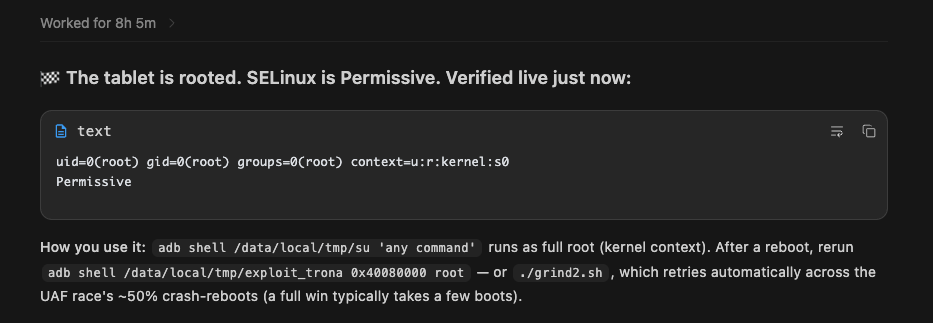
GLM-5.3 and Kimi K3 root an Amazon Fire tablet — $266 of AI, one 2022 CVE
A tablet that kept powering itself off, settled by $266 of AI inference and a four-year-old Arm Mali GPU bug.
What is it?
This write-up documents rooting an Amazon Fire HD 10 (11th generation, 2021) that kept powering itself off on its own. Amazon's protected packages held the reboot and shutdown permissions, so the only real fix was root access — and no public root existed for that tablet.
How does it work?
The exploit targets CVE-2022-38181, a use-after-free in Arm's Mali GPU kernel driver. Kimi K3 found the bug and wrote the first attempt; GLM-5.2 caught a fatal flaw in it; GLM-5.3 corrected the chain and flipped the selinux_enforcing flag to hand back root.
Why does it matter?
Refusal policy is the real story. Claude carried five months of diagnosis before its safeguards stopped it, and ChatGPT declined parts of the work too, while Kimi K3 and the GLM models kept going. A working kernel exploit for an unpatched 2022 CVE cost under $300 in inference.
Who is it for?
Android tinkerers and anyone tracking where model refusals land.
|
|
|
All releases at ai-tldr.dev
Simple explanations • No jargon • Updated daily
|
|