.jpg)
|
|
SECURITY
MAJOR
2026-08-21
Claude Mythos 5 comes to Claude Security — Anthropic's cyber model for defenders
Anthropic's most capable security model now scans Enterprise codebases, backed by a $35 million fund for open-source defenders.
What is it?
Claude Security scans now run on Claude Mythos 5, open to every Claude Enterprise customer in public beta. Mythos is Anthropic's model family kept behind vetted access because it excels at finding and chaining exploits — here, it works on your own repo.
How does it work?
A scan points Claude Mythos 5 at a repository you select and returns each vulnerability with a CWE category, severity, confidence rating, and a proposed patch. Partner products reach the model through a purpose-built interface that returns specific artifacts — a patch or a security alert — rather than open chat.
Why does it matter?
Security teams get Mythos-level code reasoning while Anthropic keeps the raw model away from potential misuse. Alongside the beta, the $35M Defender Advantage Fund pays for patching widely used open-source projects and automating the scan-and-patch loop.
Who is it for?
Security teams and open-source maintainers on Claude Enterprise plans who want automated vulnerability scanning with suggested fixes.
|
|

|
|
BENCHMARK
MAJOR
2026-08-21
NVIDIA AVO — an agent system scores 100% on ARC-AGI-3's public set
NVIDIA's AVO agent cleared every public ARC-AGI-3 environment, a benchmark where the best single model sat near 30%.
What is it?
NVIDIA AVO (Agentic Variation Operators) cleared all 25 environments of the ARC-AGI-3 public set with a 100.00 RHAE score, using Claude Opus 5 as the underlying model. ARC-AGI-3 drops an agent into an unfamiliar turn-based world with no instructions — it must work out the goal and rules by playing.
How does it work?
The design replaces fixed evolutionary search with a coding agent that decides what to try next, with persistent memory carrying earlier results forward. A separate supervisor watches for stalling and redirects the agent to a new strategy when it gets stuck.
Why does it matter?
Long-horizon autonomy is the weak spot in today's agents, and this result shows the harness around a model matters as much as the model itself. NVIDIA also ran AVO for seven days on GPU kernel optimization, producing kernels that outperform cuDNN by up to 3.5%.
Who is it for?
Agent researchers and systems engineers studying long-horizon autonomous agent design — though code and weights are research-only for now.
|
|

|
|
ECOSYSTEM
MAJOR
2026-08-21
GPT-5.6 Sol price cut — OpenAI drops API rates over 20% for three months
OpenAI's frontier GPT-5.6 Sol now costs over 20% less to call, for the next three months.
What is it?
OpenAI cut GPT-5.6 Sol API pricing by over 20% on August 21. Input falls from $5 to $4 per million tokens, cached input from $0.50 to $0.40, and output from $30 to $20. The promotional rates run through November 21, 2026.
How does it work?
The new rates cover standard API calls and flow into Codex credits and ChatGPT Work for eligible plans. Prompt caching keeps its usual 10x advantage on top of the lower base rate. Subscription pricing (Pro, Plus, Business) is untouched.
Why does it matter?
Output tokens take the deepest cut — a third off — which is exactly where agent workloads spend most of their budget. Teams running long agent loops, large code reviews, or high-volume batch jobs see the biggest savings.
Who is it for?
Teams running high-volume agent and coding workloads through the OpenAI API, Codex credits, or ChatGPT Work.
|
|
|
|
MODEL
MAJOR
2026-08-21
DeepSeek V4-Flash-Vision-Exp — an experimental V4 model that reads images
An experimental DeepSeek model that adds image understanding to the V4-Flash line, at V4-Flash prices.
What is it?
DeepSeek V4-Flash-Vision-Exp adds image input to the V4-Flash line. The model accepts mixed text-and-image prompts through the Chat Completions, Messages, and Responses APIs, with a 1M-token context window and model ID deepseek-v4-flash-vision-exp.
How does it work?
Images are tokenized (up to 384 tokens each) and can be passed as base64, external URL, or via the DeepSeek Files API. On pure-text work the model matches official V4-Flash, so vision is added without a text-quality trade-off.
Why does it matter?
DeepSeek says the jump on agent benchmarks requiring visual understanding is significant, bringing multimodal agent skills close to Opus-4.8 at flash-tier prices ($0.22/M input, $0.66/M output off-peak).
Who is it for?
Developers building vision-capable AI agents — screen readers, chart parsers, document agents — who want a cheaper alternative to frontier multimodal models.
|
|

|
|
TOOL
MAJOR
2026-08-20
Codex CLI 0.149.0 — a dashboard for every running agent task
Codex CLI 0.149.0 puts every agent task behind one searchable dashboard you can drive with shortcuts.
What is it?
An interactive codex agents dashboard is the headline change — it searches, starts, opens, renames and stops tasks from one screen. A second new command, codex queue, sends a message into a session already running, local or remote.
How does it work?
Working-directory control moves inside the terminal UI: /cd, /pwd and /cwd set and report the session root without a restart. Vim editing gains character replacement and change motions (cw, c$, cc).
Why does it matter?
Running several coding agents at once used to mean guessing which terminal held which task. The dashboard and queue command give a fleet of agents a single front door. A key safety fix: resumed and forked threads now restore the permission profile they launched with, instead of silently falling back to current defaults.
Who is it for?
Developers running several Codex tasks in parallel who need visibility and control across all sessions from one place.
|
|
|
|
MODEL
NOTABLE
2026-08-20
4DAnyone — turn one handheld video of a person into a 4D model
4DAnyone reconstructs a moving person in 4D from one casual monocular video, with code and checkpoints released.
What is it?
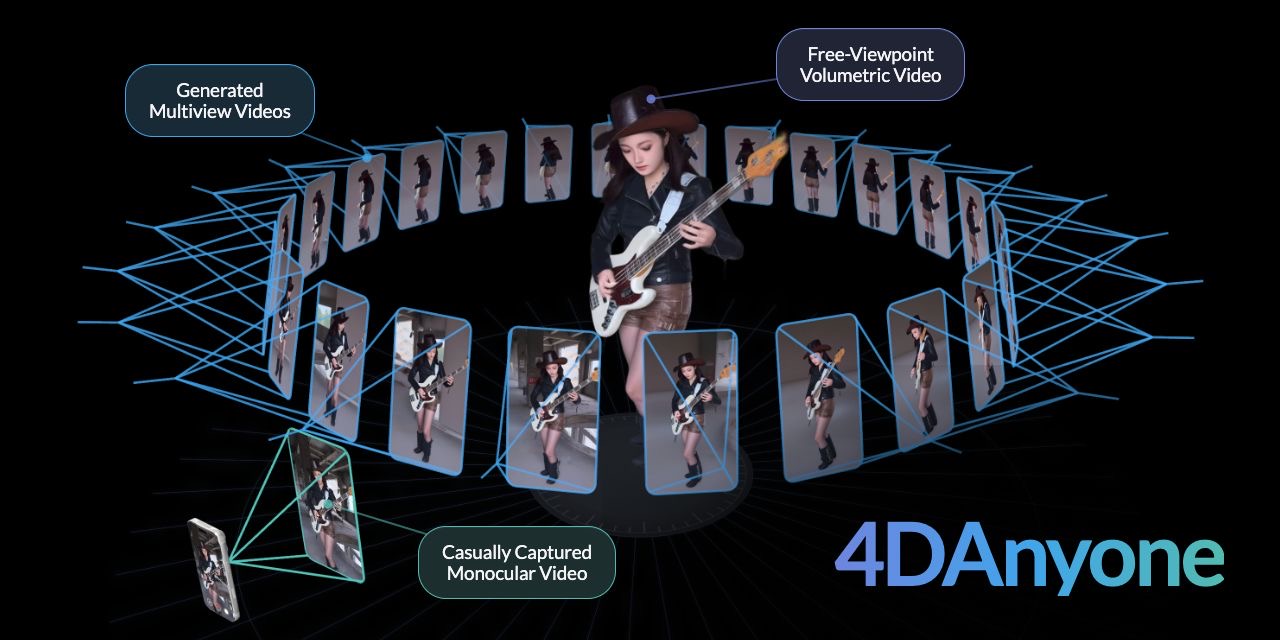
4DAnyone takes a single-camera video of a person and rebuilds them as a 4D Gaussian Splatting scene — viewable from any angle over time. From Ant Research with Zhejiang University and HKUST, accepted to SIGGRAPH Asia 2026, with code and checkpoints already public.
How does it work?
The pipeline first generates multiview-consistent video, then lifts those views into 4D Gaussian Splatting. Reference Context Packing compresses reference views into a fixed-length context, while Target Context Routing rotates which views are denoised together so information crosses groups.
Why does it matter?
Capturing a person in 4D normally needs a camera rig or studio. Working from a phone-style clip puts free-viewpoint replay, avatar creation and 3D video editing within reach of anyone with no specialized hardware.
Who is it for?
Graphics and computer vision researchers who want to reproduce or build on state-of-the-art 4D human reconstruction from monocular video.
|
|

|
|
TOOL
NOTABLE
2026-08-21
NoBuzz — a Claude Code skill that rewrites Claude's replies in plain English
NoBuzz hands Claude's answer to a second model and prints the plain-English rewrite instead.
What is it?
NoBuzz adds a /debuzz command to Claude Code that translates Claude's last reply into plain English. Three modes: colleague keeps every file path and code block intact, manager gives outcome, why it matters, and next steps at a third the length, and director returns three to five sentences covering outcome, impact and ask.
How does it work?
The skill shells out to the Antigravity CLI (agy), passing Claude's previous answer directly in the prompt with plain-English style instructions. Claude prints the returned rewrite verbatim and is not allowed to edit it, so the original voice cannot creep back in.
Why does it matter?
Style complaints about coding agents usually end in a longer system prompt the model drifts away from within a few turns. Routing the answer through a separate tool makes the rewrite a fixed step — it hit 212 points and 150 comments on HN the day it launched.
Who is it for?
Claude Code users who want responses auto-translated for non-technical stakeholders, or anyone who wants shorter, buzzword-free answers.
|
|
|
All releases at ai-tldr.dev
Simple explanations • No jargon • Updated daily
|
|