|
|
TOOL
MAJOR
2026-08-20
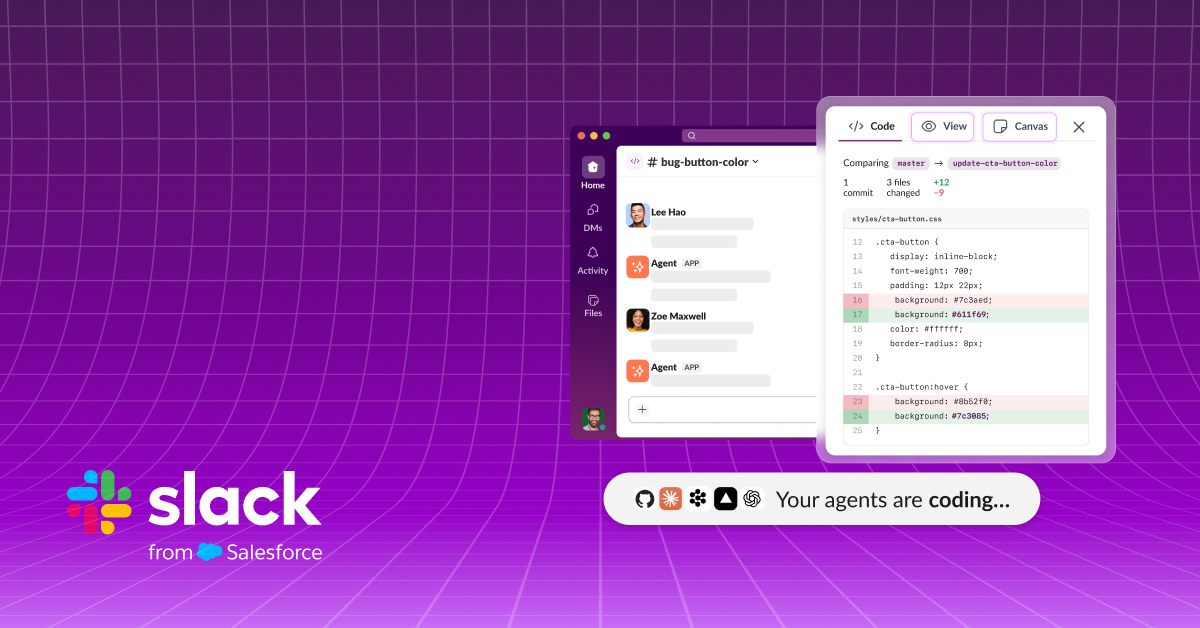
Slack Code — AI coding agents get a channel the whole team can watch
Slack Code gives a coding agent its own project channel, so planning, diffs and sign-off all happen in front of the team.
What is it?
Mention a coding agent in Slack and Slack Code now spins up a dedicated code channel for that job. The channel pulls in the people who need to be there and splits the work across tabs: the conversation, the plan, the code diffs, and a live preview of what the agent built.
How does it work?
Code channels show diffs and previews as first-class surfaces instead of walls of text. Changes flagged as high-stakes get routed to a named person for approval before they land, and when the assignment is done the channel archives itself and stays searchable.
Why does it matter?
Coding agents have mostly run in a private browser tab, so teammates only see the result once a pull request lands. Putting the run in a channel makes the intermediate work reviewable while it's still cheap to redirect. Slack reports over 70% of code channels open and close within a single day.
Who is it for?
Engineering teams already running coding agents in Slack. Claude, Devin, GitHub Copilot and Vercel are supported at launch; ChatGPT is coming soon.
|
|

|
|
TOOL
MAJOR
2026-08-20
Waymo's custom AI chip — a 5nm ASIC that runs 1,000+ TOPS in the car
Waymo now designs the silicon that turns its robotaxi's sensor data into driving decisions.
What is it?
Waymo has built its own 5nm ASIC to run the machine-learning work inside its robotaxis. The chip delivers over 1,000 TOPS aimed at front-end sensor processing and neural network inference, and is already in production in Waymo's latest robotaxi generation.
How does it work?
The ASIC handles lidar, radar and 13 high-resolution camera streams in real time, fusing them into one picture of the road. Waymo built it as two independent engines that run full parallel workloads as a single unit — if one hits a fault, the other seamlessly takes over.
Why does it matter?
Latency is the payoff. Owning the chip lets Waymo shape the silicon around its own models instead of waiting on a vendor roadmap, and cuts its reliance on outside suppliers like Nvidia and AMD.
Who is it for?
Autonomous-driving engineers and edge-AI / custom-silicon teams tracking where self-driving compute is heading.
|
|
|
|
TOOL
MAJOR
2026-08-20
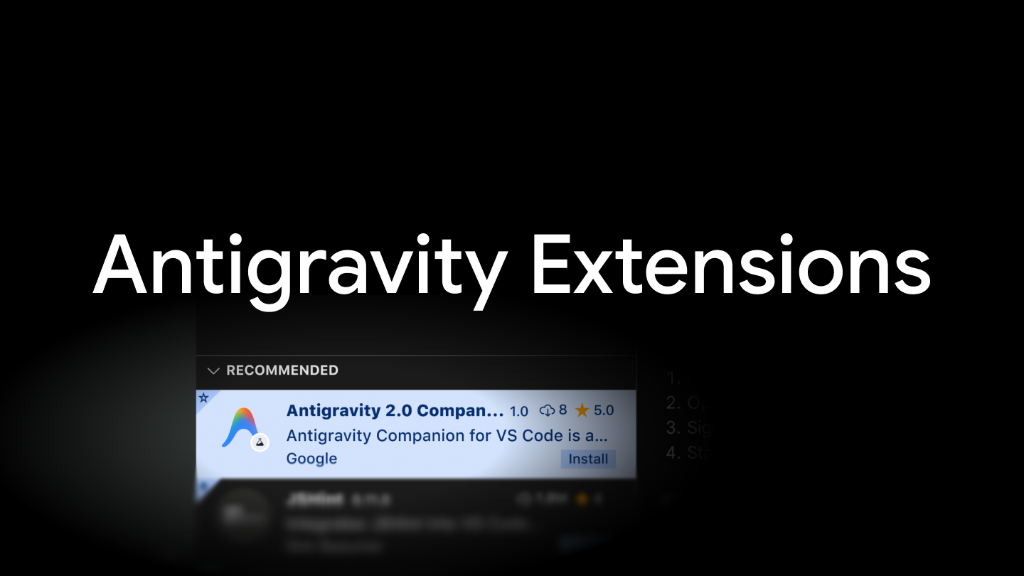
Antigravity IDE Extensions — Google's agent moves into VS Code and JetBrains
Google's agent-first coding platform now installs as a normal extension in the editor you already use.
What is it?
Antigravity extensions landed on 20 August 2026 for VS Code, Visual Studio (Preview), JetBrains IDEs (IntelliJ IDEA, PyCharm, WebStorm, GoLand, CLion, Rider) and Zed. Each installs in one click from the editor's own marketplace.
How does it work?
The extensions are intentionally thin — "lightweight, high-performance integrations" for inspecting code paths, reading compiler diagnostics or making local changes. Multi-agent orchestration still runs in the wider Antigravity ecosystem, and the extension shares context with it.
Why does it matter?
Teams no longer have to adopt a new editor to try Google's coding agent. The enterprise release lands the same day with sandboxing rules, Google Cloud budget caps, shared token pools and one-toggle audit logging.
Who is it for?
Developers on any Antigravity plan (including free) and platform teams evaluating Google's coding agent on eligible Gemini Enterprise subscriptions.
|
|

|
|
PAPER
MAJOR
2026-08-20
EnvHarness — Google's wrapper layer makes static agent benchmarks adapt
EnvHarness reshapes an existing agent benchmark into a training environment without touching the benchmark's own code.
What is it?
EnvHarness turns a fixed agent benchmark into an environment you can edit. Google Cloud AI Research built it with Washington University in St. Louis and UNC Chapel Hill, and released the code under Apache-2.0. A companion tool, EnvRigger, watches agent trajectories and writes new environment components targeting weak spots.
How does it work?
Composable wrappers hook into the standard reset() and step() interface, so the original benchmark's verifiers stay intact. EnvRigger then reads agent trajectories and synthesises targeted components from them, letting the environment and policy keep evolving together.
Why does it matter?
Static benchmarks stop teaching once an agent gets good at them. The paper reports up to a 9.0-point gain on held-out tasks with 9.8% fewer execution steps across five benchmarks — WebArena, SWE-bench Verified, and ALFWorld all improved.
Who is it for?
Agent and RL researchers who want to reuse existing benchmarks for training rather than building new environments from scratch.
|
|

|
|
SECURITY
SECURITY
2026-08-20
Semantica v0.6.6 — security release hardens ingestion, adds CrewAI support
A strongly recommended security upgrade for the MIT-licensed knowledge-graph store behind a lot of agent memory.
What is it?
Version 0.6.6 of Semantica, the graph-native context and memory store for AI agents, closes a privately disclosed batch of vulnerabilities. The maintainers mark it a security release and state that "upgrading is strongly recommended." It follows v0.6.5, itself a security release, by just nine days.
How does it work?
The fixes cluster around anything touching outside data: tarball path traversal, SQL injection, DNS-rebinding TOCTOU races, stored XSS, SPARQL injection, header injection and credential leakage across HTTP redirects. An SSRF guard now covers feed ingestion, and backup/restore and export backends were also patched.
Why does it matter?
An agent memory store deliberately swallows untrusted content — web pages, feeds, repositories, uploaded files — so an injection bug there reaches everything downstream. Beyond the patches, this release also adds a CrewAI integration and ContextGraph retraction/purge (so agents can "forget" facts).
Who is it for?
Teams running Semantica as agent memory or a RAG knowledge graph — upgrade immediately via pip install --upgrade semantica==0.6.6.
|
|
|
MODEL
NOTABLE
2026-08-20
LFM2.5-DSpark — Liquid AI's draft models decode up to 3.18x faster
Three ~300M draft models that make Liquid AI's small on-device models decode two to three times faster, with identical output.
What is it?
DSpark adds speculative decoding to the LFM2.5 family. Liquid AI shipped draft checkpoints for LFM2.5-1.2B-Instruct, LFM2.5-2.6B and LFM2.5-8B-A1B. Because the drafter only proposes tokens the target model then verifies, the emitted sequence is identical to baseline greedy decoding — benchmark accuracy doesn't move.
How does it work?
Each drafter stacks a DFlash-style parallel backbone, a lightweight sequential head that models token dependencies, and a confidence-scheduled verifier that prunes low-confidence candidates before the target model checks them. Mean acceptance out of 10 drafted tokens runs 4.81 for the 2.6B target and 6.95 for the 8B-A1B.
Why does it matter?
Small on-device models are latency-bound, and this is a free speed win. On an H100, LFM2.5-2.6B goes from 323 to 864 tokens/sec. On an M4 Max MacBook via llama.cpp, LFM2.5-1.2B goes from 138 to 350 tokens/sec. Function-calling latency on BFCL drops 57%.
Who is it for?
Developers running small models on phones, laptops and edge hardware who want faster inference without sacrificing output quality.
|
|
|
All releases at ai-tldr.dev
Simple explanations • No jargon • Updated daily
|
|