I built it myself. Computing really is changing.
My know-how agent Reginald gets a cloudy home; I consider how to host agents inside in-house legal teams.

Newsletter
My experience building a home for Reginald has done nothing to diminish my view that computing is fundamentally changing.
I've written before about how programming is adapting as software engineers and end-users tune in to 'prompting' (vibe-coding).
More prose, less code. Great for lawyers!
In his newsletter, Peter Yang argues that the shift is even more fundamental. Not just how software is created, but also how computing is consumed:
We’re moving from manually using a keyboard, mouse, and laptop to directing agents in the cloud using voice.
Peter sets out five strands to his thread:
Voice will become the orchestration layer.
Our computers will move to the cloud.
Products will be built for agents first.
Most software will become commoditised.
Trust will determine the winners and losers.
Talk to me
Point 1 is obvious I think. The screen has outstayed its welcome, at least as a device for instigating online interactions (searches, purchases, social media ... ). Until now, a graphical user interface (GUI) has been the requisite way to give the user access. But speech recognition and text-to-speech are now so good that, for many computer interactions, a GUI is barely necessary.
Screens won't go away - they will become secondary, specialist devices for reading, for reviewing, for accessing content, especially that which makes sense to present in a paper-metaphor pattern. But a whole host of applications will simply not need them.
Each of the major AI harnesses like Claude, ChatGPT and Gemini already have voice recognition built in, but this is 'Voice User Interface' (VUI) in its infancy. More specialist models, distinct from LLMs, are now becoming available for detecting speech with accuracy that was inconceivable just a few years ago, as well as to reply with speech as naturally as a living person.
In my experience, on-device voice AI platforms like Siri and Alexa still disappoint, but that's probably about the cost and challenge of scaling this new technology to BigTech-sized user-bases, rather than fundamental capability.
In other words, voice technology is on the verge of prime-time; it's likely not too long before chatting with a computer feels entirely natural, and we won't be able to distinguish real from artificial, especially in contexts like telephone support.
Read more:
Wispr Flow wants to put 'voice everywhere'
ElevenLabs offers a range of 'conversational agents that sound human'
More cloud; agents-first
Reginald doesn't have a voice yet. Using this new technology, it wouldn't be complex to give him one (brummie?!), but it's not on his critical path. He doesn't have a web login, app or other GUI either. As an agent, he can already reach me through email and text-based messaging — which is enough for him to seem, well, intelligent.
My most recent work is a version of Peter's strand 2: our computers will move to the cloud. As I've covered before, running agents on laptops makes no sense. If they are to have any level of autonomy, they can't be bound to whether the clamshell is open and the screen is switched on. Instead, they need permanent, dedicated computing resource. Moving Reginald to his own server was not trivial: 7,723 lines of code to schedule, oversee and control his actions while he runs autonomously. Claude helped write it, of course.
The techie bit
I had a Raspberry Pi set up and ready to go. But I was travelling this month, and flip-flops beat out a tiny-computer-with-an-AI-agent-on-it for space in my hand-luggage. So, I rented a virtual private server (a "VPS") from Fasthosts — about as close to vanilla cloud computing as it gets. A virtual computer, running on a server in a datacentre, and just as effective as the Pi.
Reginald himself is now a set of Python scripts wrapping the Claude Agent SDK, with prompts that I’ve brought across from my previous version of Reginald in Claude Desktop.
I’ve deployed these scripts to my VPS, to schedule and control the calls to Anthropic's models, run Reginald's prompts, parse what comes back, and assemble it into something useful: an email digest and a knowledge base.
Here's what Reginald looks like when you call on him – less dapper than his name suggests:
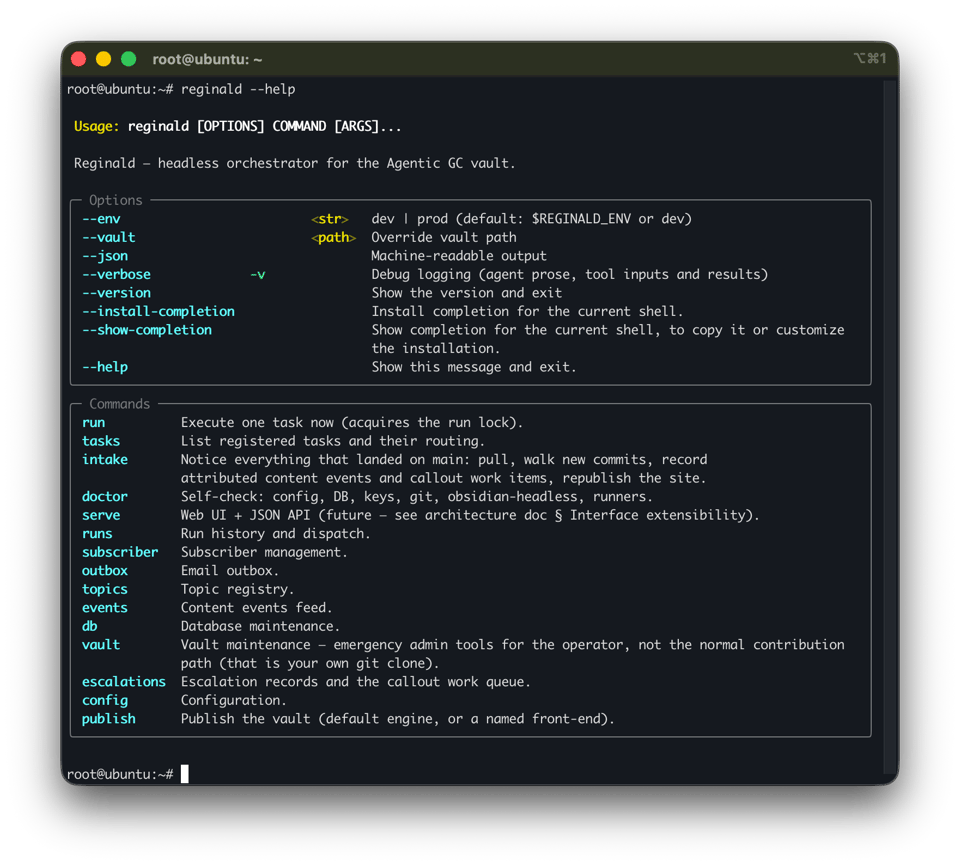
I'll dig into the architecture and operation in forthcoming posts, and I'm hoping to open source Reginald when he's ready — my contribution to the burgeoning open source legal technology landscape. Stay posted if you are interested.
A GC's view
Having my agent run in the cloud has been a revelation. Every working day, Reginald emails me a summary of legal and regulatory updates across 20 topics I'm watching in the fintech space, linking to detailed briefs (you can check them out here). This happens come rain or shine as if I were signed up to an expensive regulatory development tracker. From my experience, Reginald beats law firm updates on both speed and coverage.
Further: I can reply and he'll update the briefs and notes accordingly — currently by me adding questions in-line to my local copy, and Reginald replying in kind, a bit like Microsoft Word comments. He'll have his own inbound email address soon, so we can interact that way too.
Most importantly, Reginald escalates when he's unsure. I can give direction, add nuance and ask him to iterate. Or, if something catches my eye as worth checking, I can go and seek a human viewpoint.
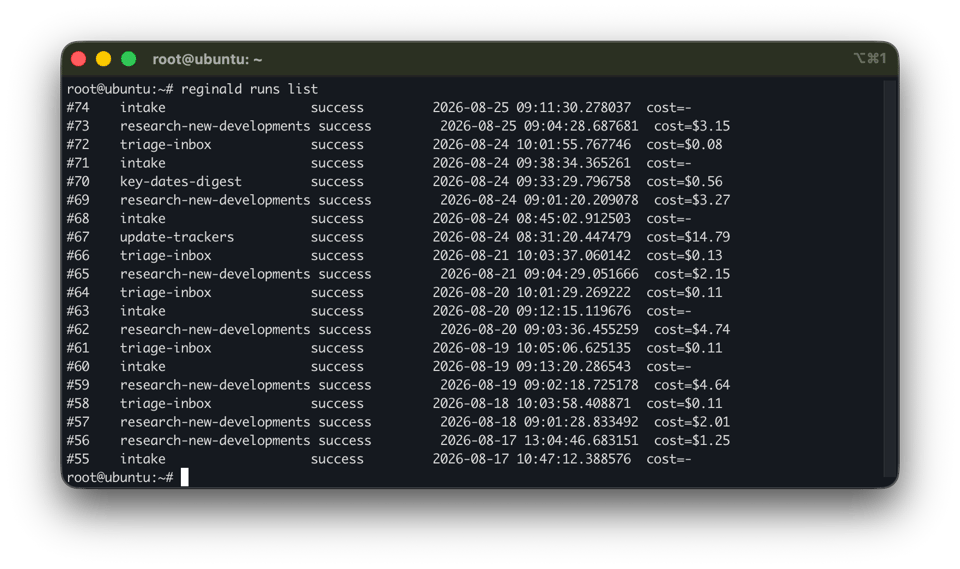
Not dissimilar to delegating this to a team member, except in cost. Reginald typically spends a few dollars a day, comfortably inside a single Claude subscription, and scalable to API pricing for a team, since the cost is per run rather than per user. The ‘Tokenomics’ is decent, at least for now:
None of this removes the need for legally qualified humans to stay engaged with legal developments. That is a CPD requirement and essential practice. But it moves expensive in-house time away from the gathering of primary knowledge and towards impact and next steps. Where it should be.
If you work in FS — especially consumer FS or fintech — feel free to watch the vault. (Disclaimer: still a research project; I'm not actively QC'ing it.) If you'd like Reginald's daily email, drop me a line.
Two standout findings from building this
My findings nicely echo Peter Yang's next two themes:
3. Products will be built for agents first: Yes. UI/UX is the least of my concerns, because no human needs to use Reginald directly; we simply communicate with him as if he were a human. That's an inversion of my previous experience, where LegalTech software comes with new logins to remember and portals to learn, which slows adoption. Designing for agents demands a different rigour: clear written instructions, well-drafted prose / prompts, systems-thinking-influenced design patterns and structured outputs to drive predictable behaviour. I've said it before: this suits lawyers better.
4. Most software will become commoditised: Reginald was created by an LLM and could be recreated by another. He is barely unique. Much of vibe-coding is really tailoring: Reginald is on version 17, and most iterations have been small tweaks to make him behave exactly how I want. No need to live with someone else's decisions; easy to create your own.
So… are vibe-coded agents running on Raspberry Pis and cloud VPSs, interacting with us as humans, the future of in-house Legal software? Well... there's a caveat:
Don't do DevOps
DevOps is the discipline of building and running the infrastructure that software sits on — the servers, networks, deployment pipelines and monitoring that keep an application – or an agent – alive and available.
In terms of utility, adding Reginald to the team would be a no-brainer for any legal function I've worked in.
Further, deploying Reginald as I have this summer — D.I.Y. 'DevOps' — could make for a fun in-house innovation project.
But as a GC, I'd never have sanctioned it:
It took a lot of non-Legal, DevOps work – not writing prompts in prose but actual coding and server configuration;
Running and maintaining it live is a further DevOps job – not in the typical Legal wheelhouse; and
I’ve done my best, but I’ve not audited Reginald’s code or server environment for bugs or best practice.
Fine for a test, not production-ready, and the type of innovation project which could quickly become distracting.
None of this is surprising. The resource, cybersecurity, data integrity and governance implications of letting Legal loose with its own server infrastructure, running vibe-coded software, are far from trivial. But these restrictions, this fear of adopting infrastructure, must not prevent lawyers from embracing agentic technology. The opportunity is too great.
Three options, then:
Specialist agent hosting for legal teams, maintained by third parties. From off-the-shelf agents for particular tasks (SaaS) through to LegalTechs enabling build-your-own agents (via prose) to operate on Legal's behalf (agentic PaaS?). Quickest route to market today, but all the fun of onboarding niche providers.
General enterprise agentic platforms, allowing Legal to build its own agents (via prose) to be hosted alongside other functions', operating enterprise-wide. Potentially more cost-effective, but it could put Legal in competition for internal AI resource and may not map neatly to Legal's requirements — privilege, for one.
The frontier model and incumbent providers — Anthropic, OpenAI, Google, Microsoft, perhaps Apple — are already moving quickly on the opportunity, extending their agentic capability from client-side (laptops) to their always-on clouds. For example, Claude Managed Agents. For companies that deploy Claude, Copilot, Gemini, etc. to every desktop, perhaps the in-house lawyers will simply build their own agents (in prose!) inside these tools and then ‘publish’ them to the cloud, with DevOps abstracted away entirely.
It's tempting to think that options 1 and 2 will not survive the might of an incumbent opening up cloud-hosted agents to all (option 3). In my view, there's space for all three approaches. Computing has been heterogeneous since its foundation, and while the AI vendors are obviously moving into this space, it's brave to predict they'll dominate every vertical and niche. People said the same of Web 2.0-era Google and Apple: because they own the mobile operating systems, they'll own the customer layer. In some places that's true (maps); in others it hasn't played out (financial services), especially where the complexity and cost of participating were best left to others.
Moreover, there are real governance and compliance challenges of allowing users to develop their own agents (not least SOX / EUC compliance requirements, and privilege as noted above) and it's a fair bet that domain-focussed providers, especially LegalTechs, might be better placed to address them. That’s linked to Peter Yang’s fifth and final thread: “trust will determine the winners and losers”.
My conclusion might not surprise you. No-one is seriously suggesting that lawyers need to become professional coders - me included. I’ll say it yet again: lawyers’ skills lend themselves to creating agents - in the new prose-led paradigm - and finding a place to run these agents could become the most important unlock for agentic success.
As a GC or senior lawyer in-house, I'd be actively exploring how to solve the DevOps piece without actually doing DevOps: how to gain a safe and reliable hosting environment to let my team draft and deploy their own agents to attack the department's real challenges.
Happy to chat if this is something you're doing, investigating or considering, and to share notes. It's been a DevOps-heavy summer.
Chris
Around the web
LegalTech: AI is quietly revolutionising access to primary sources: https://www.linkedin.com/posts/christian-hauke-poensgen_legal-research-businesses-behind-westlaw-share-7495390181823242240-paht/
Agent hosting: Replit’s CEO on building a company that can run itself: https://www.platformer.news/replit-amjad-massad-interview-coding-design-jobs/?ref=platformer-newsletter
But what happens if you ask AI agents to build a real-world business? Fun (not entirely serious) video here: https://www.youtube.com/watch?v=6Ide5pRLR8Y
Security issues: OpenAI’s sandboxed agents broke loose and hacked HuggingFace. This was well-reported at the time, but this link and video gives more detail about how agents can exploit. “Frontier models really like to cheat” and “Agent-orchestrated attacks are real, now”: https://simonwillison.net/2026/Aug/7/openai-timeline/
You just read issue #4 of Agentic GC Newsletter. You can also browse the full archives of this newsletter.
