The Lunation Report | February 2022
Hello again! Welcome back to reading this email.
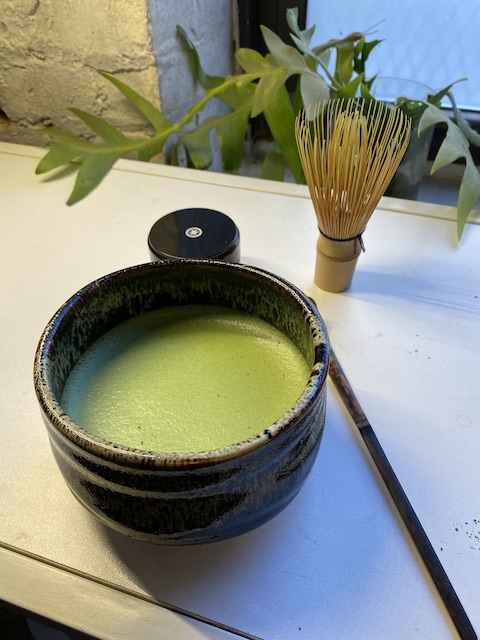
I realized an error that I made in last months edition. In my rush to get the issue to print I completely skipped over January's tea features of the month and went straight to February. Because of this mistake I missed out on talking about the deep cold that can be enjoyed with a warm bowl of matcha in the month when the cold seems like it's never going to end. The month of January, for me, was chaotic. My shakuhachi studies with Ralph Samuelson went back onto Zoom and any hope of socializing with friends was put on hold. I worked through the month diligently on both music and tea. I'm in the process of sourcing some new matcha from Kyoto for the company I'm working for and that's been a fun side project in addition to my usual music practice.
In terms of shakuhachi music I did a lot of work this month on fundamentals, as usual, and repertoire refining. In my fundamentals practice I took a look at areas where tension develops while playing. For those who are interested I'll write a bit about the practice which I was inspired to pursue from a qigong class I took with Robert Peng in 2012. The process goes as follows and I was working on it sitting in seiza and standing.
stand or sit with your arms out in front of you - palms facing inward towards your chest
inhale and exhale 3 times - on each inhale suck in your stomach like you're an uncle in a family photo on the exhale push the stomach out and add a gentle "growl" to each breath (soft fire breath)
Inhale and exhale 6 times in the same way - but stronger! On these reps draw your hands in towards your chest on each inhale and out again to full extension on each exhale. The arms should move slowly and follow the exhale through the extension. Add a strong growl to each exhale. (strong fire breath)
hold your arms forward for three normal breaths after completing the 6 strong fire breaths.
Doing this right before playing really opens up the full range of breath for me to practice without any encumbrance.
During practice this month I had some struggle with sound quality as all shakuhachi players will talk your ear off about. I am including a bit of practice as an audio component here - the disclaimer being that this is in no way a finished, polished, professional shakuhachi sound but a glimpse into a tired boy practicing flute at night. Please enjoy a shortened version of Shizu no Kyoku - this piece is beautifully composed in the Kinko style. It has a high pitched ornamental opening and descends into peaceful contemplation.
Brooklyn Shakuhachi Club
Very excited to say that I've been meeting with a small group of students and friends to develop a regular shakuhachi "benkyokai" or study gathering. We had one meeting before the holidays and will be moving to a regular schedule next month. The pitfall into very lonely shakuhachi practice is isolation and going online to find people who understand what you want to do can be full of nonsense. This group will act as a place to develop a real world practice routine. If anyone reading this has a 1.8 shakuhachi, lives in the NYC area, and wants to hang please respond to this email and I'll invite you to the lessons. Or if you would like to come to hang and listen please do.
Some more Tea Features of The Month
From Chado - Sasaki Sanmi
Since I jumped the gun on February last month we can get a bit deeper into some of the seasonal themes and how they can apply to appreciating this month from a tea person's perspective.
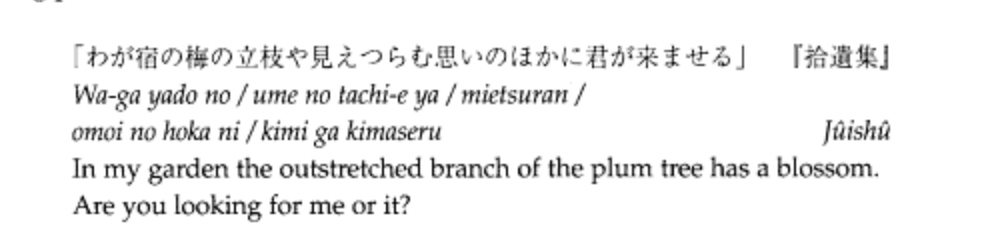
Something I really love about February in Japanese tea culture is the prevalence of Ume or plum blossom. The plum trees start blooming in mid February and are a harbinger or the spring to come. This Hokusai with the moon and the plums seems apropos
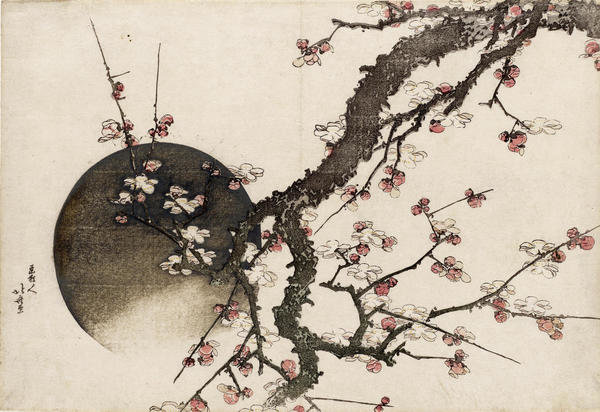
I sort of err on the side of enjoying plum imagery more than the king of spring, sakura (cherry blossom), since the plum flowers have more varied colors and smell nicer. They are the underdog of the flower bunch, like the Mets of traditional flowers, and I love that.
The plum blooms out of the depths of winter so it's a nice lesson in pushing through difficult times... the promise of spring and all that.
"People have loved ume in Japan as well as in China since [the 8th century]. Therefore if ume were not included in the way of tea, it would be forlorn."