Everyone Loses When Paying Fines Becomes a Business Strategy
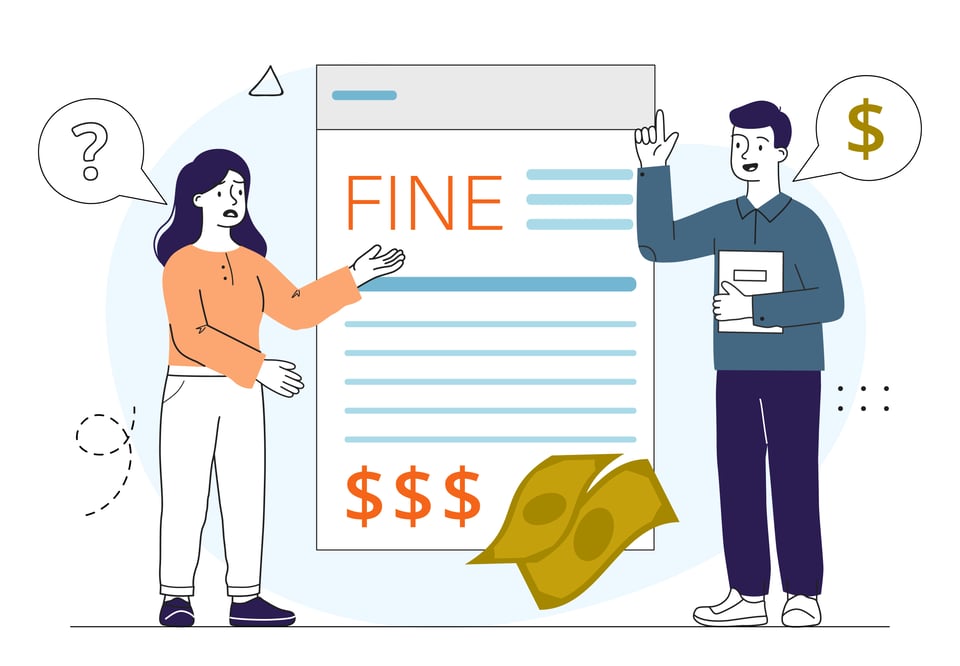
Compliance failures are triggering urgency or internal organizational reckoning less frequently. Instead, they prompt budgeting discussions, legal modeling, and risk acceptance exercises. Fines, legal fees, and settlement agreement costs are appearing in budgets. Legal teams estimate exposure ranges. Finance teams compare the cost of compliance with the combined cost of enforcement actions, settlements, and reputational management. Leadership approves risk with the same detachment applied to insurance premiums or licensing fees.
This approach reframes regulation as optional and treats harm as acceptable as long as it remains within acceptable financial constraints. While that framing may look efficient on a spreadsheet, it introduces deep operational, ethical, and strategic risks over time.
How fines and settlement agreements replaced accountability
Most regulations are reactive; they exist because people were harmed. Infrastructure failed in ways that caused lasting financial or human damage. Each regulation reflects lessons learned from financial or human harm, as well as from subsequent litigation and public pressure.
When organizations decide to absorb fines or resolve violations through settlement agreements rather than meeting regulatory obligations, that logic gets flipped on its head. Harm becomes a theoretical mathematical calculation rather than concrete. Impact becomes abstract rather than personal. Projects shift from preventing harm through compliance to loss containment.
Over time, this shift reshapes organizational behavior in predictable ways.
Executives focus on the likelihood of enforcement rather than the possibility of harm. Often, the attitude “we haven’t gotten caught before, so the risk is low” is pervasive among leadership. If you think about that in the context of a speeding ticket (I didn’t get caught yesterday, so my risk of getting caught today is low), you know what a fallacy that is. Despite this, product teams move faster because it is accepted that, if compliance remediation is required, it can occur later, if at all.
Rewards are paid for on-time delivery despite the product's noncompliance with regulatory requirements. When harm occurs, legal teams negotiate settlements that include no admission of fault, minimal operational change, and limited or nonexistent ongoing oversight. Most importantly, the victims are always silenced. The organization continues operating as designed, while the underlying risks remain unchanged.
This is the new reality for most regulatory requirements, especially when a company is owned by private equity, which aims to maximize value with minimal investment and focuses on the short term. Private equity is worse than other forms of corporate ownership because it is typically assumed that the company will eventually be divested, and any accumulated harm is then shifted to others to address.
Why this strategy scales harm
Paying fines or entering settlement agreements resolves individual incidents without correcting the systems that caused them.
Settlements typically address a specific violation while leaving incentives intact. Fragile data pipelines remain fragile. Safety checks stay underfunded. Testing coverage remains incomplete. Accessibility barriers persist. Bias remains embedded. Security gaps remain documented but unresolved. Even settlement agreements that require future regulatory compliance are rarely re-assessed for that compliance.
Each cycle reinforces the lesson that the consequences of regulatory violations are survivable, negotiable, and rarely transformative for the company that violates them. The same can’t be said for the people harmed by the violation.
This is how isolated violations become patterns and how edge cases turn into routine failures. This is how manageable risks accumulate until they produce systemic damage that no single settlement or recall can meaningfully address.
Organizations that rely on this model often describe it as pragmatic. They argue that compliance slows delivery. They claim regulation interferes with innovation. They frame enforcement as a source of friction rather than as a means of customer protection.
What these arguments consistently ignore is the compounding cost of repeated harm.
The human cost never stays external
Within a boardroom, fines and settlement agreements seem distant and manageable. Outside that room, the impact is immediate and personal.
Employees burn out when they are repeatedly asked to ship work they know carries avoidable risk. Customers lose trust when failures recur, accompanied by apologies that sound as if they are being read from a script generated by ChatGPT. Communities suffer when infrastructure fails repeatedly. Regulators escalate scrutiny when patterns become impossible to dismiss as isolated incidents.
Eventually, accountability takes the form of outcomes that frequently do not align with early risk models, including leadership turnover, sustained brand damage, market instability, talent loss, and regulatory oversight. This fallout is far more disruptive than completing the compliance work required from the outset.
Paying fines or settling claims delays accountability, but it certainly does not eliminate it.
Compliance is a design choice
Organizations that take regulation seriously behave differently long before enforcement becomes likely.
They involve experts in quality, safety, accessibility, privacy, and risk early in decision-making. They document decisions and challenge assumptions. They treat uncertainty as something to be tested rather than ignored. They invest in governance, monitoring, and validation so that failures surface internally rather than after customer harm. They make these choices not out of fear of penalties or settlements, but because they understand how to minimize risk in complex systems.
Mistakes still occur. The difference lies in how quickly those mistakes are detected, acknowledged, and corrected. Failure becomes a signal for improvement rather than a tolerated byproduct that triggers the “blame game.”
What regulators cannot fix
Regulators can impose fines and approve settlement agreements, but they cannot design internal systems. Judges and juries can assign blame and quantify financial penalties, but again, cannot change corporate processes and policies. When regulators, judges, and juries are involved, the response is always reactive, occurring after the harm has occurred. Regulators, judges, and juries cannot influence test strategies, incentives, or product schedules. They cannot override leadership decisions made long before a violation occurs. Finally, they can’t prevent the company they just penalized from continuing the same bad behavior the next day.
When leaders treat fines and settlements as routine costs of doing business, regulation alone cannot create safety, fairness, or reliability. The organization will continue to search for the least costly acceptable failure.
Real compliance begins with a different question. Not “how much will this cost if we are caught,” but:
1) Who could be harmed if this fails?
followed by
2) Is there a group that will be disproportionately harmed if this fails
Until organizations consistently choose that question, fines and settlement agreements will remain a tax on preventable harm, and the public will continue to bear the real price.
Final Thoughts
Treating fines and settlement agreements as routine operating expenses does more than weaken compliance. It reshapes how organizations define responsibility. When harm becomes a line item rather than a failure to prevent harm, prevention ceases to be the goal. The system prioritizes organizational profitability over safety, legality, or fairness.
That choice carries consequences that compound over time. Each accepted violation reinforces incentives to defer fixes, narrow accountability, and externalize risk. Each settlement that leaves systems unchanged teaches the organization that it can continue as is. Eventually, the gap between leadership models and public experience becomes impossible to contain.
Compliance does not fail because regulations are unclear. It fails because organizations decide that meeting those regulations is optional until enforcement becomes unavoidable. By the time regulators intervene, the harm has already occurred, trust has already eroded, and the costs for remediation far exceed anything early prevention would have required.
The question is not whether fines and settlements can be absorbed. Most large organizations can absorb them for years. The question is how long an organization can operate while repeatedly choosing not to prevent known harm before the damage becomes irreversible.
Organizations that want to avoid that outcome must reject the idea that compliance is a financial calculation performed after the fact. It is an architectural and governance decision made at the beginning. Until leadership treats harm prevention as non-negotiable, fines and settlement agreements will continue to function as a fee for permission to fail.
Add a comment: