Infographic of: The Leitner System and Spaced-Repetition Software
Education: Memory, Study and How Learning Sticks
The Leitner System and Spaced-Repetition Software
Sebastian Leitner, Piotr Wozniak (1972-1987)
Reviewing material after increasing intervals, while revisiting mistakes sooner, makes study more efficient and supports lasting recall.
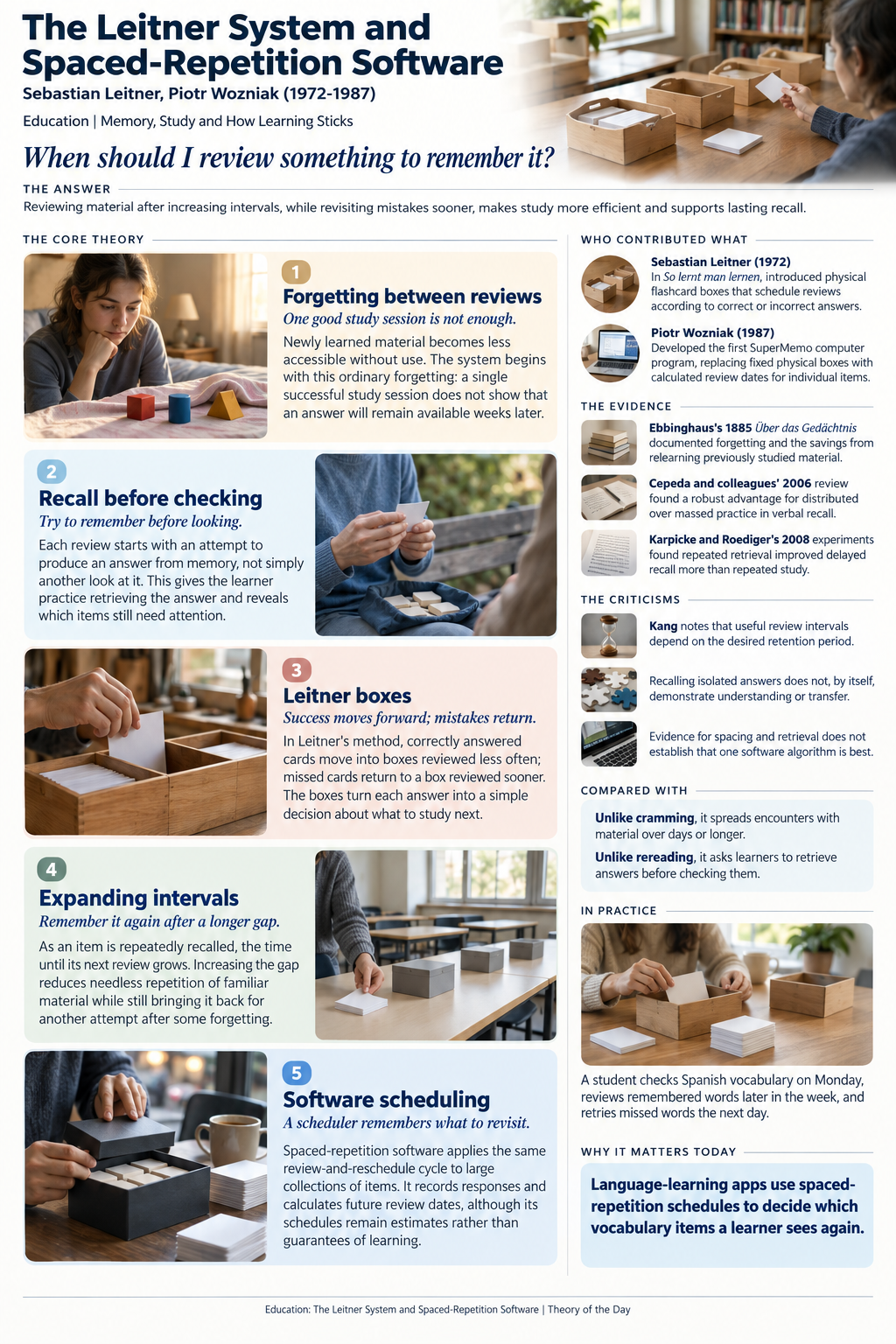
The Leitner system arose from a practical problem: people forget much of what they study, yet reviewing everything equally wastes time. German science writer Sebastian Leitner described a flashcard-box method in his 1972 book So lernt man lernen. Its aim was to give learners a manageable way to decide what to review and when. In the 1980s, Piotr Wozniak pursued the related problem of scheduling many individual reviews by computer. Together, these approaches are often discussed as spaced repetition, though neither invented the broader idea that study should be distributed over time.
In a Leitner box, a learner first tries to answer a question on a card. A correct answer sends the card to a box reviewed less often; a wrong answer sends it back to a box reviewed sooner. Repeated success therefore creates longer gaps between encounters, while troublesome material returns frequently. Software follows the same basic cycle but records responses and assigns a future review date to each item. The schedule is an aid to study, not a measure of whether someone fully understands a subject.
Leitner's distinctive contribution was a simple physical procedure: boxes made review frequency respond to performance without complex calculations. Wozniak developed the SuperMemo computer program in 1987 and later described methods for calculating review intervals from users' answers. Computer scheduling could handle far more items than a small box and adjust dates item by item. These are practical systems built on older findings about memory, particularly the benefits of distributed practice and the value of trying to retrieve an answer rather than merely looking at it again.
Evidence supports those underlying principles more strongly than it supports any single box layout or software formula. Hermann Ebbinghaus's 1885 experiments documented forgetting and showed that previously learned material could be relearned with less effort than entirely new material. A 2006 review by Nicholas Cepeda and colleagues found a reliable advantage for distributing verbal practice across time instead of concentrating it in one session. In experiments published in 2008, Jeffrey Karpicke and Henry Roediger found that repeated retrieval improved later recall more than additional study of material already learned.
There are important qualifications. The best gap depends in part on how long the learner needs to remember something; no fixed interval suits every goal, item or person. A correct flashcard answer can also conceal a shallow grasp of a concept, so spaced repetition should supplement activities such as explanation, problem-solving and applying ideas in new contexts. Feedback matters when learners answer incorrectly, lest they keep practicing an error. Moreover, research establishing the benefits of spacing and retrieval does not prove that a particular commercial algorithm outperforms every alternative.
The approach matters because it turns two broad findings about memory into a daily decision: attempt to remember, then choose when to return. A learner preparing for a language exam, for example, need not spend equal time on every word. Familiar words return after longer waits; missed words receive earlier attention. Whether managed with boxes or software, the system is most useful for material that must remain accessible over time, alongside study methods that build understanding as well as recall.
The argument in four steps
- Memories become harder to retrieve when they are not used.
- A successful recall shows that an item is ready for a longer gap before review.
- A failed recall shows that the item needs another review sooner.
- Therefore, scheduling each review around recall performance concentrates practice where it is needed.
How it works
- The learner studies an item, then tries to retrieve its answer at a later review.
- Successful retrieval lengthens the wait; an error brings the item back sooner, often after feedback.
- The record of answers sets the next review date, keeping difficult items in more frequent rotation.
Who contributed what
- Sebastian Leitner (1972): In So lernt man lernen, introduced physical flashcard boxes that schedule reviews according to correct or incorrect answers.
- Piotr Wozniak (1987): Developed the first SuperMemo computer program, replacing fixed physical boxes with calculated review dates for individual items.
Compared with rival views
- Unlike cramming, it spreads encounters with material over days or longer.
- Unlike rereading, it asks learners to retrieve answers before checking them.
Further reading
- Sebastian Leitner, So lernt man lernen (1972)
- John Dunlosky and colleagues, Improving Students' Learning With Effective Learning Techniques: Promising Directions From Cognitive and Educational Psychology (2013)
- Benedict Carey, How We Learn: The Surprising Truth About When, Where, and Why It Happens (2014)