Infographic of: Open Systems Theory of Organizations
Management: Organization Theory
Open Systems Theory of Organizations
Daniel Katz, Robert L. Kahn (1966)
Organizations survive by exchanging resources and information with their environments and adjusting how they work in response.
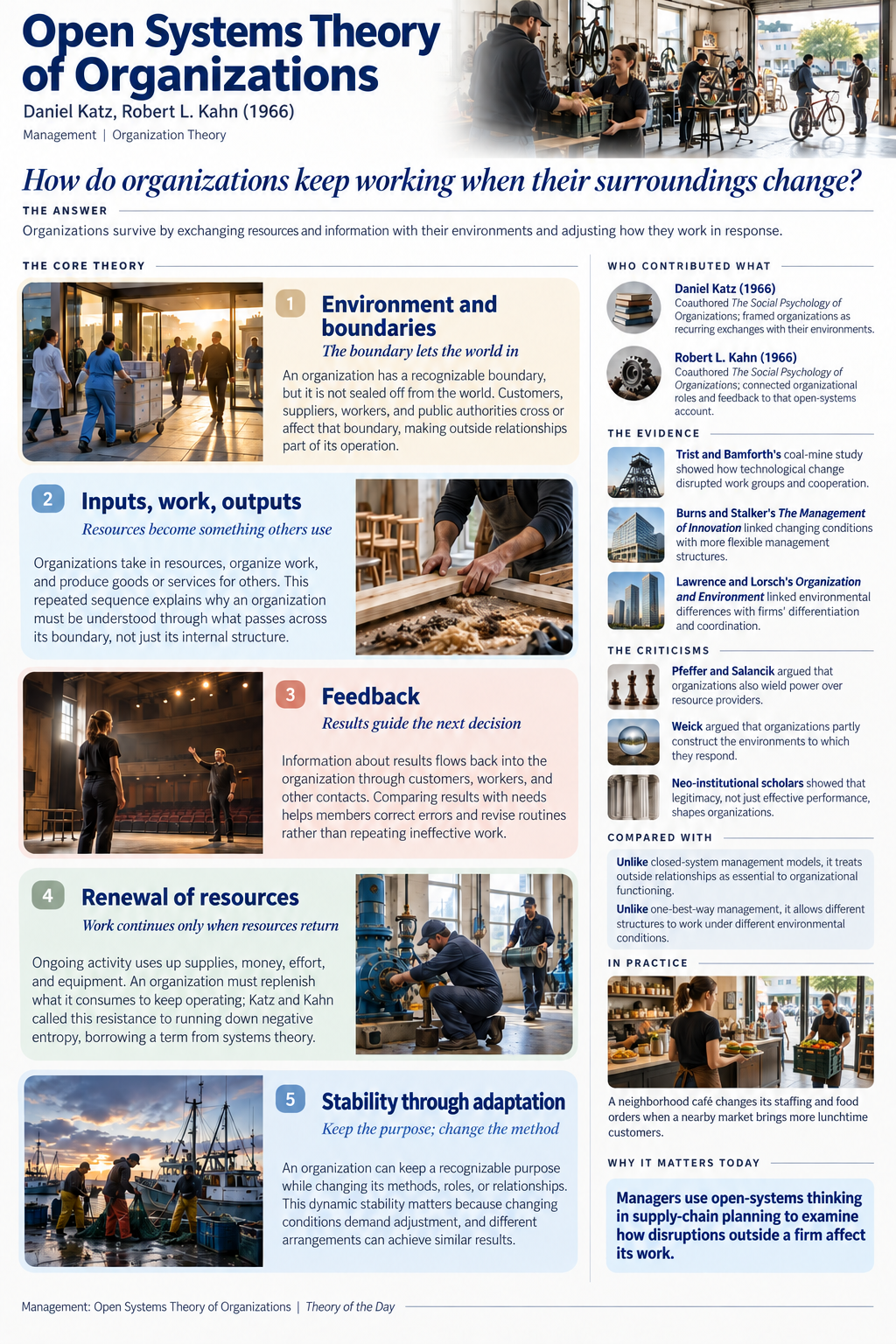
Open systems theory entered organization studies as scholars questioned approaches that treated workplaces chiefly as self-contained arrangements of jobs and rules. General systems thinking had already distinguished systems that exchange matter, energy, and information with their surroundings from closed ones. In 1966, Daniel Katz and Robert L. Kahn applied an open-systems approach to social organizations in The Social Psychology of Organizations. Their concern was practical as well as theoretical: an organization cannot be explained solely by its chart or internal procedures when its workers, resources, customers, and constraints come from outside.
In this account, an organization takes in resources, carries out work, and produces outputs for its environment. Those outputs affect what it receives next. Sales, complaints, staffing difficulties, or a supplier's delays can all provide feedback about whether established routines are working. Continued operation also requires replenishing resources used up in production and administration, an idea Katz and Kahn described with the systems term negative entropy. The organization maintains a recognizable pattern of activity not by remaining unchanged, but by adjusting that pattern while continuing to obtain what it needs.
Katz and Kahn developed their account together; the published theory does not support a neat division in which each invented a separate half. Their book brought environmental exchanges, feedback, recurring work cycles, and organizational roles into a single analysis of social organizations. Earlier, Ludwig von Bertalanffy had helped establish general open-systems thinking, though he did not write this organizational theory. Related organization scholars developed further implications: Tom Burns and G. M. Stalker examined management under different rates of change, while Paul Lawrence and Jay Lorsch investigated how firms divided and coordinated work when facing different external demands.
Research supports important parts of this picture, although no single study tests the entire theory. Eric Trist and Ken Bamforth's 1951 coal-mining study showed how a change in technology disrupted established work groups and cooperation. Burns and Stalker's 1961 study, published as The Management of Innovation, associated more changing conditions with more flexible management arrangements. Lawrence and Lorsch's 1967 Organization and Environment compared firms facing different conditions and examined their need both to differentiate departments and to coordinate them. Together, such studies make it difficult to treat internal organization as independent of its setting.
The theory's breadth is also a limitation: describing an organization as open does not, by itself, predict exactly which response will succeed. Jeffrey Pfeffer and Gerald Salancik later emphasized that access to external resources involves power and dependence; organizations also try to influence those who supply them. Karl Weick argued that members help construct the environments they perceive and respond to. Neo-institutional research added that organizations adopt practices for legitimacy as well as for efficient performance. These developments complicate simple stories of automatic adaptation.
Open-systems thinking remains useful because it asks managers and researchers to trace connections across organizational boundaries. A café facing a new lunchtime rush, for example, must obtain more ingredients, arrange staffing, observe what customers buy, and revise its routines. The same questions apply at a larger scale to disrupted supply chains: what enters, what work changes, what leaves, and what comes back? The theory does not prescribe one best structure. It provides a way to investigate how organizations keep working amid continuing exchanges with the world around them.
The argument in four steps
- Organizations depend on their surroundings for people, materials, money, and information.
- They turn these inputs into goods, services, and other outputs.
- Responses to those outputs provide resources and information that shape future activity.
- So organizations survive by renewing their resources and adjusting their work as conditions change.
How it works
- Members notice shifts in demand, supplies, or rules and reconsider how tasks are divided.
- Delays, filtered information, and poorly coordinated departments obstruct changes to routines.
- Reliable access to resources and useful results determine whether the revised pattern of work lasts.
Who contributed what
- Daniel Katz (1966): Coauthored The Social Psychology of Organizations; framed organizations as recurring exchanges with their environments.
- Robert L. Kahn (1966): Coauthored The Social Psychology of Organizations; connected organizational roles and feedback to that open-systems account.
Compared with rival views
- Unlike closed-system management models, it treats outside relationships as essential to organizational functioning.
- Unlike one-best-way management, it allows different structures to work under different environmental conditions.
Further reading
- Daniel Katz and Robert L. Kahn, The Social Psychology of Organizations (1966)
- W. Richard Scott and Gerald F. Davis, Organizations and Organizing: Rational, Natural, and Open System Perspectives (2007)
- Jeffrey Pfeffer and Gerald R. Salancik, The External Control of Organizations: A Resource Dependence Perspective (1978)