Infographic of: Resource Dependence Theory
Management: Organization Theory
Resource Dependence Theory
Jeffrey Pfeffer, Gerald Salancik (1978)
Based on: Jeffrey Pfeffer and Gerald R. Salancik, The External Control of Organizations: A Resource Dependence Perspective (1978)
Organizations cannot make what they need, so those who control vital resources hold power over them and shape their behaviour.
Jeffrey Pfeffer and Gerald Salancik published The External Control of Organizations: A Resource Dependence Perspective in 1978. At the time, much research explained organizations by looking inside them, at their structure, leaders and technology. Pfeffer and Salancik asked a different question: why do organizations bend to the outsiders they depend on? They built on the sociologist Richard Emerson's 1962 idea that power comes from other people's dependence, and on James Thompson's 1967 work on how organizations cope with uncertainty.
The book opens by arguing that organizations are not self-sufficient. They are social creatures embedded in networks of exchange, and their behaviour makes sense only against that setting. Pfeffer and Salancik then redefine effectiveness as an organization's ability to satisfy the demands of the groups whose support it needs. Managers respond to the demands they notice, so what they perceive shapes what they do. The middle chapters explain how dependence arises, and the later chapters show how organizations try to manage it.
The mechanism rests on three conditions. A resource creates dependence when it is important to survival, when someone else has discretion over who gets it, and when few alternative sources exist. Whoever controls such a resource gains power and can make demands. Organizations rarely accept this passively. They merge with suppliers or customers, diversify to spread risk, form joint ventures, put outsiders on their boards of directors, choose executives who suit their environment, and lobby governments. Inside organizations the same logic applies: units that solve the most critical problems gain influence.
Others shaped the theory before and after the book. Emerson supplied the core idea of power-dependence relations. Thompson showed that organizations try to shield their core work from uncertainty. Pfeffer's 1972 studies of mergers and of corporate boards were early tests, and Salancik and Pfeffer's 1974 study of a university budget showed that departments able to bring in scarce resources won more money. Aldrich and Pfeffer's 1976 review set the approach beside rival views of environments. Later, Casciaro and Piskorski refined how dependence should be measured.
Several studies fit the theory. Mergers followed patterns of interdependence between industries, board makeup tracked firms' needs for outside links, and university budgets followed departmental power. Critics raise doubts. Casciaro and Piskorski argued in 2005 that the theory mixes up power imbalance with mutual dependence. Mizruchi concluded in 1996 that evidence on what interlocking boards actually achieve is mixed. Reviewers also note that central ideas such as dependence and power are measured in many different ways, which makes results hard to compare.
The theory still matters because it gives a simple, testable way to think about who really controls an organization. Researchers use it to explain why nonprofits seek varied funding, why firms recruit well-connected directors, and why companies form alliances. It also reminds managers that strategy is partly about reducing reliance on a few powerful outsiders.
The work, part by part
1. No organization stands alone
Introduction and opening argument
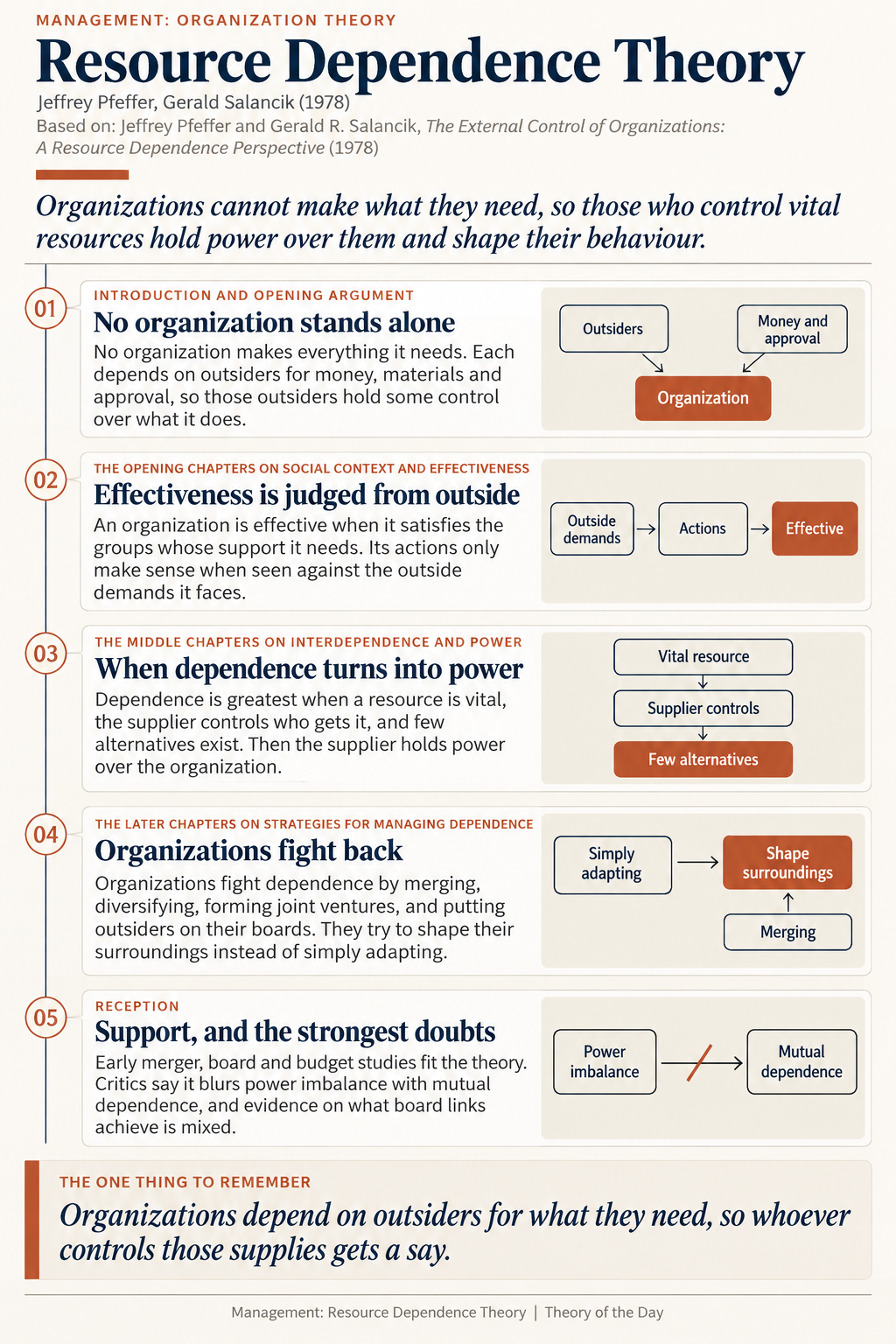
Jeffrey Pfeffer and Gerald Salancik wrote The External Control of Organizations to challenge studies that explained firms mostly by their inner workings. They argue that no organization produces everything it needs, so each must deal with outsiders who hold money, materials or approval. Their book therefore asks who controls an organization's lifeblood, and what managers do about it.
2. Effectiveness is judged from outside
The opening chapters on social context and effectiveness
In the opening chapters Pfeffer and Salancik say organizations are social creatures embedded in networks of exchange, and their actions make sense only against that setting. They define effectiveness as an organization's ability to satisfy the demands of those groups whose support it needs, not as some neutral measure. Managers, in turn, respond to the demands they notice, so what they see shapes what they do.
3. When dependence turns into power
The middle chapters on interdependence and power
Next they ask when dependence becomes dangerous. Pfeffer and Salancik say it grows with three conditions: how important the resource is to survival, how much freedom the supplier has to decide who gets it, and how few alternative suppliers exist. Where one outsider controls a vital resource and no substitute exists, that outsider has power over the organization.
4. Organizations fight back
The later chapters on strategies for managing dependence
The later chapters turn to what organizations do about dependence. Pfeffer and Salancik describe mergers that absorb a supplier or customer, diversification that spreads risk, joint ventures, and boards of directors that bring powerful outsiders inside. They also treat the choice of executives and political lobbying as ways to reduce uncertainty, so organizations try to shape their surroundings rather than merely adapt.
5. Support, and the strongest doubts
Reception
Pfeffer's 1972 studies of mergers and boards, and his 1974 university budget study with Salancik, found patterns matching the theory. Critics disagree on how well it holds: Casciaro and Piskorski in 2005 argued it blurred power imbalance with mutual dependence, and Mizruchi in 1996 found the evidence on what board links achieve was mixed. Hillman, Withers and Collins in 2009 reviewed it as a lasting framework still being refined.
The argument in four steps
- No organization produces all the resources it needs, so it must trade with others.
- Dependence grows when a resource is vital, tightly controlled and has few substitutes.
- Those who control such resources gain power, and managers respond to their demands.
- So organizations merge, ally and seat outsiders on boards to manage dependence, which explains much behaviour.
Who contributed what
- Jeffrey Pfeffer (1972): Merger as a Response to Organizational Interdependence tested whether mergers followed patterns of dependence between industries.
- Gerald Salancik (1974): Co-authored a university budget study showing departments with scarce, valued resources gained power.
The evidence
- Pfeffer's 1972 merger study found firms merged in patterns matching the interdependence between their industries.
- Pfeffer's 1972 board study found board size and makeup tracked firms' needs for outside links.
- Salancik and Pfeffer's 1974 study found university budgets followed departments' power to obtain resources.
The criticisms
- Casciaro and Piskorski said in 2005 it confuses power imbalance with mutual dependence.
- Mizruchi found the evidence on what interlocking boards achieve is mixed.
- Reviewers find core concepts such as dependence are hard to measure consistently.
Compared with rival views
- Unlike contingency theory, it stresses power over resources, not a fit between structure and environment.
- Unlike population ecology, it lets managers shape their environment instead of being selected out.
Why it matters today
Researchers use it to explain why nonprofits seek varied funding and appoint well-connected board members.
Further reading
- Amy J. Hillman, Michael C. Withers and Brian J. Collins, Resource Dependence Theory: A Review (2009)
- Gerald F. Davis and J. Adam Cobb, Resource Dependence Theory: Past and Future (2010)
- Tiziana Casciaro and Mikolaj Jan Piskorski, Power Imbalance, Mutual Dependence, and Constraint Absorption: A Closer Look at Resource Dependence Theory (2005)