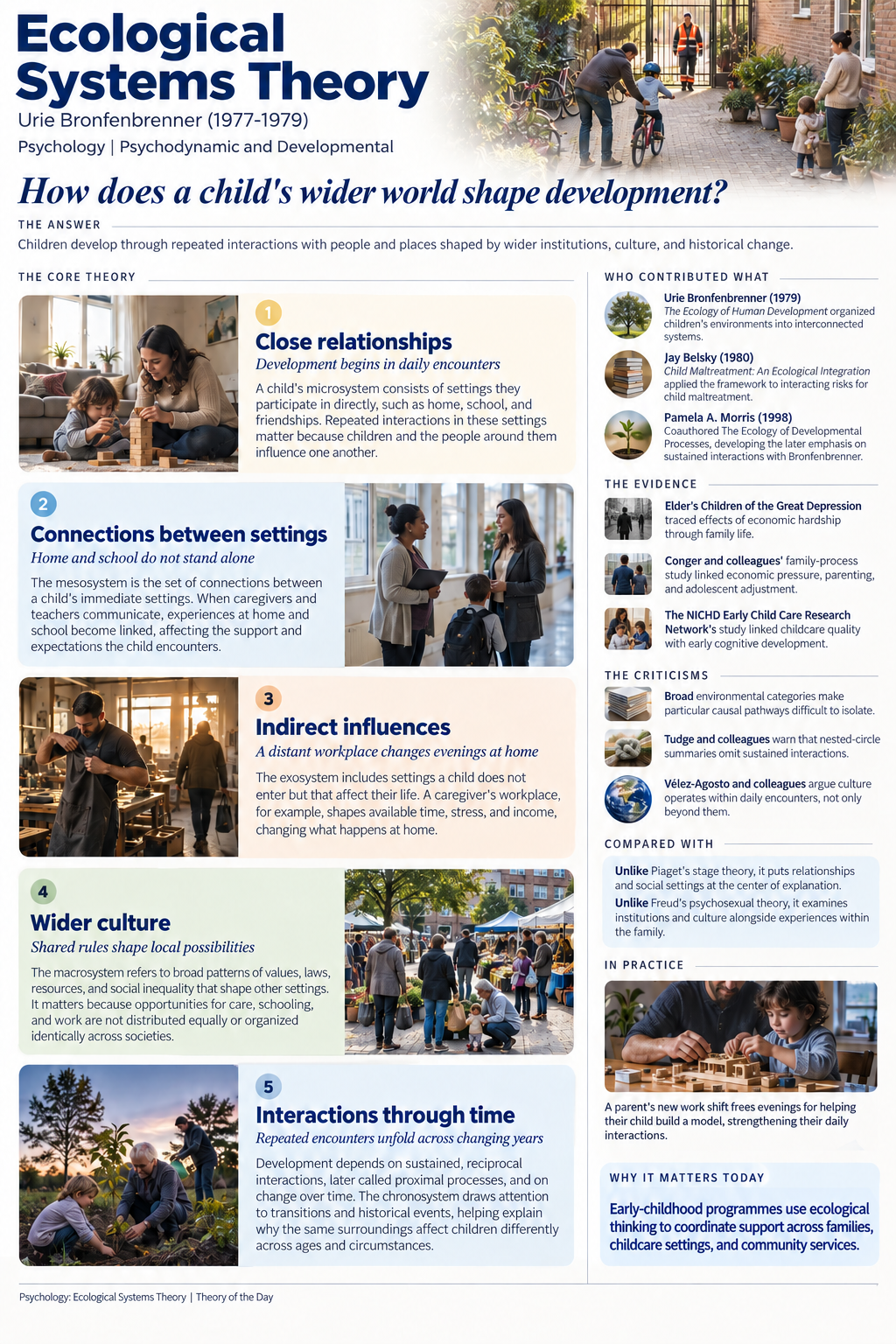
Infographic of: Ecological Systems Theory
Psychology: Psychodynamic and Developmental
Ecological Systems Theory
Urie Bronfenbrenner (1977-1979)
Children develop through repeated interactions with people and places shaped by wider institutions, culture, and historical change.
Urie Bronfenbrenner developed ecological systems theory in the 1970s, presenting an early account in a 1977 article and a fuller one in his 1979 book, The Ecology of Human Development. He objected to studying children as though development happened chiefly inside the individual or in isolated laboratory situations. To understand a child, he argued, researchers must examine ordinary relationships and the wider arrangements that shape them. His approach became important in developmental psychology because it joined close observation of everyday life to questions about institutions, culture, and social change.
The theory describes environments as interconnected systems. The microsystem contains settings a child experiences directly, such as home and school; the mesosystem consists of links between those settings. The exosystem includes arrangements that affect the child indirectly, such as a parent's workplace, while the macrosystem includes broader cultural values and social structures. Bronfenbrenner later emphasized the chronosystem: development unfolds amid life transitions and historical change. Crucially, children also act on their surroundings. Development arises through ongoing exchanges, not through environmental forces simply acting upon a passive child.
Bronfenbrenner supplied the original framework and later revised it into a bioecological model. This revision gave particular weight to proximal processes: sustained, increasingly complex interactions between a developing person and other people, objects, or activities. Jay Belsky extended ecological thinking in 1980 by examining child maltreatment as the product of interacting risks across family and wider social settings, rather than a single parental trait. Pamela A. Morris worked with Bronfenbrenner on the 1998 account of developmental processes, which helped articulate the roles of process, person, context, and time.
Research supports the importance of connections across levels, although no single study verifies every part of the framework. Glen Elder's Children of the Great Depression, published in 1974, followed lives shaped by economic hardship and changing family circumstances. Rand Conger and colleagues reported in 1992 that economic pressure was associated with parental distress, family relationships, and adolescent adjustment. Research published by the NICHD Early Child Care Research Network in 2002 linked the quality of early childcare with children's cognitive development. These findings illustrate plausible pathways from wider conditions to everyday experiences.
The theory is broad, and that breadth creates difficulties: researchers cannot easily separate the causal effects of overlapping settings. Jonathan Tudge and colleagues have also argued that familiar diagrams of nested circles often miss Bronfenbrenner's later emphasis on what people repeatedly do together. Edinete Vélez-Agosto and colleagues question placing culture only in a distant outer layer when cultural practices also shape face-to-face encounters. The bioecological reformulation addressed some earlier weaknesses by specifying interactions and time more clearly, but it did not remove the challenges of measuring complex lives.
Ecological thinking remains useful because a child's immediate difficulty may have sources well beyond the child. A parent working unpredictable hours, for example, has fewer opportunities for regular evening activities, even if the family's relationships are warm. Schools and early-childhood services use this perspective to consider how family routines, childcare, employment, and community resources fit together. The theory does not predict one outcome for every child in a given setting; it provides a disciplined way to ask how particular people develop through particular relationships under particular social and historical conditions.
The argument in four steps
- Children grow through repeated activities and relationships in their immediate surroundings.
- Relationships across home, school, and other settings reinforce or disrupt those experiences.
- Workplaces, institutions, cultural expectations, and historical events shape what happens in those settings.
- So development reflects the continuing interplay between children and their changing environments.
How it works
- A child repeatedly plays, learns, and negotiates with people in familiar settings.
- Support or strain travels between settings, while institutions and culture shape what each setting offers.
- Developmental outcomes depend on these interactions, the child's characteristics, and when life changes occur.
Who contributed what
- Urie Bronfenbrenner (1979): The Ecology of Human Development organized children's environments into interconnected systems.
- Jay Belsky (1980): Child Maltreatment: An Ecological Integration applied the framework to interacting risks for child maltreatment.
- Pamela A. Morris (1998): Coauthored The Ecology of Developmental Processes, developing the later emphasis on sustained interactions with Bronfenbrenner.
Compared with rival views
- Unlike Piaget's stage theory, it puts relationships and social settings at the center of explanation.
- Unlike Freud's psychosexual theory, it examines institutions and culture alongside experiences within the family.
Further reading
- Urie Bronfenbrenner, The Ecology of Human Development: Experiments by Nature and Design (1979)
- Jonathan Tudge and colleagues, Uses and Misuses of Bronfenbrenner's Bioecological Theory of Human Development (2009)
- Edinete Maria Rosa and Jonathan Tudge, Urie Bronfenbrenner's Theory of Human Development: Its Evolution From Ecology to Bioecology (2013)