Infographic of: Deliberative Democracy
Politics: Political Philosophy
Deliberative Democracy
Joseph M. Bessette, Joshua Cohen, Jürgen Habermas (1980-1992)
Democratic decisions gain legitimacy when free and equal people discuss reasons, listen to objections, and help shape the outcome.
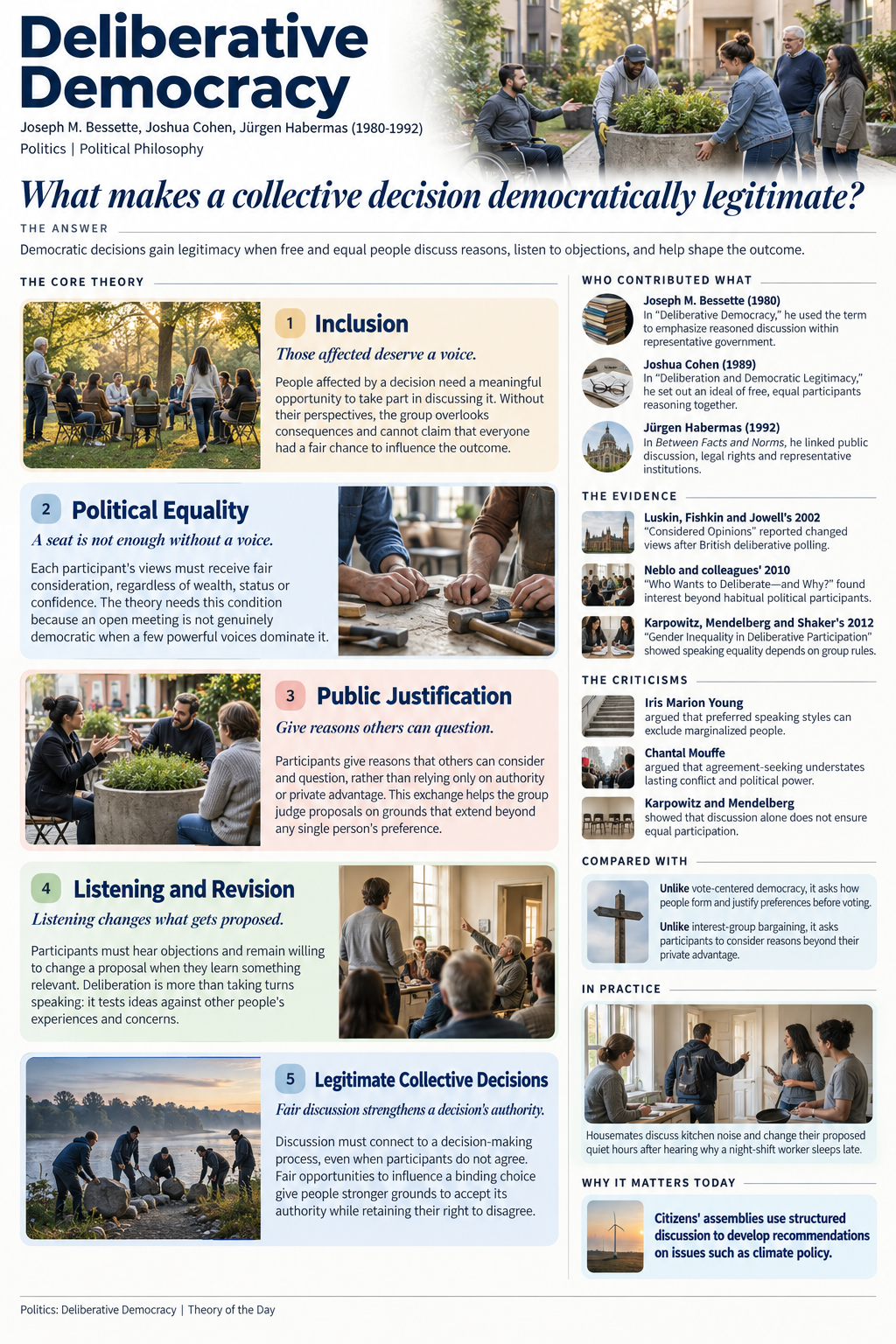
Deliberative democracy developed from dissatisfaction with accounts of democracy that focus mainly on counting votes or bargaining among competing interests. Joseph M. Bessette used the term in 1980 to emphasize reasoned discussion in representative government. During the late 1980s and early 1990s, Joshua Cohen and Jürgen Habermas developed influential accounts of why public reasoning matters for democratic legitimacy. They addressed a difficult question: when citizens disagree deeply, what gives a collective decision authority over them?
The central answer is not that discussion always produces agreement or the best policy. It is that people subject to a decision should have fair opportunities to exchange reasons, question proposals and influence what is decided. Participants encounter information and experiences they might otherwise miss; objections expose weaknesses, and proposals can change in response. Deliberation requires inclusion and political equality, not merely an invitation to speak. It also needs a connection to institutions that make decisions, because discussion by itself does not settle a public question.
The contributors emphasized different parts of this picture. Bessette drew attention to deliberation within representative government. Cohen's 1989 essay, “Deliberation and Democratic Legitimacy,” described an ideal procedure in which free and equal participants offer reasons to one another while seeking terms of cooperation. Habermas's Between Facts and Norms, published in German in 1992, connected public discussion to rights, legislatures and law. On his account, discussion in wider society informs formal political decisions; democratic legitimacy depends on the relationship between those settings, not on replacing institutions with a single public meeting.
Evidence is best understood as testing particular claims about deliberation, rather than proving a complete philosophical theory. In “Considered Opinions” (2002), Robert C. Luskin, James S. Fishkin and Roger Jowell reported changes in participants' views after British deliberative polling. Michael A. Neblo and colleagues' 2010 study, “Who Wants to Deliberate—and Why?”, found willingness to deliberate beyond the usual politically active participants. Christopher F. Karpowitz, Tali Mendelberg and Lee Shaker showed in 2012 that group rules and composition affect gender equality in speaking. These findings also caution against assuming that any discussion is automatically fair.
Critics question both the ideal and its implementation. Iris Marion Young argued that expectations about what counts as proper argument can privilege some speakers over others, overlooking stories and other ways of communicating political experience. Chantal Mouffe argued that a search for agreement risks understating enduring conflict and power. Deliberative democrats have responded by paying greater attention to inequality, emotion, testimony and disagreement. Research on small public forums likewise examines the conditions under which quieter participants are actually heard, rather than treating participation as equal simply because everyone was invited.
The theory still matters because public choices involve people who must live with outcomes they oppose. A fair process does not erase that disagreement, but it gives citizens opportunities to explain their concerns and challenge decisions before they are made. Citizens' assemblies, for example, bring selected residents together to learn, discuss and recommend responses to issues such as climate policy. Deliberative democracy supplies a way to judge such exercises: who was included, whose reasons received attention, whether views could change, and how the discussion shaped the eventual decision.
The argument in four steps
- Collective decisions bind people who hold different interests and values.
- Equal votes alone do not let people examine one another's reasons.
- Inclusive discussion gives participants opportunities to challenge claims and revise proposals.
- Therefore, decisions reached through fair public reasoning have stronger democratic legitimacy.
How it works
- People affected by a shared problem enter a discussion with different experiences, interests and proposed solutions.
- Questions and objections reveal overlooked consequences; unequal power or restricted participation can prevent this exchange.
- Participants weigh the revised options, then use an agreed decision rule without requiring unanimous consent.
Who contributed what
- Joseph M. Bessette (1980): In “Deliberative Democracy,” he used the term to emphasize reasoned discussion within representative government.
- Joshua Cohen (1989): In “Deliberation and Democratic Legitimacy,” he set out an ideal of free, equal participants reasoning together.
- Jürgen Habermas (1992): In Between Facts and Norms, he linked public discussion, legal rights and representative institutions.
Compared with rival views
- Unlike vote-centered democracy, it asks how people form and justify preferences before voting.
- Unlike interest-group bargaining, it asks participants to consider reasons beyond their private advantage.
Further reading
- Joshua Cohen, Deliberation and Democratic Legitimacy (1989)
- Amy Gutmann and Dennis Thompson, Democracy and Disagreement (1996)
- Iris Marion Young, Inclusion and Democracy (2000)