Infographic of: Desirable Difficulties
Education: Memory, Study and How Learning Sticks
Desirable Difficulties
Richard A. Schmidt, Robert A. Bjork, Elizabeth Ligon Bjork (1992-1994)
Based on: Robert A. Bjork, Memory and Metamemory Considerations in the Training of Human Beings (1994); Richard A. Schmidt and Robert A. Bjork, New Conceptualizations of Practice: Common Principles in Three Paradigms Suggest New Concepts for Training, Psychological Science (1992); Elizabeth L. Bjork and Robert A. Bjork, Making Things Hard on Yourself, But in a Good Way: Creating Desirable Difficulties to Enhance Learning (2011)
Study conditions that make learning feel slower and harder can produce stronger, longer-lasting memory than smooth, easy practice.
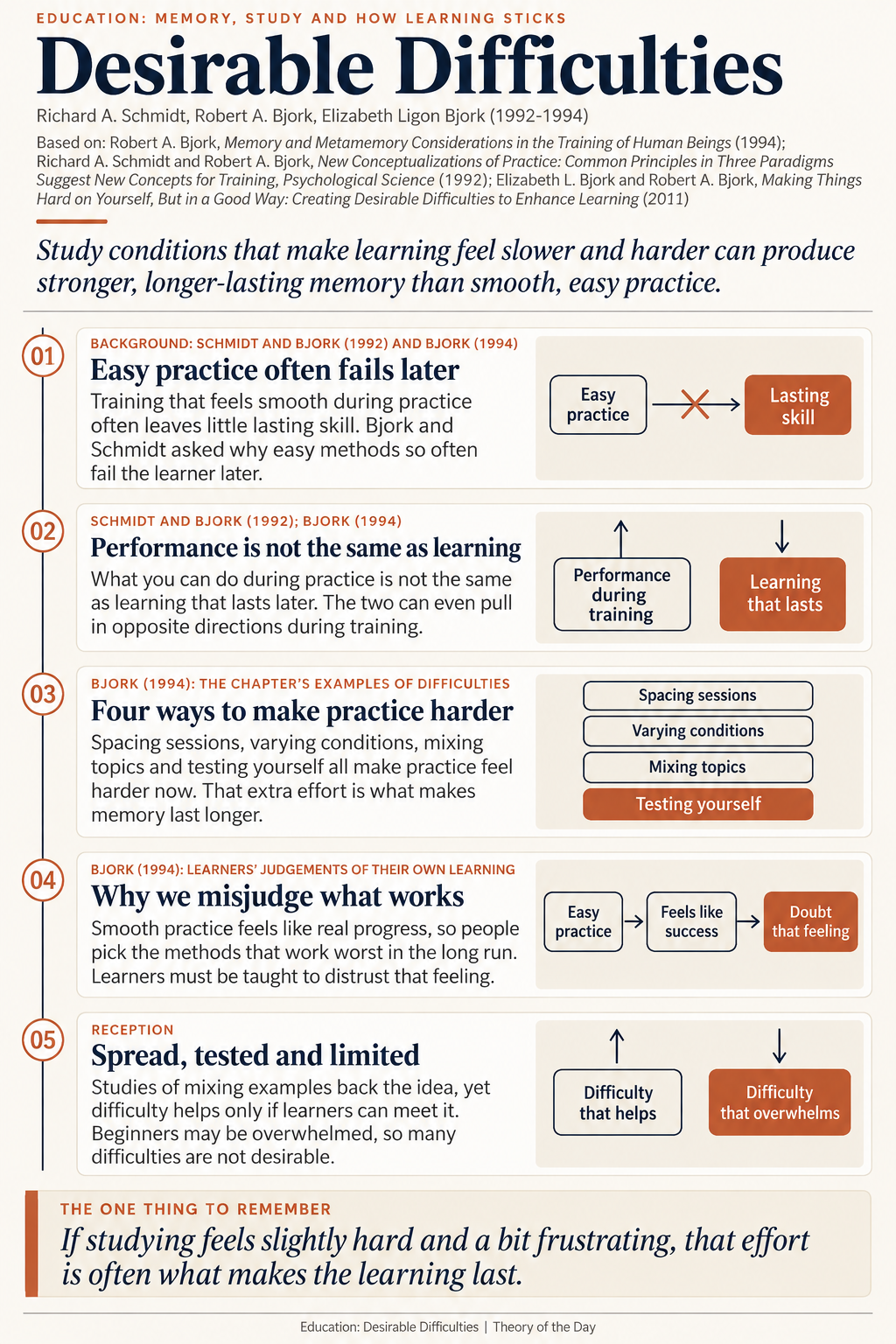
The idea of desirable difficulties grew out of work by Richard Schmidt and Robert Bjork in the early 1990s. They noticed a puzzle that runs through research on motor skills, verbal memory and problem solving: the training conditions that make practice go best often leave people with the least lasting skill. Their 1992 article in Psychological Science set out this pattern, and Bjork's 1994 chapter in a book on metacognition, which means thinking about one's own thinking, gave it the name and applied it to education. The question was why the easiest-feeling methods so often fail the learner later.
The argument is built in steps. First comes a distinction between performance, what a learner can do during practice, and learning, the lasting change that shows up after a delay or in a new setting. The authors argue that the two are separate and can even move in opposite directions. Bjork's chapter then lists conditions that slow practice yet help retention: spacing study sessions, varying the conditions of practice, mixing topics instead of blocking them, and testing instead of rereading. Making learners generate answers belongs in the same family. The chapter then turns to why people misjudge all this.
The mechanism is effort. Added difficulty forces the learner to work harder to retrieve, compare or reconstruct knowledge, and that work seems to leave a stronger and more flexible memory. Because the same difficulty slows practice and produces errors, it makes learning feel worse. Bjork argues that learners and teachers read ease as a sign of mastery, so they choose smooth methods such as rereading or repeating one task in a block. This illusion of knowing is why the best methods are often the least popular.
Others shaped the idea. Schmidt brought the motor-learning tradition, including Shea and Morgan's 1979 finding that random practice beat blocked practice on later tests. Robert Bjork supplied the label and the link to metacognition. Elizabeth Bjork joined him in later work, especially the 2011 chapter that restated the idea for students and teachers, and the Bjorks' lab at UCLA produced much of the supporting research.
The evidence is broad. Slamecka and Graf's 1978 experiments showed that generating words beats reading them, and Kornell and Bjork's 2008 experiment found that mixed examples of paintings taught artists' styles better than blocked ones, even though most learners believed the reverse. Critics argue that difficulty is not always helpful. John Sweller's cognitive load theory predicts that beginners can be overwhelmed by hard tasks. McDaniel and Butler stress that the benefits depend on the learner and the task. Others worry the label can be circular, since a difficulty is called desirable only when it works. Bjork himself says plainly that many difficulties are undesirable.
The idea still matters because it changes practical advice. It supports spaced revision timetables, low-stakes quizzes and mixed problem sets in schools and universities, and it warns students against trusting how fluent their studying feels. It also explains why teaching that looks effective in the classroom can disappoint on later exams. Used with care, it gives teachers a simple rule: make learning effortful, but only in ways that students can manage.
The work, part by part
1. Easy practice often fails later
Background: Schmidt and Bjork (1992) and Bjork (1994)
In the early 1990s, Richard Schmidt and Robert Bjork saw that training methods that look best during practice often leave little lasting skill. Their 1992 article drew on motor-skill, verbal and problem-solving research, and Bjork's 1994 chapter in a book on metacognition (thinking about your own thinking) applied the point to education. The question was why the easiest-feeling methods so often fail the learner later.
2. Performance is not the same as learning
Schmidt and Bjork (1992); Bjork (1994)
Both works separate performance, what you can do during practice, from learning, the lasting change that shows up later or in new settings. They argue that the two can move in opposite directions. Conditions that speed up practice can leave weak retention and weak transfer (using a skill in a new situation), while slower, more error-prone practice can build more durable knowledge.
3. Four ways to make practice harder
Bjork (1994): the chapter's examples of difficulties
Bjork names conditions that slow practice yet help retention: spacing study sessions apart, varying the conditions of practice, mixing topics instead of blocking them (interleaving), and testing yourself instead of rereading. Making learners generate answers rather than simply read them belongs here too. Each adds effort during learning, and that effort is what strengthens later recall.
4. Why we misjudge what works
Bjork (1994): learners' judgements of their own learning
Bjork argues that learners and teachers judge learning by how easy practice feels, which is a poor guide. Fluent, error-free practice creates an illusion of mastery, so people choose the very methods that serve them worst. For this reason, he says, learners need to be taught to distrust that feeling and to value effortful methods.
5. Spread, tested and limited
Reception
The idea spread through the Bjorks' 2011 chapter and many classroom studies, such as Kornell and Bjork's 2008 painting experiment, where mixed examples taught artists' styles better even though most learners believed otherwise. Critics, notably cognitive load researchers such as John Sweller, note that difficulty helps only when learners can meet it, so beginners may be overwhelmed. Bjork himself stresses that many difficulties are undesirable.
The argument in four steps
- Learners and teachers judge success by how well practice goes in the moment.
- But performance during practice and lasting learning can move in opposite directions.
- Spacing, variation, mixing topics and self-testing slow practice yet strengthen memory and transfer.
- Therefore teachers and learners should seek effortful, error-prone practice, as long as the effort is one the learner can meet.
Who contributed what
- Richard A. Schmidt (1992): Schmidt and Bjork's article drew on motor-skill research to show training that boosts practice performance can weaken lasting learning.
- Robert A. Bjork (1994): Coined 'desirable difficulties' in his metacognition chapter and linked them to learners' misjudgements of their own learning.
- Elizabeth Ligon Bjork (2011): With Robert Bjork, restated the idea for students and teachers with practical advice on spacing, testing and interleaving.
The evidence
- Shea and Morgan's 1979 motor-skill study found random practice beat blocked practice on retention despite worse practice scores.
- Slamecka and Graf's 1978 generation experiments showed that producing words yourself beats merely reading them for later memory.
- Kornell and Bjork's 2008 study found mixed painting examples taught styles better than blocked ones, though learners disagreed.
The criticisms
- Sweller's cognitive load theory: difficulty can overload novices and harm learning.
- McDaniel and Butler (2011): which difficulties are desirable depends on learner and task.
- Critics say the label risks circularity: difficulties are called desirable only if they help.
Compared with rival views
- Unlike behaviourist training models, it says easy, error-free practice weakens long-term learning rather than helping it.
- Unlike the learning-styles view, it says one effortful method serves all learners, rather than matching teaching to preference.
Why it matters today
Teachers and app designers use spaced, mixed and self-testing practice, now widely promoted in study-skills guidance for school and university students.
Further reading
- Peter C. Brown, Henry L. Roediger III and Mark A. McDaniel, Make It Stick: The Science of Successful Learning (2014)
- Mark A. McDaniel and Andrew C. Butler, A Contextual Framework for Understanding When Difficulties Are Desirable (2011)
- Nicholas C. Soderstrom and Robert A. Bjork, Learning versus Performance: An Integrative Review (2015)