
Did Rhodesia Have A Right To Exist?
I should say right away that the answer is no. If that’s good enough for you, then you can stop reading, right now. But I do think it’s interesting to pursue this question a little further.
First, some background, for those who might not know. Southern Rhodesia was a self-governing British colony that occupied the territory now occupied by the country of Zimbabwe. It had elections, a parliament, a government, a Prime Minister, a television service, and even its own army and air force. But it was under overall British sovereignty and the constitution under which it governed itself was under the control of the United Kingdom’s parliament.
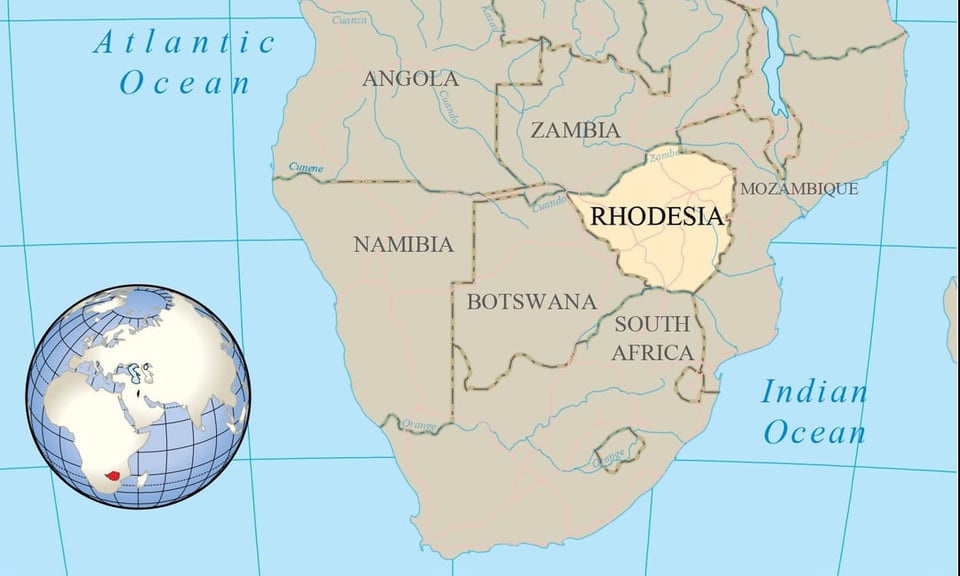
In 1964, following the colony of Northern Rhodesia being granted independence as Zambia, the government of Southern Rhodesia changed the name of the country to Rhodesia (which wasn’t actually within their powers). In 1965, they unilaterally declared Rhodesia independent (i.e. a fully independent, sovereign nation).
It’s worth looking at the text of their Unilateral Declaration of Independence. To save you having to read through the whole thing, I’ve highlighted the relevant bits in red (so feel free to skim though, I’ve included the whole thing only so that I can’t be accused of cherry-picking):
Whereas in the course of human affairs history has shown that it may become necessary for a people to resolve the political affiliations which have connected them with another people and to assume amongst other nations the separate and equal status to which they are entitled:
And Whereas in such event a respect for the opinions of mankind requires them to declare to other nations the causes which impel them to assume full responsibility for their own affairs:
Now Therefore, We, The Government of Rhodesia, Do Hereby Declare:
That it is an indisputable and accepted historic fact that since 1923 the Government of Rhodesia have exercised the powers of self-government and have been responsible for the progress, development and welfare of their people;
That the people of Rhodesia having demonstrated their loyalty to the Crown and to their kith and kin in the United Kingdom and elsewhere through two world wars, and having been prepared to shed their blood and give of their substance in what they believed to be the mutual interests of freedom-loving people, now see all that they have cherished about to be shattered on the rocks of expediency;
That the people of Rhodesia have witnessed a process which is destructive of those very precepts upon which civilization in a primitive country has been built, they have seen the principles of Western democracy, responsible government and moral standards crumble elsewhere, nevertheless they have remained steadfast;
That the people of Rhodesia fully support the requests of their government for sovereign independence but have witnessed the consistent refusal of the Government of the United Kingdom to accede to their entreaties;
That the Government of the United Kingdom have thus demonstrated that they are not prepared to grant sovereign independence to Rhodesia on terms acceptable to the people of Rhodesia, thereby persisting in maintaining an unwarrantable jurisdiction over Rhodesia, obstructing laws and treaties with other states and the conduct of affairs with other nations and refusing assent to laws necessary for the public good, all this to the detriment of the future peace, prosperity and good government of Rhodesia;
That the Government of Rhodesia have for a long period patiently and in good faith negotiated with the Government of the United Kingdom for the removal of the remaining limitations placed upon them and for the grant of sovereign independence;
That in the belief that procrastination and delay strike at and injure the very life of the nation, the Government of Rhodesia consider it essential that Rhodesia should attain, without delay, sovereign independence, the justice of which is beyond question;
Now Therefore, We The Government of Rhodesia, in humble submission to Almighty God who controls the destinies of nations, conscious that the people of Rhodesia have always shown unswerving loyalty and devotion to Her Majesty the Queen and earnestly praying that we and the people of Rhodesia will not be hindered in our determination to continue exercising our undoubted right to demonstrate the same loyalty and devotion, and seeking to promote the common good so that the dignity and freedom of all men may be assured, Do, By This Proclamation, adopt, enact and give to the people of Rhodesia the Constitution annexed hereto;
Essentially, it boils down to “we, the Rhodesian people, have a right to become an independent, sovereign nation, but the British government is refusing us the type of independence that we want, and is instead offering only a form of independence so utterly unacceptable to us that we simply cannot accept it”.
So what was it that was so unacceptable in the independence that the British government was offering? Well a lot of British colonies were becoming independent around then, and it seems the British government was relatively relaxed about what form of government they could have. The previous year, for example, Northern Rhodesia had become independent as Zambia, with the form of government being that of an executive presidency. But crucially, the constitution of any newly independent country would give them the power to then modify that constitution in any way they saw fit, with Britain having no power to object.
In other words, Britain was pretty flexible about the constitution that a newly independent Rhodesia would start out with, but if there was anything in that constitution that the people of Rhodesia found objectionable, they could immediately change it, right after the first election was held.
So what was the problem?
Well the problem that the while Southern Rhodesia had been a self governing colony since 1923, it had not been under a democratic franchise. Instead, there was both a property qualification and a English language qualification for voting which resulted in only around 5% of the population being able to vote, who pretty much were the 5% of the population who were white. Every single MP and every single government minister was white.
And the government of Rhodesia wanted independence under that same constitution. They wanted to be an independent and sovereign non-democracy, where only the richest 5% of citizens had the vote.
And that wasn’t something the British government was prepared to offer. Any colony becoming independent had to start off as a democracy. That was non-negotiable.
But this goes deeper. Let’s look at they key part of their declaration of independence again:
“…they are not prepared to grant sovereign independence to Rhodesia on terms acceptable to the people of Rhodesia”
If that was true, then it wouldn’t be a problem. A party could stand in the initial democratic election on a platform that the constitution should be amended to strip the vote from the 95% of the population who’d only just got it, and all the black people would enthusiastically vote to have their right to vote taken away, and then the parliament so elected could amend the constitution to do so.
Except that wouldn’t happen, would it?
Because the statement “…they are not prepared to grant sovereign independence to Rhodesia on terms acceptable to the people of Rhodesia” only makes sense if you define the people of Rhodesia as the white population of Rhodesia.
It is clear from the constitution that the Rhodesian government didn’t consider the black people in the country they ruled to be Rhodesian. Whether or not they considered them to be people is a question outside the scope of this post. But they certainly didn’t consider them to be Rhodesian (because otherwise, that line in the constitution makes no sense).
Rhodesia wasn’t just the colonial name for the country now called Zimbabwe. It was a country of the white settler population of that area, for the white settler population of that area, with the indigenous black population being regarded as foreigners and non-citizens in that land.
If we define “the Rhodesian people” as the white, English speaking people of that land, then I absolutely believe that they had, and still have, a right to live in peace and freedom, and to exercise democratic rights in the country of which they were citizens.
What they didn’t have was the right to create a country that was exclusively for them, and which excluded others who lived in that country and had just as much claim to it (actually more, but again that’s another subject).
People have rights. Countries do not. It’s a complicated world, and there are many areas where the reality on the ground is messy and neat solutions don’t fit. I’m not denying that. But I think it’s reasonable to say as a general starting point that while peoples have the right to self-determination, it has to be all of the people of a land, not just some of them.
Rhodesia did not have a right to exist.


