
Ambiguity Belongs In Your Story, Not Your Text
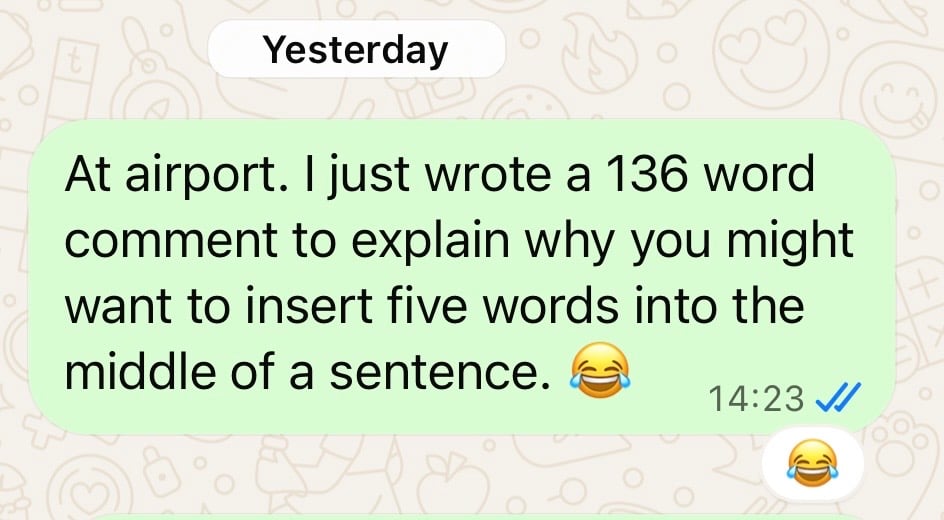
A friend of mine has recently begun writing a novel, and he asked me if I could look over it. I’m always keen to give my inner editor a workout, but as with helping my daughter, doing this has also helped me clarify some of the principles I try to follow in writing, because rather than simply suggest a correction, I’ve found myself writing long Word comments explaining my reasoning.
And one thought I had was that while it’s perfectly fine, and often desirable, for the reader to not know what’s happening in your story, they should never be confused about whether they’ve misread something. You don’t have to tell them everything, but they should understand what it is that you have told them, and be happy that if there’s something they don’t know it’s because you haven’t yet told them, not because they misread or misunderstood what you wrote.
This thought was sparked by a sequence of sentences my friend had written that could be read in two different ways. So the scene was a man sitting in his office in 2009, and the sentences basically said:
His phone rings.
He decides he ought to answer it.
It’s his mother, and she never calls him at work, so it must be important.
It is important, his brother is in trouble.
But did she ring him on a mobile phone, with “Mum” appearing on his display, or an an old style desk phone, without any display? Because in 2009, it could be either.
If a mobile phone, then the above boils down to:
His mother phoned him, so he decided he ought to answer it because she wouldn’t be phoning him unless it was important, given that she never phones him at work.
But if it was a desk phone, then the above boils down to:
His phone rang, and he decided he’d better answer it, because it might be something important, and it is his job to answer the phone, and when he did answer it, it turned out to be his mother, so then he knew it was important, because she never phones him at work.
Now, in a sense, it doesn’t matter. It’s the same story either way. But for me, it jarred me out of the narrative, because I didn’t know if the third sentence, about it being his mother, was explaining why the second sentence said he thought he ought to answer it (i.e. it’s referring to before he answers the phone) or what he discovered upon answering the phone (i.e. it’s post answering the phone). Because the narrative was just consecutive sentences, it wasn’t clear what the cause and effect was.
In this case the solution is to do a mild rewrite on the passage, perhaps joining some sentences together with subordinating conjunctions (and yes, I did just have to look up that phrase, but it’s basically words like “because”, “since”, and “given”), and possibly adding some description, like, say, describing him answering the phone, and if it is a desk phone, perhaps changing “his phone rang” to “the phone on his desk rang”.
This is a trivial example, but I thought it’s a good one, because it’s also an example of how as the author, when you have the scene pictured in your head, you can easily overlook ambiguity. (In this case, you might be picturing in your mind a workplace office, with a desk, and a man reaching for a ringing early 21st century desk phone).
This is why having someone else look over your manuscript, whether that be an editor or a beta reader, is so useful. You need eyes that are not your eyes looking at your text, not because they’re better eyes, but because they’re not connected to the brain that wrote that text.


