Review: The Strange Case of Jane O.
I’ve come to really enjoy literary fiction that incorporates genre fiction elements, particularly sci-fi and horror. I love the “slightly speculative,” where maybe the setting is dystopian or near-future, but with all the hallmarks of literary fiction — interiority, character development over plot, excellent prose, and avoidance of predictable beats in favor of more exploration of the characters and their psychology.
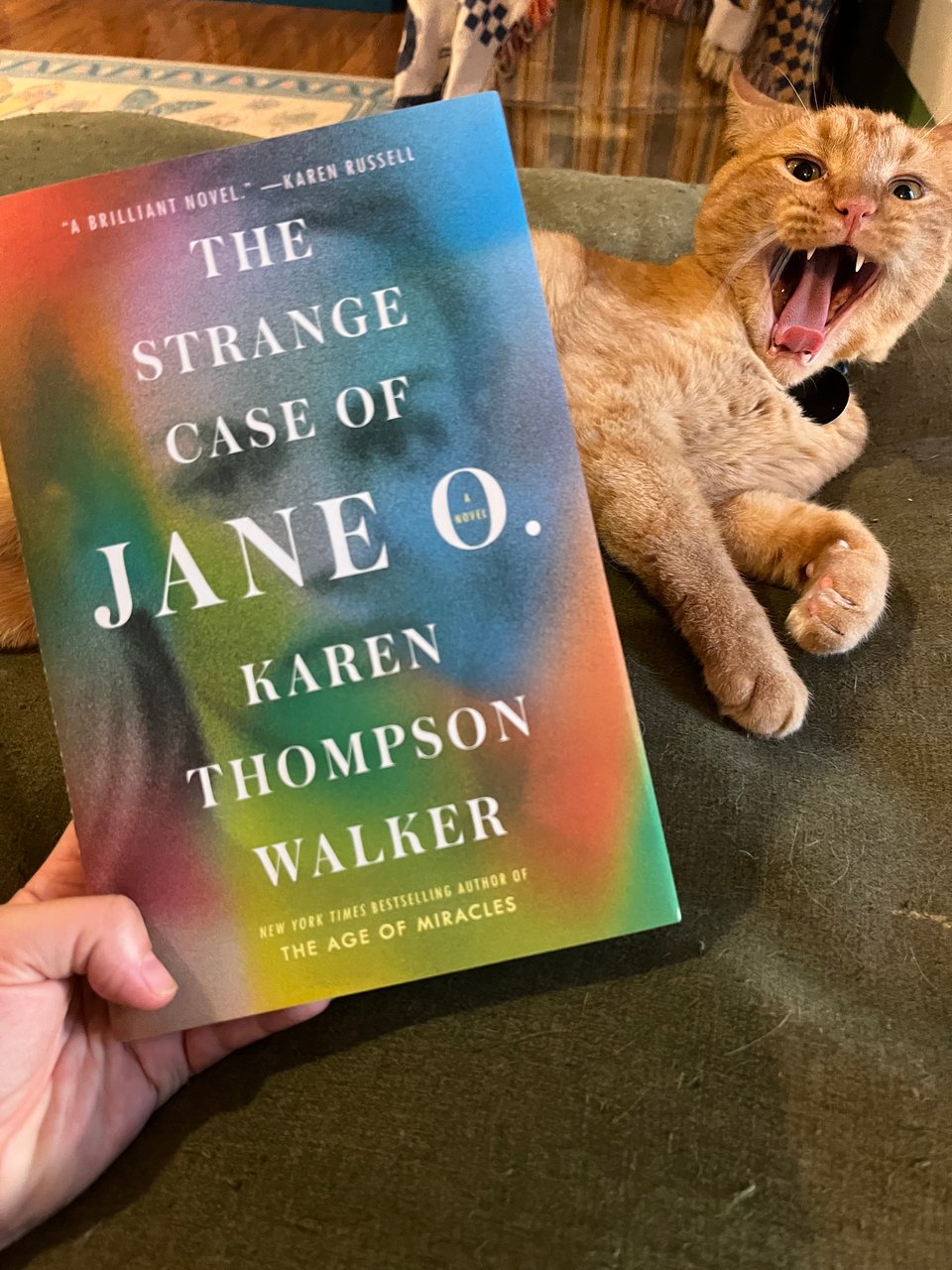
Given that, Karen Thompson Walker’s novel The Strange Case of Jane O. managed to hit some sweet spots for me, even though I ultimately found it a bit of a letdown. It’s a difficult novel to summarize, but I’ll do my best. A 30-something woman in New York City, known only as Jane O., starts seeing a psychiatrist, Dr. Byrd, after experiencing unusual symptoms – hallucinations, premonitions, amnesia. Jane is a librarian at the New York Public Library and a single mother to a young son. She’s a remarkably reliable, stable person, and she’s never had experienced mental health issues before. Her symptoms are far out of the ordinary, and they are disturbing to her and the few people in her life.
The narrative is split between Dr. Byrd’s account of his sessions with Jane and Jane’s journal entries, written as letters to her son. The central mystery of Jane’s illness is gripping and a page-turner, uncanny in a highly satisfying way. As Jane’s case unfolds, it’s obvious that both Jane and Dr. Byrd are unreliable narrators. They make odd choices, sometimes unethical ones, often frustrating ones. The book explores big themes around the unreliability of memory and how much we can trust our own subjective experiences. By the end of the novel, I had decided that it didn’t matter if what the protagonists had described were true or not, just that it was true to them.
What did bother me is that Jane is an extreme loner. As the story unfolds, it becomes clear why she has trouble connecting with people. But I have grown tired of novels with protagonists who have zero friends and are estranged from their families. I’ve seen this across literary fiction and in genre, too: a few thrillers, mysteries, and more than one romance novel. I’m tired of it. Loneliness is a worthwhile concept to explore in fiction, but the completely isolated loner who has no one is not so interesting to me at this point. The protagonist who has relationships and friends, who tries to connect with other people and still feels lonely – that is much more interesting. And I think that’s where Jane O. fell flat, both the character and the book as a whole. I found the mystery of Jane’s symptoms entirely engrossing, and at times, I was really rooting for her and felt immensely sad for her. Yet, I often could not connect with this character because she connects with no one.
The Strange Case of Jane O. reminded me a great deal of Ilana Masad’s Beings, another lit fic novel with speculative, sci-fi elements that I liked but didn’t love. Both books feature LIS professionals with zero friends. Look, I know my profession. We’ve got introverts, curmudgeons, and grumps galore. It’s true! But it’s not all of us. Some of us became librarians because we genuinely love working with people, and much of the work requires people skills. We’re not hiding in back rooms all day with piles of books. I don’t know. Maybe it’s time for me to write that book instead.
Audiobooks in Brief
Even though I tore through Jane O., I’m in the middle of a bit of a reading slump. I’ve been listening to audiobooks, though. Here are two I enjoyed recently:
Didn’t You Used to Be Queenie B? by Terri-Lynne Delfino: I loved this book. It’s like Margo’s Got Money Troubles meets The Bear. Interestingly, I saw many parallels between this book and Theo of Golden — redemption, celebrity-in-hiding, intergenerational friendships. But Queenie B. has far superior execution. In particular, this book explores addiction with a raw and real empathy and gets a lot right about the struggles of workers in the food industry. Plus, like Delfino’s other books, it’s got some great Italian American representation.
Daddy Issues by Kate Goldbeck: I loved Goldbeck’s first romance novel You, Again, but I avoided this follow up because it features a significant age gap and the single dad trope. Both give me the ick. But I’m so glad I gave Daddy Issues a chance because it’s genuinely funny and sweet. It’s as much about a young woman figuring out her shit as it was about falling in love. It’s a real and lived-in romance novel that features average people with shitty jobs. I always like those.

