"I wanted to make astronomy accessible to people like me"
A Q&A with astronomy educator Carissa Avina-Beltran
Hello JustSpace readers! Now that we’re deep into the (Northern Hemisphere) school year, we wanted to take a look at one of the many excellent astronomy education programs who are working to bring space science to the public. We’re big fans of Rising Stargirls, an initiative founded by UC Irvine astronomy professor Dr. Aomawa Shields, which runs workshops for middle schoolers combining astronomy and the arts. See below for our conversation with astronomy educator Carissa Avina-Beltran, a Program Coordinator for Rising Stargirls. This interview has been lightly edited for length and clarity.
Q&A with Carissa Avina-Beltran
What are your current positions?
I'm a program coordinator for the Rising Star Girls and handle all sorts of admin tasks for Dr. Shields and her research group at UC Irvine. I also work as a telescope demonstrator at Griffith Observatory here in Los Angeles. And then lastly, I'm an events program specialist at the Columbia Memorial Space Center in Downey.
You must be driving a lot!
Yes! That's just part of living in Los Angeles, but it's okay because I'm a local and I'm used to it.
It’s great that you have such a density of observatories and institutions where you can work.
Throughout my education, and once I arrived at Griffith, I learned the history of observatories and space institutions here in California, and I totally agree: we're so lucky. But it also makes sense, once you learn the history of scientific societies and philanthropic funding for astronomical observing and research through observatories in California.
Can you tell me a little bit about your career path and how you ended up in astronomy education and communication?
I started out as a community college student out at Santa Monica College. I was really into Latin American studies, because if you have taken any history class, that's actually American history. You learn about American imperialism throughout the world, and the history of how Latin American communities migrated to the US has always been something that has been near and dear to my heart as a first-generation college student whose parents immigrated from Mexico.
But then I took an astronomy class, just because I had to take an elective. It was taught by a professor who worked at JPL. We would ask him all sorts of questions, and he would just say, "Well, the leading theory is this. This research says this. This researcher says that. But we really don't know." And I'm like, "How do you not know? You work at JPL! You work at NASA! How can we not know these things?" That just fascinated me, and I always loved math. Physics, ultimately, is just a math word problem.
So, I wanted to know more about astronomy, and at some point, I decided, “I’m going to pursue astrophysics, because this is awesome, and I want to learn more.” And I wanted to also make these things accessible to people like me, or people who may not have that background. Because just like Latin American history, it's something that certain people aren't exposed to. A lot of people deem themselves “not math people,” or had bad experiences in math or physics, and maybe that's not their avenue into connecting with astronomy.
So I transferred to SF State. I was able to do research with the exoplanet group there. My PI [Principal Investigator] was Dr. John Brewer. Not only did he allow me to learn how to do the data analysis behind the work he was doing to search for Earth-sized exoplanets, but I was also able to work with some of the grad students who are in instrumentation. So that was really awesome, and that was also one of my passions: learning by doing. I'm a very hands-on person as well, so I had a great time, and I really got to learn by doing.
I volunteered at our on-campus planetarium, and at our on-campus observatory. From there, I pitched– It was something I worked on together with my PI. He told me, “I have funding, if you ever want to do something with Spanish science communication.” I said, “That's interesting, I would love that. Why don't we do a bilingual astronomy night?” So that's where I started: We organized monthly astronomy nights where we opened up our observatory, opened up our planetarium, and hosted some students that could speak Spanish and were studying physics or astronomy in the area. And they conducted talks in Spanish and English. It was amazing. We had a great turnout. I feel like we served and reached a lot of that Latino population there in San Francisco, which most people know as being in the Mission District, in addition to the student population on campus.
It was nice to have that audience there and also bring back a spotlight to the campus as an institution that was available to the public. These events showed students and Bay area residents that our observatory is open two to three times a week, and they're more than welcome to visit the observatory and look through our telescopes throughout the week. That also brought this outpouring of the public that really helped the student volunteers improve their science communication.
After I graduated, I started working at the Columbia Memorial Space Center as a museum facilitator. They had restarted their astronomy nights after shutting down for some time during the pandemic. So I led the building of that community here in Los Angeles. I had connections with the grad students in the area who are now postdocs. Once you're in the astronomy community and the space community, you begin to learn who's an ally to women, and Latinos, and underrepresented minorities, and the LGBT communities. You form those networks, and I really wanted to platform those people, because I wanted to reflect the diversity of the LA area. So I started inviting them to speak at these events, while hosting telescope workshops, and expanding the museum’s outreach.
From there, I started working at Griffith. I cold-emailed the hiring manager of the telescope operators, who was also in that network. At Griffith, the employees (many of them in the LA entertainment industry) helped me with public speaking while I became more comfortable with these really large telescopes, like the 16-ft long, 12-inch Zeiss refractor– Which seems small to me now! But initially, I was scared of saying the wrong thing. I had to practice and build this quick adaptability and flexibility when answering questions with the public, whether that was a fifth grader or an adult. It could be someone who has no background. It could be someone who has all the background. I was an amateur astronomer and just practicing my science communication and presentation skills there, and really building on how to keep people engaged.
With all of that experience, I then applied when Dr. Shields had an opening for Rising Star Girls, and that's where I put my science communication and planning skills into practice with the summer camp workshop format. So, this is where I'm at now.
I’ve often heard that the skills developed in acting, comedy, or improv can be really useful for public speaking. You're in the LA area, so you’ve probably tripped over three people today who do improv, right? Is this overlap of skills something that you see talked about in the Los Angeles science communication world?
Oh, definitely! I had that mindset of, “If you can make people laugh, you can make them learn anything.” That was always an approach that I had with my presentations in undergrad, and when I arrived at the Space Center. At Griffith, there's a lot of actors and a lot of people who do improv, and they have these theatrical techniques that I didn't know. But that all made sense to me, because you have to kind of put on this show sometimes, to make astronomical and physics concepts more digestible, and to bring in the audience, to meet them where they're at. So I've really learned from my colleagues at Griffith. Some of them have experience in the theater. That's what they do, through improv, or at local LA theater. Some are trying to be actors, or influencers, and things like that, while others have been doing science communication for decades. I've been able to learn from a lot of them.
It's so funny, because it is a very supportive environment, and even if you make a mistake, they'll workshop it with you, and I really like that. They are very encouraging and supportive of mistakes, very contrary to the academic environment, where it’s common to put you on the spot with a “gotcha” question. This is very different: we often say to each other, "Okay, what's a better way to say that?" Or, "Hey, I really like that. Can I put a spin on this?" It's very collaborative and very open to constant improvement and trying things out. So that's been super helpful, and something that, when I'm training facilitators with Rising Stargirls and at the Space Center now, I try to share with them. It’s not always about knowing the numbers. It's not always about knowing the answer to every single question that's going to be asked. It's about communicating so that people are having a good time and actually listening and taking in the information you are sharing.
It’s interesting to hear that science communication intersects not just with improv skills, but also with improv culture: that sense of “we're all on the same team here,” much more than in academia. I hadn't thought about that before.
I've been out of academia for a minute. After graduating, I find that some of the best speakers tend to be amateur astronomers or hobbyists. It's been really nice to see that camaraderie and to find this other community that is passionate about astrophysics, but that has a very, very different approach.
There’s still a lingering culture within academia that sees any career move away from research– even towards science communication– as a kind of failure. Did you struggle with any of that when you were deciding whether to go to grad school or straight into your science communication work?
Definitely. Like I mentioned, I come from a very different background than the typical astronomy or physics student, or even STEM student. Initially, through all the challenges and all the hardships, I did decide, “Hey, I do want to do a PhD.” But then the pandemic happened. I think we all were just reconsidering– Like, things were really chaotic, so do I see myself dedicating seven years of my time to being away from my family, if things are going to continue to be uncertain? I was realizing that I also need to be there for them, and I have these responsibilities, and at the moment, [grad school] is just not something I can commit to. So I need to do something else.
I still keep in touch with those in academia, and think about getting a Master’s. It was honestly more of the financial aspect and having to move really far away from my family. I just wasn't ready for that. COVID unearthed a lot of things. I feel like we all have COVID on our resume at some point, where there's a massive career shift, whether people quit their jobs and went back to school, or decided not to go to school.
It sounds like you're a great example of someone who can be really successful, a multiply-employed science communicator, without having to spend seven years getting a Ph.D. about it.
Yeah, and it was hard, I'm not going to lie. I did take some introductory entry-level jobs. But I'm really glad that I stuck with it and saw what I wanted to bring to the table and developed that. I'm here now because these are the exact things that I wanted to do. Which is also why I'm really grateful for Dr. Shields. I didn't know she had a need for a program coordinator, but I'm so glad that she does, because now I get to work with someone who's brilliant and who I looked up to during my undergrad. And now I’m able to run a program that introduces kids from communities like my own to astronomy and physics!
That's a perfect segue. Tell me more about Rising Stargirls!
Rising Stargirls is a creative arts workshop that introduces middle schoolers to astronomy through theater, drawing, and writing exercises. We host these workshops online through Zoom, and also now in person. We had over 50 participants total through the summer, and it's been really, really great to see all of these participants connect more to these science identities throughout this workshop while also learning about the different fields in astronomy.
How did Rising Stargirls get started? Did Dr. Shields just start this in her spare time while she was being a professor?
In 2015, as Dr. Shields began her postdoc, her own existence and journey as an African American woman in astronomy with a love for makeup and fashion (and a background in acting) led her to begin hosting astronomy workshops at local middle schools in Los Angeles. She incorporated theater, writing, and art into short astronomy lessons, motivated to promote and inspire girls of color to bring their full selves to what they learned. For example, she introduced these “playbooks”, so that aside from participating in the learning activities, the participants also decorated their playbooks and used them to reflect on the topics they covered. So when learning about constellations, they formed important connections to the constellations they saw in the sky at night. The playbooks, lessons, and activities guided participants through the major fields of astronomy through their own creative lens.
Rising Stargirls provided a space where anyone in that middle school age could learn informally about astronomy. Dr. Shields had a very specific vision, influenced by her own opportunity to attend a high school with an on-campus observatory where she was first able to observe the sky with a telescope. With three workshops completed, Dr. Shields continued Rising Stargirls as a professor in UC Irvine’s Department of Physics and Astronomy.
Since its start in 2015, Rising Stargirls has been incredibly successful. There have been over 100 participants in the last ten years. Additionally, the program has now grown from Dr. Shields as the sole facilitator, to now having 7 facilitators (students from UCI) teaching and running activities, in addition to my role as the program coordinator to plan and prepare the workshops.
How do families apply? Is it still through the schools or can anyone apply?
Anyone can apply for the virtual workshops. We open registration in the spring, and then we host the workshops in the summer. The virtual workshop is a two-week workshop where we meet two hours a day. They get to learn about all kinds of things: stars, the solar system, exoplanets, black holes, galaxies, the history of science and scientists in the field. The new things that we're looking at are dark matter and dark energy, because the kids have so many questions about that. They're so curious, so we have to expand and adjust to what they're interested in.
The in-person camps tend to happen in the LA and OC area. That's where we're going to focus this coming summer. Once we decide where we're going to be hosting, then those locations will go out to not only our website, but also the areas that we're collaborating with.
So it's middle school students, but is it just girls, or is it now open to all?
It's open to anyone in the middle school age range, so that's 11 to 14. One of my teacher friends says that up to third grade, students are learning to read, and then after that, they're reading to learn. So, we want students that are already at that reading level, but before they get to high school where everything's just too cool for them. So this is the ideal age where they're still wanting to experiment and be creative. And they're really curious.
I love this combination of the arts and STEM. It seems like that would really engage the kids from all different directions and interests. What kinds of activities do they do in the program?
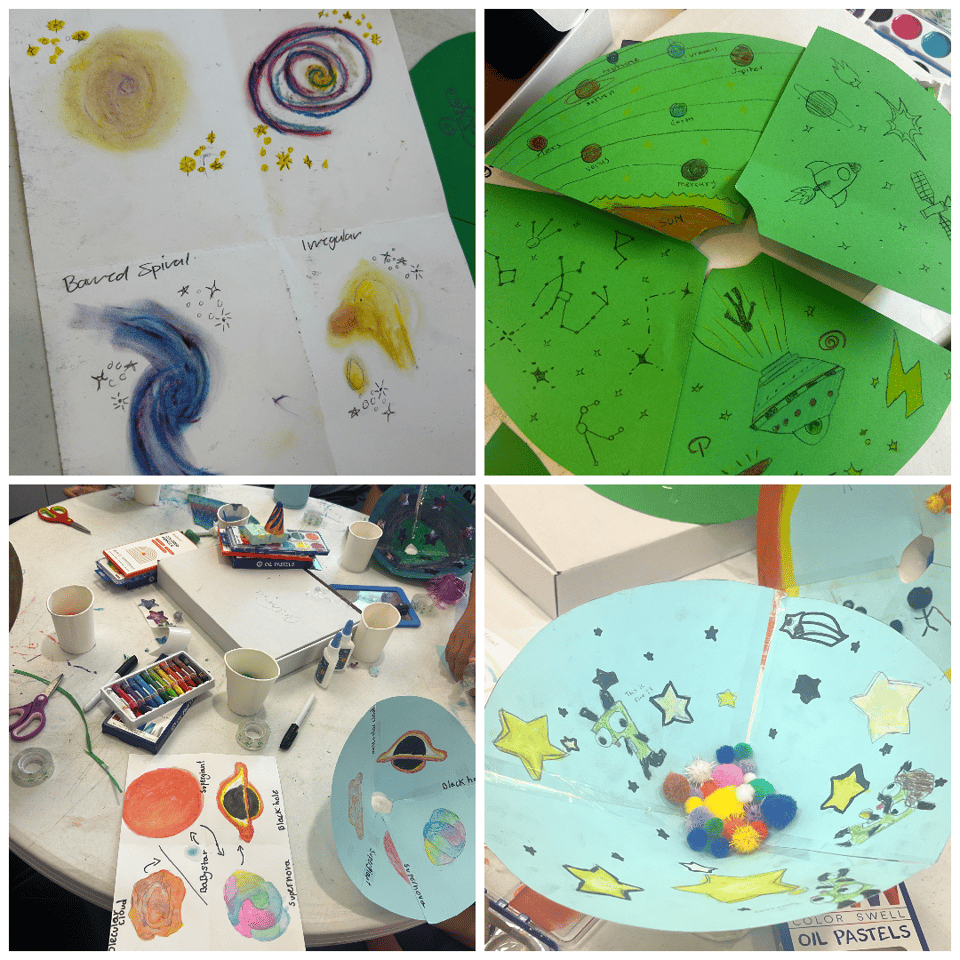
Drawing, illustrating, coloring, painting. They make kaleidoscopes and models of black holes and neutron disks with jets, and then decorate them.
We use our Celestial Buddies [plush celestial body toys] to incorporate some of our theater activities. We basically have them play around with the Celestial Buddies and create little skits. They were obsessed with those. I'm surprised one didn't go missing. They also just like to be silly and play around. With this new era of media, you can already see that they know how to work with, like, TikTok and Instagram and Reels, but they are just creating these silly scenarios with each other. You can hear them applying what they learned. Taking creative liberties, but applying what they learned there.
Oh, and here’s another one: they create their own constellation, draw it, and then write a story about it. That allows them to reflect a little bit and explore their thoughts. Then they share their story with the group, so they're also practicing their presentation skills.
They feel really comfortable sharing because we make it a safe space. Some would say the participants were TOO comfortable, where we would run out of time to let each person share. [Laughs] We do have rules from the start, to be respectful of one another. And you can totally see them building that confidence. And if they don't want to share, that's totally fine, they can opt into the surveys before and after the workshops, where we gauge if they see themselves as science people, if they talk about science with friends and family. And you can definitely see that they do this more consistently towards the end of the program.
That seems so crucial, especially at that age, to begin to identify yourself as someone who is “science-y”.
Right, exactly. In our paper, we cite a study showing that it’s in this middle school age group when you start to see a lack of confidence with all students. Primarily with girls and non-binary learners, you start to see a little bit more of that. Even when we were going to outreach events and advertising for this program in classes, the girls were a lot more hesitant, thinking, “This might not be for me,” until we brought out the plushies. It's really nice to see, and to communicate to them, that “Hey, this doesn't mean you have to be an astrophysicist. This doesn't mean you have to take up astronomy as a hobby. We just want you to have this experience and this connection to this topic, so that as you grow up, you’ve already made these personal connections. The activities were great, but you also made friends. You made these connections with other people in the class, so you'll remember that as a positive experience as you continue through your academic journey. You'll have these positive experiences in your belt to combat any negative things that might come up along the way.”
I definitely have those negative experiences, myself. You know what it's like, when it's just you and another girl or non-binary person, and everyone else doesn't want to work with you, they challenge the knowledge that you have. Then you think, “Well, I'm just going to do this alone.” It’s very isolating and makes you second-guess yourself. Sometimes I only had professors that I could go to for help. Luckily, my campus was one of the more diverse ones. And I worked with many of the grad students as an undergrad, which was also really nice, because they had a very different kind of confidence that I learned to develop throughout and after my undergraduate studies.
Looking at the photos of previous workshops, it looks like this is a hugely diverse group of kids.
Oh, definitely, definitely. We had learners of all backgrounds. The online virtual workshop had so, so many students from all over the country. We had students from Texas, the East Coast, NorCal. We had a student from the UK, we had a student from India. I think they were all really fascinated with each other, too, which was really nice to see. They would say things like, “Oh my gosh, this person has an English accent, or a Texan accent. What's in Texas?” And learning that they're seeing different objects in the sky, as well, through these conversations. It was so beautiful to see.
How can people support Rising Stargirls? Do you take donations?
At the moment, we don't take donations, but we would love to have people stay up to date with us by following us on our Instagram: @RisingStarGirlsOrg. They can also feel free to check out our website, but our Instagram is where we'll post any updates, especially when registrations are live. We do have a webinar coming up in December, where we’ll share some of our insights from this past summer with others in the community, teachers, and anyone who’s interested.
That was going to be my next question! For people who are inspired to start similar work in their local area, do you have any advice for them?
They can check out our website. We have handbooks of our activities available for download completely for free. We highly encourage people to use what works for them from that material. We love sharing our philosophy and our approach to learning astronomy there. They can find more resources through the handbooks, or they can just reach out to us through our email. And again, check out the webinar in December.
To bring it back to you, do you have any advice for people who are intrigued by hearing about your career path, and who might also want to get into science communication and education?
Just take opportunities that align with what you want, and be honest with yourself. You don't have to follow the path that everyone else does just because they tell you to and because that's what has worked for everyone else. It might just not work for you, and if your heart is telling you, no, just say no. And also, do what calls to you. Find those opportunities, fail at them, fail again, fail a third time, keep failing, keep trying. And just put yourself out there, because you are unique and amazing.


Add a comment: