TEETH: The End Of Everything?
Welcome, watery newsletter-folk, to the TEETH newsletter! This is a (mostly) weekly transmission about our explorations in the very secret land of Tabletop Roleplaying-Games.
What appears within this letter is written and compiled by veteran game critic and designer, Jim Rossignol, and former Mojang alumni and famed illustrator, Marsh Davies. Why not come and join us over on the TEETH Discord! Free tooth emojis for everyone! Here’s what to expect:
Hello, you.
Links!
The End Of Everything
Hello, you.
GOLD TEETH news, other than the PDF being ON SALE NOW, is that we’re moving ahead with printing. We’ll have more details on fulfilment, shipping, and other stuff when we know ourselves, but it’s all falling into place, and well within the timeline Marsh sketched out earlier in the year.
Thanks to everyone who offered feedback on the PDF, we absolutely appreciate it.
For the essayish back end of he newsletter I am going to give you a book review this time, but not a review of a TTRPG book, or even one that is likely adjacent. It's a novel that would be almost impossible to adapt in any form. I am not even going to attempt to tie it back to TTRPG stuff with any certainty, even though I had some ideas about how to do that. I might act on those another time.
The book is by M John Harrison, who is a writer who has had an outsized influence on me personally. He's also a writer who is polarising, and not just for other readers, but for me. I love his work, but some of it I really don't like. The first book of his Light series, a science fiction trilogy written as a sort-of-but-not-really-satirical response to Iain Banks' challenge to him to "have more fun", which in turn made me think that perhaps I have too much fun, is a book I would base a career on mimmicking, if I could. The other two books in the series I found irritating. His more recent cosmic/municipal horror experiment The Sunken Land Begins to Rise Again is probably my favourite book of all time, filled with incredible prose, sinister imagery and wry laughs, but it's such a hard statement of anti-plot literature that I am certain it will appear half-formed and meaningless to most people. Impressively deliberately so. My friends, to whom I have widely recommended it because we often share broad categories of taste, are hugely divided on it. For some of them it means nothing, to the point of being nonsense, and to others it speaks on a profound level. What does that say about them? What does it say about me?
Anyway, you get the idea. If I am to link Harrison's work to TTRPG at all then it is probably via his early fantasy work, the defining "weird fiction" Viriconium, which I will one day write an RPG inspired by, expressing some of my love for (and provocation by) those books, novellas, and short stories. Yes, I am working on that, expressly, and perhaps one day soon I will talk about it with more clarity. Clarity is not a very Harrisonian trait, of course, so I shall avoid it where I can.
-Jim (writing this) & Marsh (getting GOLD TEETH printed)
Links!
Thursday Gareau does a deep dive into the history of Blades In The Dark over on Injector Seat. Piecing together the law with greater cogency, and looking at how that world emerged from Harper’s earlier work. If you have even the slightest interest in the Blades setting, or even RPG settings in general, then this is essential material: Part 1, Part 2, Part 3.
We definitely don't link to enough reviews. Here’s one of Sarah Cole’s TERMINUS.
TEETH friends Strange Stories, they of the podcast series of, well, strange stories, are launching an RPG of their own! “For seventeen years on our podcast, we’ve studied the architects of the uncanny. Now, our game brings their worlds to life. Drawing on the work of Rod Serling, H.P. Lovecraft, Ursula K. Le Guin, Octavia Butler, Clark Ashton Smith and Robert E. Howard (just to name a few), we plunge players into extraordinary situations that reframe the ordinary.”
It’s rare that I’d get excited about a LARP, but this one presses certain buttons. I think you know the ones. Strandfall is a “solarpunk orienteering larp” with radio transmitter props.
The End of Everything
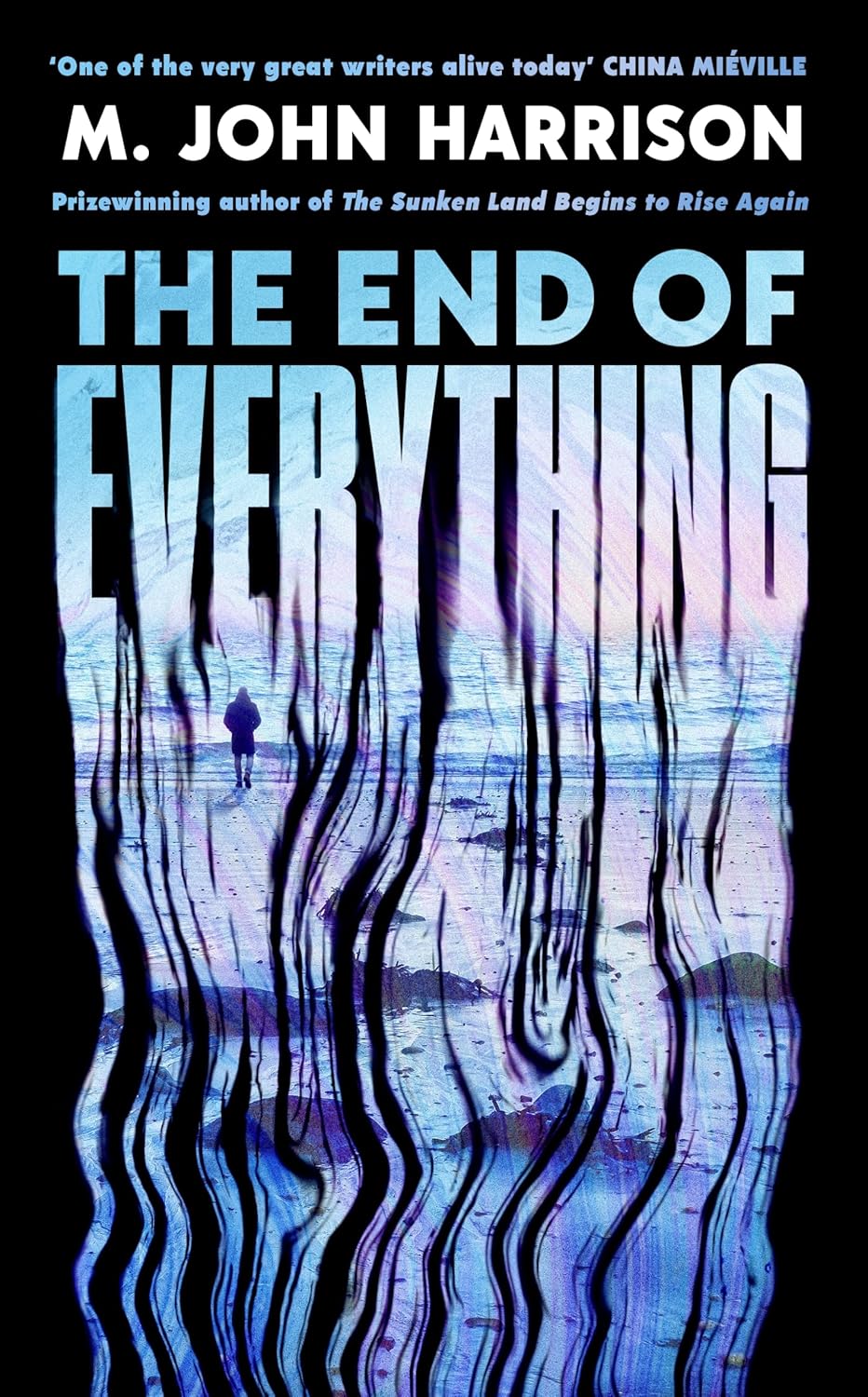
The End of Everything shares DNA with M John Harrison's previous book, The Sunken Land Begins to Rise Again, in much the same way that the eerie people, objects, and entities in both books share a genetic similarity with each other. Both books toy with resemblances and changes in the balance of those resemblances. Both books are also riven with decay: decay of the world, and probably of thought and meaning. And the contain a great deal of water. Engulfing, submerging, bodies of water.
MJH's own deeply personal and contingent interests in language and story, such as it has become in these later books, are on display here. He has said before that he's not really into narrative, or even causality, which seems like a strange thing for anyone to say, but the evidence is becoming quite pronounced. I would go as far as to say that both books feel private, even though he published them for us all to read. And I do not mean that in any transgressive, unpleasant way, but simply in one that is esoteric and interior to a person. Something wincingly ironic and subjective.
Like Sunken Land, The End of Everything is a muted horror story with moments of real levity (although there are more moments of livid horror in this newer book). It is steeped in everydayness and is filled with the sort of thoughts we have, or even half-form and then discard, as we move through the world. They are recorded and foregrounded as the characters navigate a half-broken, on-the-way-to completely broken, world.
While Sunken Land's thoughts were often of internal identity and baffling personal transformation, The End of Everything is a little more Ballardian with the transformation being more out there in the world. If he were reviewing the book I imagine Ballard would have talked about how writers use catastrophe to give themselves a blank slate, and to make a blank slate of themselves, which he took a few runs at, over the years. Harrison himself said how he aspired to do what Ballard was doing in the 1960s, which is to say writing science fiction that is deeply psychological, to the degree found in dreams or expressionism. I think he can say he has definitely achieved that now.
Like Ballard's surreal catastrophes (themselves channelling the early 20th century surrealists via the language of later 20th century sci-fi) the world of The End of Everything writes itself on its inhabitants as it ceases to be. It presents a horror stuff that we can all relate to, even if the story remains impenetrable and resistant to meaning, because:
"The crisis has become permanent."
The crisis has become permanent. Hasn't it, though? Jesus, Mike. He's writing early 21st century surrealism via the medium of early 21st century sci-fi, where the sci-fi is unable to reach escape velocities.
The story is told in almost conversational tones in which characters confide observations and side thoughts about an eerie catastrophe and what it does to you on the inside. Does to you. To you. Often that second person address, outward but referring to themselves, as we often do as we chat and gossip. That’s so often how the stream thoughts are presentend throughout this book. The casual, almost lazy second personing of the self. It has appeared in Harrison's other work, but in this book it is constant, looping.
This is in part because the story is a continued exploration of the fragmentation of self that appears in The Course of The Heart and then Sunken Land. It is about how we are splintered beings, never a whole, unfractured person, even where that is subtle, unnoticed, unanalysed. (But it might just as likely be explosive or incomprehensible.) One part of you is thinking one thing, says Harrison, while another part knows it to be untrue.
To illustrate this in the most brutal fashion, one of the characters has dementia, and then other illnesses, causing a flurry of chaotic connections. Confusion is in every scene. Scenes confuse into each other.
What also struck a note for me, personally, was that it depicts the fragmentation of South East England, Kent specifically, where I spent my teenage years. (And where I still spend time with my childhood friend.) It’s an inverted Kent, still visible, but also vanished. That particular local connection isn't available to everybody reading this book of course, but it is available to us, and it's a peculiarly evocative one as a result. If you have been to Dungeness, or Deal, or Ryde, then you might catch a whiff of it.
The End of Everything has a big sci-fi premise in which the world changes forever, and has a character which is a biological machine fished out of the sea that becomes a sort of person. But it's not really about most of that so much as it uses big images as eerie provocations. Perhaps it's not really about anything. "Perhaps it's not really about anything," could be a sentence from the book. Struggling with the specificity and vagueness and "felt" meaning of words, of uncertainty, is a central theme for Harrison, and reaches a fever pitch here. Sentences like this crop up all the time: "There was perhaps an element you could only describe as 'diligence' — although you would always wonder what you meant by that.'
It's a book filled with sentences with that sort of cloudiness. From the descriptions of the aliens to the assertions made by the characters, these explorations of vagueness are everywhere and, I think intentionally, sometimes they get in the way. They get stuck on you like the weird and possibly toxic materials the Kent of The End of Everything is smothered in. And this chaotic chemistry works, somehow. The man can write a sentence.
"Inexplicable losses of optimism spread in quiet concentric circles like the graphic representation of radio waves on the cover of a 1920s popular science magazine."
One of the notions the characters in the book have to deal with is the phrase "going through a bad patch" being literalised. A bad patch is a distortion, perhaps shared, of reality, and of the mid. Going through a bad patch is a waking nightmare. Uses of very humble phrases are very Harrison, but they're also very human. We do just repurpose what we have to hand. The whole book seems to dwell on that behaviour. It’s hardly Mad Max, but the post-apocalypse here is about humans adapting to the weird hand they have been dealt. Fishing things out of a sea filled with alien artefacts, “like a stew.”
The End of Everything is funny, horribly violent, mystifying. God, I wish I could write like this. Perhaps with another thirty years of practice I will find my own "mature style".
Reading this book in a sweltering darkened room during a catastrophic heatwave as my children occasionally interrupt me to complain about boredom was instructive. This is not a book about climate change, because, as I mentioned, I don't think it is necessarily a book about anything, really. At least not in the analytical sense where we decide works of literature have specific and deliberate themes. But climate change runs right through it, like a seam in a rock. That's just an aspect of the material it's carved from. We're all in the middle of it. The crisis has become permanent.
Harrison is an old man. I worried that the book, based on its title, might be a sort of sign off, a farewell declaration. Perhaps it is. But it doesn't read like that, even though there are echoes of the inevitable future in there. Another world will come along soon enough — so the characters in The End of Everything like to tell us.
But will it be an MJH world? I hope so. But I don't know. I am sorry. My kids tell me I have been morbid of late, like my mother. They're almost certainly correct.
More soon ! x
Add a comment: