TEETH: Some very Strange Stories, indeed.
Welcome, favoured adventure-folk, to the TEETH newsletter! This is a (mostly) weekly transmission about our explorations in the very secret land of Tabletop Roleplaying-Games.
What appears within this letter is written and compiled by veteran game critic and designer, Jim Rossignol, and former Mojang alumni and famed illustrator, Marsh Davies. Why not come and join us over on the TEETH Discord! Free tooth emojis for everyone!
Hello, you.
Links!
Strange Stories - The Role-Playing Game
Hello, you.
TEETH news is fairly slow this time, with the book being prepared for printing and discussions of paper, scheduling, and all the other things books are made of making things feel quite slow. But GOLD TEETH is now on the horizon! Its black sails are flapping menacingly, and a lewd sea shanty can be heard echoing across the waves. Looks good, sounds good. will soon be good in Backers' rope-calloused hands. General sale to follow. Good times roll.
Anyway, this week we've an interview by Marsh with some Friends Of Teeth, over at Strange Studies of Strange Stories, they of the popular podcast which will seen also be what we anticipate as being a popular TTRPG. The Backerkit thinger is up for a pre-follow, so get over there and lend support. After, that is, reading all about it in the interview below.
Love,
-Marsh & Jim
LINKS!
The ENNIEs nominees are up. Nothing from us this year, but you can be sure we'll be sailing our brig directly into the line of fire for 2027. Stuff that caught our eye here included Spine, a solo adventure about a book, and Bonsai Diary, another solo book about journaling the growth of a tree. In the more traditional book realm I was reminded that I really do need a copy of Menagerie of Unbearable Things.
Comrade Gillen continues his list of his favourite TTRPGs, in some kind of order. This time: Paranoia Red Clearance, Goat Crashers, O' Captain My Captain, Unannounced Descended For The Queen Game, Inevitable, Thief & Necromancer, Thistle & Hearth, Rosewood Abbey, Scum & Villainy, and The Very Complicated Homebrew Game Made By My Friend James.
This review of The One Ring's Hands of the White Wizard neatly summarises why we're playing it. "Once they meet him, however, the GM must be clear that this version of Saruman is subtly different from that one in the Lord of the Rings. He is a bit less abrasive, a bit less grasping. Barely. But a bit more hope exists in this version. Perhaps the Player-heroes can fan that flame of hope into a blaze. And change Middle-earth of the Third Age for the better. " We'll probably look at our own take on this soon, because we're deep, perhaps too deep, into our own campaign at this point.
We really have banged on about Wyrd Science issue 8 a fair bit, but that’s only because you should own a copy. Jim has two (count ‘em!) articles in there, speaking to Jon “Blades in the Dark” Harper and the team behing DOOMSONG.
Not strictly a TTRPG thing, but you know that we have overlapping interests in the realm of digital stories, and so narrative toolset Patterkit was of interest. It's the kind of intelligently made bit of tooling that makes me want to create a game design just to use it. If you are doing this sort of thing in games then take a look. It's impressive AF.
Also not strictly about TTRPGs, but given that I grow kilos of the stuff each year, I was interested in this social history of rhubarb.
~ADVERTISEMENT INTERMISSION~
There's so many of you now that the newsletter it becoming expensive to run! If you'd like to contribute to upkeep the best way to do so is in buying something from us. That way we get to keep making stuff, and you get games to play.
Seriously though, check out our games. Some of them are even free!
Strange Stories - The Role-Playing Game
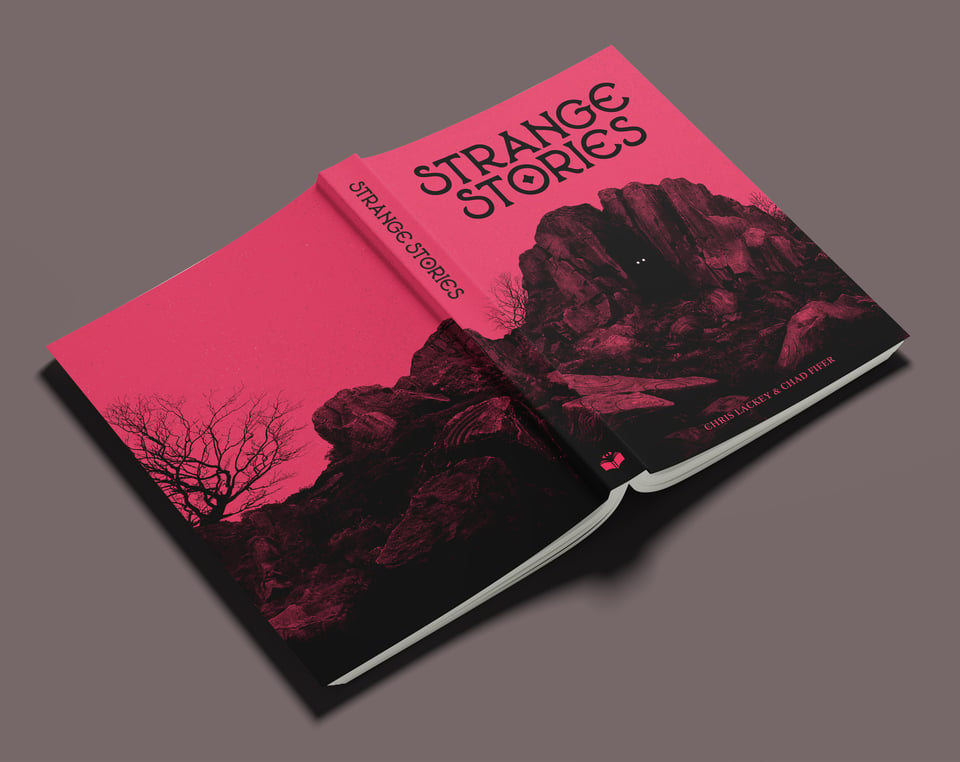
For seventeen years, Chad Fifer and Chris Lackey have been guiding listeners through the unheimlich outlands of fiction—first as the H.P. Lovecraft Literary Podcast and latterly as Strange Studies of Strange Stories. Few know the unknowable as well as they—so, who better to transform the kaleidoscopic realm of weird fiction into something you play instead of read? Strange Stories - The Roleplaying Game, which launches on Backerkit on the 21st July, promises to thrust players into thrilling single-serving scenarios inspired by a pantheon of outsider writers and genre luminaries—Lovecraft, Le Guin, and Robert E. Howard among them. The premises are lurid and the variety truly wild: "A wilderness retreat wakes forgotten cosmic horror... High-tech harpooners hunt vampires in the neon city sprawl... Barbarians chase a traitor across dimensions to 1980s Los Angeles..." I was lucky enough to playtest one such scenario early in development, in which my fellow players and I were extraterrestrials living under disguise in picket-fenced suburbia. Picking from pre-gen characters, we were promptly plunged into the story at the point where our clandestine plans had gone off the rails. What followed was a perfectly paced escalation of chaos. I caught up with Chris to talk about how the system works to satisfy fantasies drawn from across the spectrum of weird fiction.
Marsh: Your podcast started out focused on HP Lovecraft but has spilled into the wider world of classic genre fiction. Aside from the fact that the term "classic genre fiction" itself gestures to a particular literary scene and a particular time, what are the shared qualities that make for a Strange Story?
Chris: When we say 'Strange Story', we’re talking about estrangement. Viktor Shklovsky's concept of ostranenie (defamiliarization) is the artistic technique of presenting common things in an unfamiliar way so we can see them clearly again. He argued that we get used to horror, beauty, and people until we stop truly experiencing them, and that art's job is to make things real again.
For us, the shared quality across classic horror, sci-fi, and fantasy is that disruption. A 'Strange Story' takes our mundane, familiar world and introduces a bit of the unreal. A bizarre cosmic anomaly, a robot that wants a friend, or a barbarian looking for ultimate magical power, to compel the reader (or players) to view reality through a different lens.
With Strange Stories: The Roleplaying Game, we wanted to tap directly into that specific narrative engine. Because it's a rules-light system built for self-contained, one-night sessions, it perfectly emulates the pacing of a short story. Players don't spend hours tracking complex mechanics; they are immediately dropped into a situation that requires immediate choices.
So while we absolutely do it because the fantastic is incredibly fun, the heart of a Strange Story is using the unreal to make us feel something real.
Marsh: So how do you evoke that through your game?
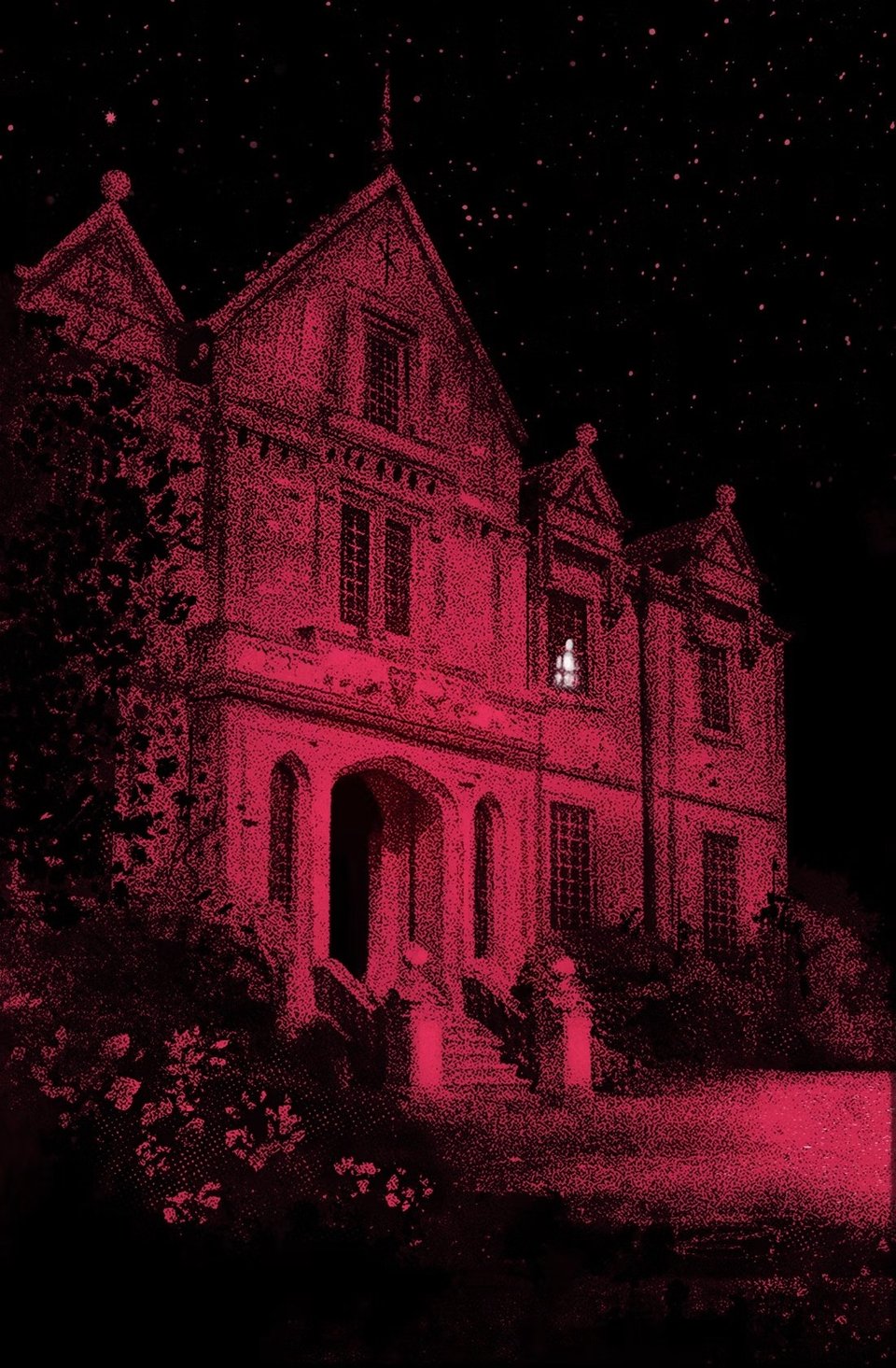
Chris: The primary quality we evoke is the disruption of the familiar. Taking characters the players can relate to and forcing them to confront something strange.
We intentionally created the mechanics to be lightweight. In a lot of traditional RPGs, when conflict appears, players immediately look at their character sheets to begin trying to gamify the situation. And I think that breaks the tension. We wanted to eliminate that mechanical buffer. By keeping the rules light, players stay trapped in their characters' perspectives. They don't react like tactical gamers; they react like terrified or astonished protagonists in a short story. Hopefully.
Second, we structure the game for a tight, single session. A classic weird fiction story doesn't usually spend chapters setting things up; it gets right to the good stuff because it doesn’t have the time to mess around. That’s why we push the pregenerated characters. It’s easier to choose from A, B, or C than it is to come up with something whole-cloth. Also, we know what is going to happen in these stories, so we make a character that will fit.
We’re also doing something that I’ve never seen before: audio adventure companions. Each scenario will include a 30-minute podcast to help the Story Guide (GM) prepare to run the game. This will go over all the main plot points, story guide characters, story options, and what happened in playtesting. That way, you can prep for your game while doing the dishes or commuting home from work.
Marsh: Because these phrases mean all sorts of things to different people—who often then become inexplicably angry when their expectations are confounded—what do you mean by "rules-light"?
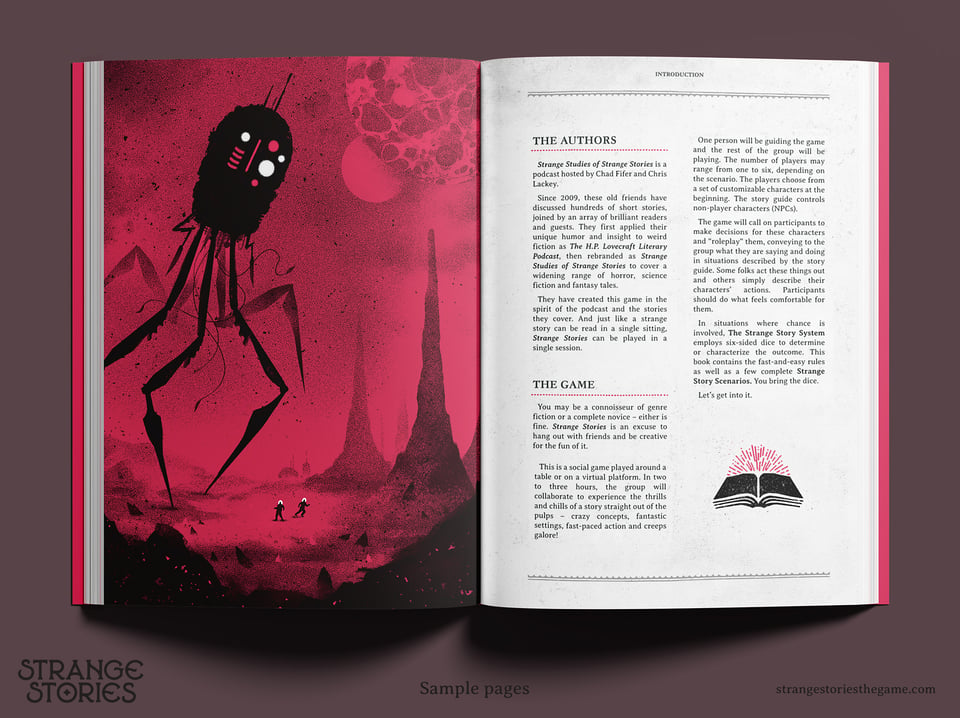
Chris: For us, 'rules-light' means two very specific things: low barrier to entry for the players, and mechanics that serve the fiction, not the other way around.
When you sit down to play Strange Stories, we don’t want players to have to read a rule book before play. And we don’t want the story guide to have to keep referencing the rules. It should be simple enough to keep in your head.
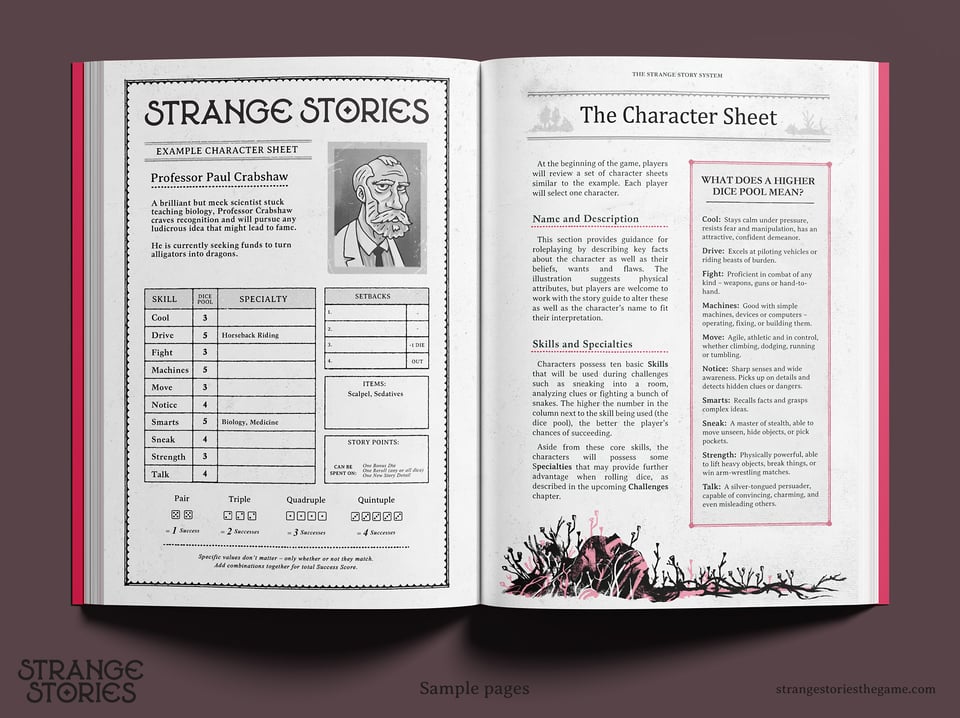
That’s not to say that it’s simplistic. We want the narrative to alter the odds. The system uses a pool of D6s, looking for matching numbers. The more skilled the character, the bigger the pool. Dice are added or subtracted to reflect situational modifiers. It’s very easy for the story guide to be able to judge how much of an advantage or disadvantage any given situation might invoke. So the story keeps moving forward, and you don’t get bogged down in rules.
Marsh: How did you come to settle on the exact lightness of those rules? Did you ever have to rein in a desire to systematise things to keep the system versatile? For example, I imagine a Call of Cthulhu-style sanity system might work in one context but be redundant or awkward in another.
Chris: Things were more complicated at first. But as we playtested, it became clear what needed to go and what needed to stay.
Call of Cthulhu is very near and dear to me, and I love the sanity mechanic, but for Strange Stories, I found that our damage system works for both mental, physical, and even situational complications. We call them ‘setbacks,’ and they are a kind of narrative damage. Setbacks are words or short phrases that describe why your character is having a hard time. Things like “sprained ankle” or “frayed nerves” are assigned by the story guide, which gives the guide control over the story's tone. If it’s early in the story and you want to keep it light, the setbacks can be mild and go away after a scene is over, or if you’re at the end of an adventure and you want the stakes high, you can make the setbacks life-altering.
We are always trying to find what facilitates fast and fun storytelling. And if you keep that in mind, it seems pretty clear.
Marsh: Strange Stories goes further afield in sourcing its fiction, but Lovecraft inevitably looms large in the background—as do the various heavyweight Cthulhu games. Does catering to the wider field of weird fiction let you come at the same material from a new angle?
Chris: I love what those heavyweight games do. Call of Cthulhu is an absolute masterpiece of tension and investigation, and Trail of Cthulhu’s GUMSHOE system does incredible things with procedural mystery. They’ve defined the hobby for decades for a reason. But those games are engineered to emulate a very specific type of story: the long, slow-burn investigative descent into madness.
But like our podcast, we don’t want to limit ourselves to cosmic horror and mystery. Genre fiction is incredibly diverse and tells all kinds of stories, and we wanted to make sure our game could help us tell those stories.
When you open the door to authors like Clark Ashton Smith, Ursula K. Le Guin, or Isaac Asimov, the stories can be about anything. Planetary diplomacy, ancient sorceries, or surreal dreamlands; they all have to be accessible with this system.
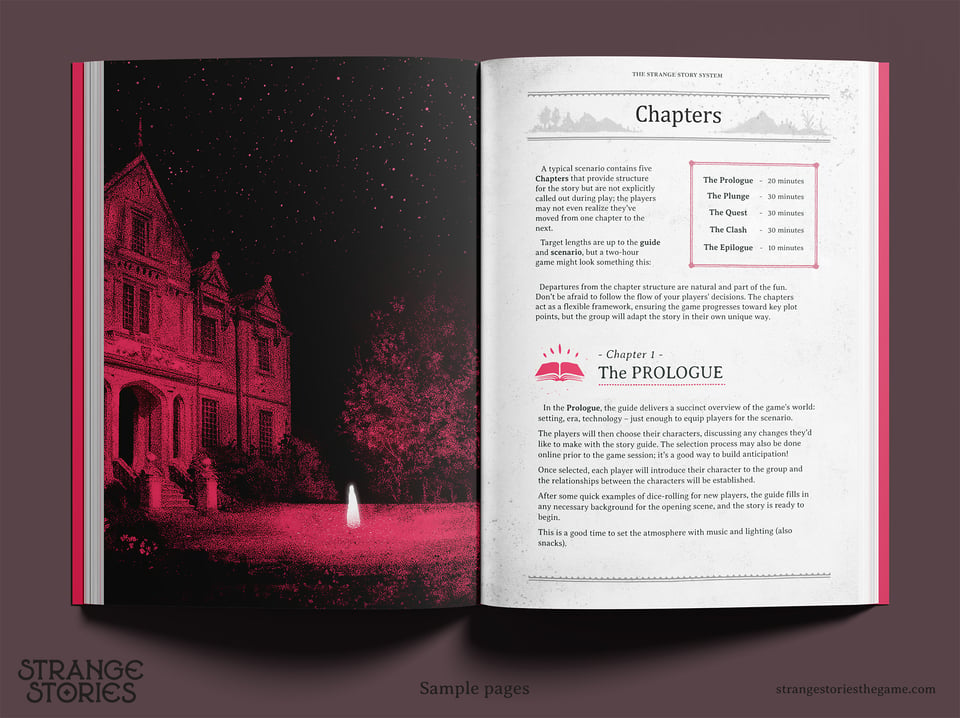
Strange Stories is ultimately about quick, self-contained sessions, with games taking only about two hours to play. By expanding the field beyond just traditional cosmic horror, the system has to get completely out of the way of the narrative so you can experience those massive, diverse ideas immediately without getting bogged down.
Marsh: Some of the stories you discuss on the podcast, and I'm thinking particularly of those by Robert Aickman here, have an acute and intentional vagueness. They often lack defined resolution and are all the more unsettling because of it. I think that's a really interesting quality to try and cultivate in a roleplay setting—but a challenging one to fit around player agency. Maybe this is more of a general GMing question than specific to your game, but how would you preserve that sort of uncanny, terrifying ambiguity without snubbing players?
Chris: I think it’s important to have a complete story. Though Aickman's stories are often ambiguous, there is usually a satisfying ending. When you get to the end of an Aickman story, you know it’s over, but the takeaway is something you’ll be thinking about for a long time. What was this about? What does this mean? What do I do with this?
In a TTRPG, having this kind of ending is very difficult, but it can be done. And I think it’s all about setting expectations. If players know this story is going to be a bit surreal, they will play into it. Strange Stories starts with a prologue and ends with an epilogue. The prologue sets expectations and explains who the characters are, what world they live in, and what they want. It also sets the tone. If players know what they’re getting into, not only will they roll with it, but they will also play into it. Hopefully having more fun.
I really love our Epilogue system for wrapping things up. After the main adventure concludes, each player may narrate a short scene featuring their character. This can look anywhere from a few minutes to several years into the story's future. It gives the player agency to tweak the ending to suit their desires. If it’s a Lovecraftian horror story and the players won the day, a player might want their epilogue to have a classic dark twist: their character returns home, only to find a cultist waiting inside. Cut to: the exterior of the house, and a desperate scream echoes out into the night! We’ve found this to be super fun, and I’m constantly surprised by the creative ways players wrap up the game.
Marsh: I love the sound of an Epilogue—we try for something similar with TEETH and GOLD TEETH, checking in on the characters' fate, long after the events of the game have concluded. They should be haunted by what has transpired—and that's just as true of the reader of a Strange Story! Thanks for your time, Chris.
And with that, Marsh concludes the interview. We see him lit by the light of his monitor as he punctuates the final sentence with a smirk of complacent satisfaction. But what's that behind him? Chris Lackey, his pale face streaked with blood, eyes rolled to white, lurches from the darkness, two savage knives glinting in his hands! Cut to black.
Add a comment: