Notes on 'Flesh', 'Stoner', 'The Stranger'
Three novels over the decades that touch upon the theme of free will
“He was forty-two years old, and he could see nothing before him that he wished to enjoy and little behind him that he cared to remember.”
- John Williams’ ‘Stoner’
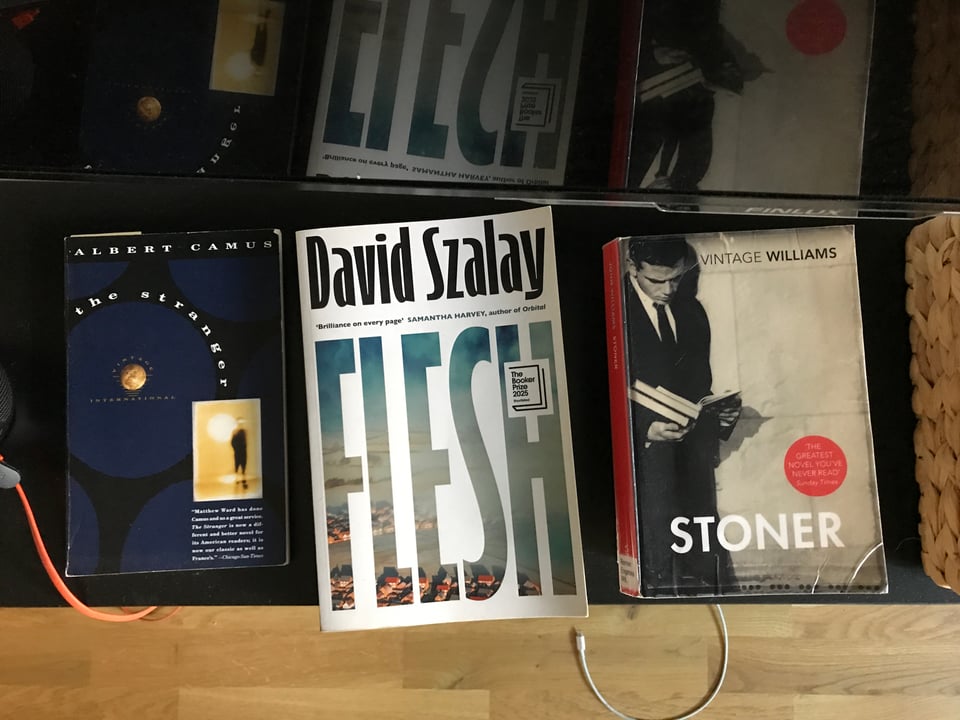
David Szalay's Flesh, Albert Camus' The Stranger and John Williams' cult classic Stoner: it’s been a strange (to say the least) stretch of weeks in which my inner compass kept turning toward these philosophical novels. What they’ve left me with is a suspicion of free will. I picked these up at random (or did I?) and found them connected to each other with a thread of the absurd in the everyday.
In Flesh, Szalay traces the life of Istvan, from a nondescript Hungarian small town, with nothing to his name, who ends up scaling the heights of London's high society. Why call it Flesh though? A book makes its title, rather than the other way round and I feel Flesh is perfect for the premise. At the start of our lives we’re all mere lumps of tissue, bone, and flesh; we live suspended between living and dying, trying to figure out ourselves and a million other peripherals in the meantime. Flesh is what we are; Flesh is what we’re trying to make of life around us.
Istvan goes with the flow of his life, loving a little, working, saying not much. He moves countries, cities, professions; people fall behind him like stations pulsing past a night train's window. Major milestones arrive and he plods through them without much deliberation, not much of the vocal kind anyway, rarely with a constant loved one nearby to ventriloquate his interior life to. Events in his life pretty early on leave him little time to make a splash of reactions. As a reader I realize how luxurious it is to be afforded an interior life on the page. He is a sole marching hero, with no time to search for purpose or declare passion.If he feels an emotion, and he does a few, it shows up in his life. He loves his mother. He loves his son. He hops from gig to gig, knowing full well the work isn't respected and comes to him easier than others because of his background. But he needs sustenance and such is his fate. He notes that even if some things are important to him, they won’t be to the people around him as they’re devoid of the context of his experiences. So what’s the point of speaking at all? A kind of early, preemptive withdrawal from society.
Szalay writes to this sentiment:
“He realizes that the things that are so important to him—the things that happened, and that he saw there, the things that left him feeling that nothing would ever be the same again—they just aren’t important here. Those things have no reality here. That’s what it feels like. So it makes you feel slightly insane or something, to have those things inside you, when they seem to have no reality here.”
Camus' Meursault is the inverse. Famously indifferent, passively drifting, he declines even a pretense of grief at his own mother's death. "There's no point," he tells the disapproving attendant, and later kills a man with neither passion nor motive. Told in the first person, The Stranger grants us repeated entry into Meursault's thoughts. But the novel also tells us that he barely has any. Mersault’s inner world in the latter part of The Stranger reads as if he’s tired and bored of the world around. Another withdrawal.
“It was as if that great wash of anger had washed me clean, emptied me of hope, and, gazing up at the dark sky spangled with its signs and stars, for the first time, the first, I laid my heart open to the benign indifference of the universe.”
It's easy to mistake Istvan for Meursault, lazy too, and Istvan is a bit too quiet. Upon a closer look though: Meursault is passionless where Istvan is silently driven by some measure of it. One has nothing beneath the surface; the other has a kernel of feeling he seldom lets out. Istvan commits no venial sins; Mersault is being charged by the court of a crime that might point to the vacuity at the centre of his being.
Both books, Flesh and The Stranger, ask us:What decisions actually shape a life, if we make any at all? We flatter ourselves that we push some buttons, but the lives of these men are molded by unseen, unnamed forces far larger than they know. Camus writes in The Stranger:
“From the dark horizon of my future a sort of slow, persistent breeze had been blowing toward me, all my life long, from the years that were to come. And on its way that breeze had levelled out all the ideas that people tried to foist on me in the equally unreal years I then was living through.”
Which brings me to the real subject both books circle: the nature of the "self" and the limits of freedom. Is the self anything more than a spur of the moment reaction to circumstance? Anything more than a bundle of chemical interactions triggered by internal, unknown stimuli and momentary external influence? In a world so far beyond our control, how much of us exists in and of ourselves, and how much merely via others? And finally, the moral dichotomy of the free choice: do we genuinely make choices, or unwittingly repeat patterns imprinted on us in our formative years?
John Williams' Stoner pitches this very inquiry into an even quieter territory. Published in 1965 and rescued from obscurity decades later, it follows William Stoner, a farm boy sent to the University of Missouri to study agriculture, who stumbles into a literature class, changes course, and stays for a lifetime. This does not posit Stoner in direct conversation with The Stranger and Flesh on the face of it, but there’s a thread of being lost nevertheless. Pondering over the first world war, Williams writes:
“A war doesn’t merely kill off a few thousand or a few hundred thousand young men. It kills off something in a people that can never be brought back. And if a people goes through enough wars, pretty soon all that’s left is the brute, the creature that we—you and I and others like us—have brought up from the slime.”
Istvan has served in a war in Iran. At the time of The Stranger’s publication (1942), France was invaded, defeated by Nazi forces, and split as a country in two. And by November 1942 France had been occupied by German troops. Yet, Camus excludes mentioning the Germans or even just the war in the novel. By letting it hang in the air right above the novel, he makes Mersault’s novelistic apathy so much starker. We could assume that Mersault is surrounded by warfare and that greatly informs this absurdist atmosphere of the novel, but its never really said. Williams’ Stoner switches his majors from agriculture to English (stirred by a Shakesperean sonnet), discovers his love of teaching, engages in a passionless marriage, and lives on past three wars.
Where Istvan crosses borders and Meursault crosses moral lines, Stoner barely moves at all. He marries badly, but endures it, raises and loves a daughter who is pushed out of his life, enters and loses a love affair to institutional (worldly) pressure, and spends forty years teaching under a petty rival who savages him at every opportunity. Nothing seemingly dramatic happens to him (he refuses serving in the first world war), and yet everything does.

Yet Stoner is also the decisive refutation of Meursault. Unlike Meursault, he is granted full access to an interior life — Williams tells us in the famous early passage that Stoner loved the university "because it gave him a place in the world". And unlike Istvan, Stoner chooses, repeatedly, at great cost: literature over farming, Edith against every instinct, a doomed love over comfortable silence, his department over another university, to let Catherine go rather than eloping with her. The disappointments pile up nonetheless, not because he doesn’t make choices but perhaps because he does. What does that tell you of free will?
What links him to Mersault and Istvan is the sense that a life can be lived seriously, even devotedly, without ever resolving into triumph. Maybe it is so that fidelity to the (now overglorified) mundane and unglamorous might be its own kind of heroism, Stoner seems to say.
Across the 350 pages of Flesh we see Istvan repeatedly engrossed in sexual relationships which involve unhealthy asymmetries of emotion and power. Stoner has an ability to persist against all odds, and so he does even in sex with his wife. He keeps going when he ought to try and have at least a full conversation with her to understand her hesitance. Mersault’s general detachment and ability to adapt to any external circumstance make his life in prison pleasantly tolerable, especially since he gets used to the idea of being restricted and unable to have sex with Marie.
If the self is only a sequence of reactions to forces beyond our control, then what redeems a life could be attention. Istvan endures, Meursault sees, Stoner persists. None of them is free in the way we like to imagine freedom, and none of them gets what they wanted, or what they thought they wanted. But the novels, these stories point to the fact that meaning in life accrues regardless.
This passage towards the end of Szalay’s Flesh puts some of this mystery in perspective:
“All that burgeoning physicality is held within yourself as a sort of secret, even as it is the actual surface that you present to the world, so that you’re left absurdly exposed, unsure whether the world knows everything about you or nothing […] Perhaps it is at that age, he thinks, that you first have the sense that you and your body are not entirely identical, that you occupy the same space without being entirely the same thing.”
In Stoner, John Williams tries to sketch the narrative arc of a character who is drawn out by a love for his job. This is unlike in both Flesh and The Stranger. Istvan works as a means to an end, life unfolding in the process as a mere off-shoot of that thirst for sustenance. Mersault, on the other hand, is hardly attached to anything in his life. Not the people, not the work. John Williams said in an interview about his Stoner:
“I think he's a real hero. A lot of people who have read the novel think that Stoner had such a sad and bad life. I think he had a very good life. He had a better life than most people do, certainly. He was doing what he wanted to do, he had some feeling for what he was doing, he had some sense of the importance of the job he was doing … The important thing in the novel to me is Stoner's sense of a job … a job in the good and honourable sense of the word. His job gave him a particular kind of identity and made him what he was.”
Binaries aside the other aspect that defines Stoner for me is the self-imposed limitation that comes from the incapability of expressing his emotions honestly to those around. For me William’s Stoner speaks precisely to the constant anxiety of a life not lived (well). Some of us wait for a chance to right it (like Istvan, unlike Mersault), while others make right with what we have, are given (Stoner). We choose, decide; we survive to tell the stories of those choices. In the end, a winter awaits us, warm or cold, we have to make our choice.


Add a comment: