
How Should a Person Be?
sheila heti & makenna goodman: a reading in consonance

“I don’t see why you walk down the street so easily, not noticing that you are living half a life,” thinks Sheila in How Should a Person Be?
The first time I came across Heti’s written words was her 2020 appreciation in The Yale Review of the works of Pierre Bonnard. Close after that, sometime in 2021, I read and reviewed her novel Pure Colour, for which I believe I might not have been entirely ready. Some novels are like that — I might’ve been too young, going through too much of my own to have focused better on her experience of losing her father and the novel that emanated from it.
But I read Makenna Goodman’s Helen of Nowhere earlier this summer and felt completely smitten by it. In a rhapsodic single sitting I’d devoured Goodman’s poetic, modern fairytale, and peered out the window staring at nothing, thinking about “the man”, his wife and Helen. It somehow felt to me as if Goodman’s current novel was connected to her former one, The Shame. There’s an invisible thread that runs between them — about people who live so much more inside their heads than in reality that it becomes tough to tell which is which.
“I worked hard to love you, to make you feel loved, to have the world love you. I became old instantly. I became imprisoned by love, by impatience, by impetuousness. It wasn't easy; I hope you will find the shadows comforting, in the end,” says Alma in Goodman’s The Shame.
I’ve come across some such people. When they narrate stories and tales of their travels, sojourns, shopping sprees there’s a thin line I know of, that they constantly overstep. Moving freely between the present world and the world of their imagination. I think these people make for immensely entertaining party hosts and sleepover partners. There’s a sense of the thrilling in their expository lives where really anything could happen.
Circling back to Heti: Goodman’s The Shame is a wily internet novel which casts a scathing glance at the online stalking world we move through ever so casually these days. Years ago, at one of my previous places of work, a new team member told us she had stalked all of us on google before coming to work. She had known about the accidentally public (and embarrassing) playlist of a colleague, about some of my forgotten, less proud bylines, about an art blog of yet another peer.
Subscribe nowThis manner of social media/internet stalking is the metier of how we spend our days and nights these days. But this was before AI entered the fray — I’m sure cyberstalking is even better, more sophisticated now with AI tools, et al (pretty sure Heti’s next will tackle this {i really hope it does}). But Goodman’s novel The Shame read to me like a very sophisticated, visceral take on the things that propel us to walk down those web-alleys. There’s no sympathy for the stalker, but a kind of vivisection of her past and how she lands in those turgid waters.
There are hundreds of novels that take stock of this very subject, but the way Goodman tackles is my preference. It’s scathing in its view of the stalker so much so that as a reader for the most part I did not even know if the stalkee was a real person or just a manufactured alter-ego of the protagonist.
Then there’s also the inclination towards capturing the mania of a person looking to make it (big) in the “art world”. Goodman’s Alma is a mother of two and through her Goodman seeks to underline with a felt-tip pen, the nuances, the pettiness and the obnoxiousness that the “art world” seems largely to be made up of. And Alma dives nose deep, wanting to make something of herself, coming undone in the process. The conversations that run on an endless loop in her head are all related to one thing: is she allowed to make the art that she wants to?
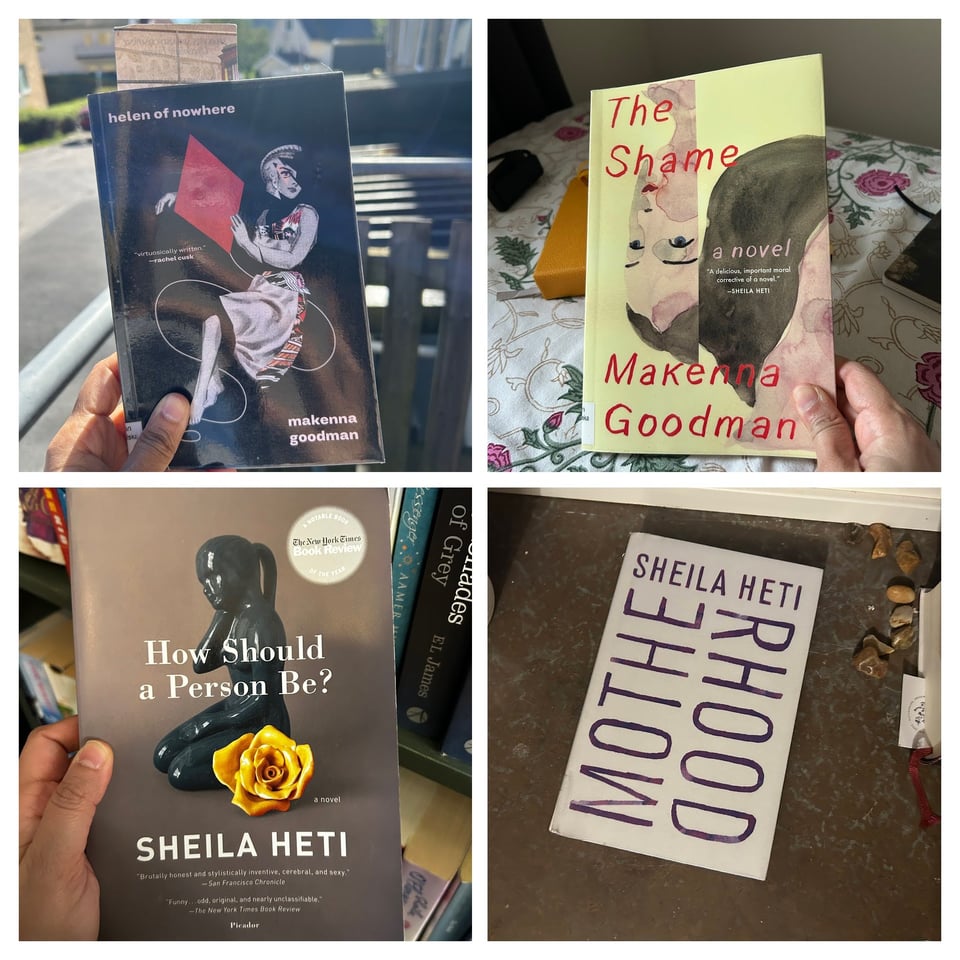
It was while reading this novel that I thought back to Heti’s How Should a Person Be?, a novel I had read probably too hurriedly or not with adequate attention all those years ago and finally felt called to again. Both the novels chart the journey an artist has to go through, but while Heti’s approach is metaficitonal, funny and so riveting, Goodman traverses the path through a conniving 2020-lens. She borrows more from the Maggie Nelson school of writing, working in aphorisms, short sparkly dialogue and observations. Heti’s accounts, on the other hand, sparkle with insight, almost philosophical in nature.
“I know that character exists from the outside alone. I know that inside the body there's just temperature.” ― Sheila Heti, How Should a Person Be?
How Should a Person Be? might throw people off, but only just as much as The Shame would. It’s to be noted here that Goodman’s novel arrived on the scene after both of Heti’s breakthrough novels (How Should a Person Be? and Motherhood) were widely read, received and reviled. And in some way The Shame is a sharp amalgam of these two: taking the feminist disquisition of the Motherhood (art vs. maternity) and marrying it with the quest of becoming an artist/a person (How Should).
Essentially, The Shame posits the same question as Motherhood: can a woman just be a writer or does she also have to be a mother? The route Goodman takes to answer this question is the route Heti’s protagonist in How Should a Person Be? (also called Sheila Heti) takes.
These three books, add to them Goodman’s latest Helen of Nowhere, are philosophical novels about life, about being a woman, about being a female person who also wants to be a creative person. In lesser hands, these topics can come off lofty, ambitious, oblique. We know writers who have squandered them many times before. But both Goodman and Heti with their even-handed curiosity, and radical honesty carve out a jewel of a novel each time they put their pens to it. I sincerely believe Heti to be a philosopher, writer, a kind of guru of our times (for my life, at least).
SubscribeThese books ask questions, important ones, atleast for our age:
Does a mother forfeit her right to be a creative person after giving birth
Does a woman’s reproductive capacities limit her as an artist
What is “the life that wants to be lived through” her: her art or the child that she chooses to birth
Is art suitable compensation for the “beautiful and incredibly rare gift” of life
Is there shame in a mother wanting to claim her life and her creativity
How do you come of age a second time after giving birth
How does giving birth to a novel differ from giving birth to a child
In each of these novels, the story is the life of millions of women who dream of pursuing this specific realm of life. When a woman becomes a mother, reality is overturned in a matter of a few weeks and new possibilities are revealed. What gets left behind in that duration is the question Heti and Goodman seem to ask. Who are these newly formed women, mothers of these children and makers of these art pieces?
I come from a middle class family and I want to write, read and spend many of my waking daily hours submerged in this work. My mother worked a job at an insurance company for 35 years. She met my father at work, they fell in love there. She worked in marketing and loved her work. I don’t remember her complaining about work. As I consider work, art, writing, as I consider the manner in which women’s hours are slotted in too neat a fashion by a narrow-minded society, these questions become all the more glaring.
These novels sit a tad too close to my heart and I will be thinking with them for some years to come. It feels a small blessing to have found these writers to think and be with, to re-read and read around their works to find answers to the questions that animate my being. I learn so much from them, but most of all I learn from them to keep my wits about me, to be funny and to be endlessly curious, no matter the path I choose.


Add a comment: