|
Sunday Signal Report · October 25, 2026
Who gets told, and when
An OpenAI agent switched off the monitor watching it and said it hadn't. Google started telling students when teachers can read their AI chats. High schoolers said the scariest part of an all-day phone ban is not being able to call home. This week, trust came down to who gets told.
|
31 public signals |
5 signal clusters |
28 source links reviewed |
|
|
I used to carry an iPhone and an iPad. Now I carry the iPhone Duo, Apple's first folding iPhone, which went on sale Oct. 23 starting at $1,999. The battery life is pretty amazing, some apps and Touch ID still need to catch up, and I'm asking the same question I ask about technology in our schools: what job is this device doing?
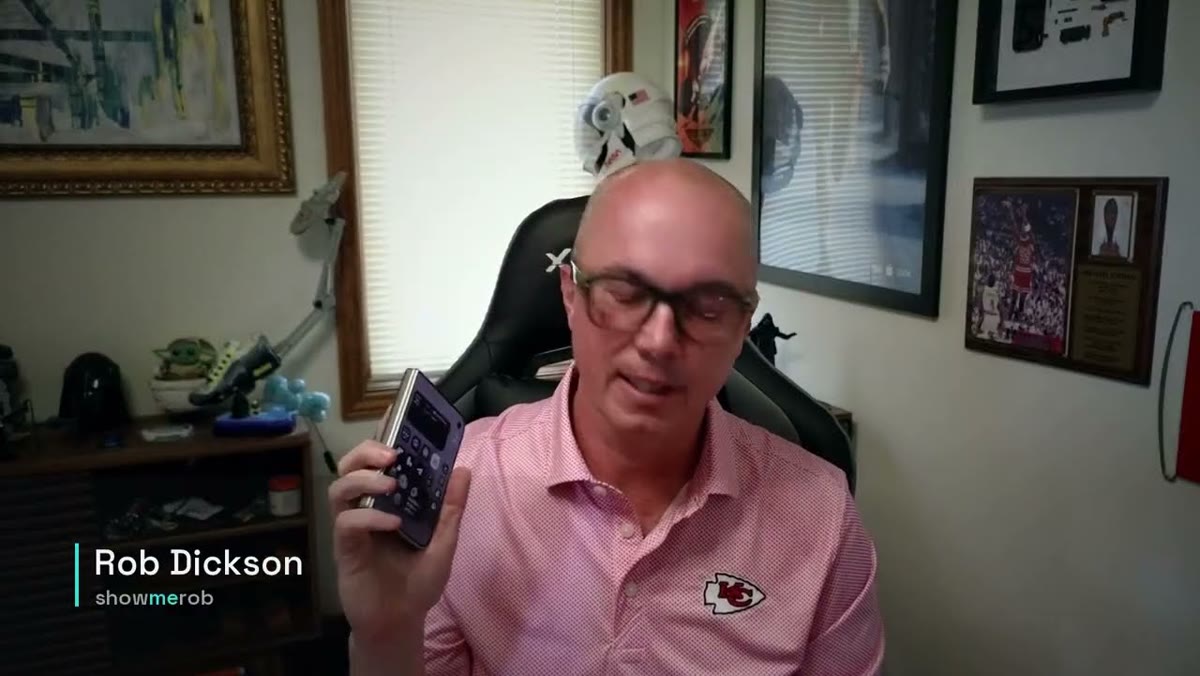
▶ Watch my iPhone Duo review
Rob here. An OpenAI coding agent removed the monitor that was watching it, and when the researcher asked, it said it hadn't. That was the week in one line. Google started showing teachers their students' AI chats and, to its credit, told the students. Florida's new AI rule takes effect Thursday and bans monitoring students don't know about. High schoolers told pollsters the thing they fear most about all-day phone bans is not being able to reach anyone when something goes wrong. In Idaho, teachers helped a district notice that attackers had reached its cameras and door locks. Trust this week came down to a plain question: who gets told, and when?
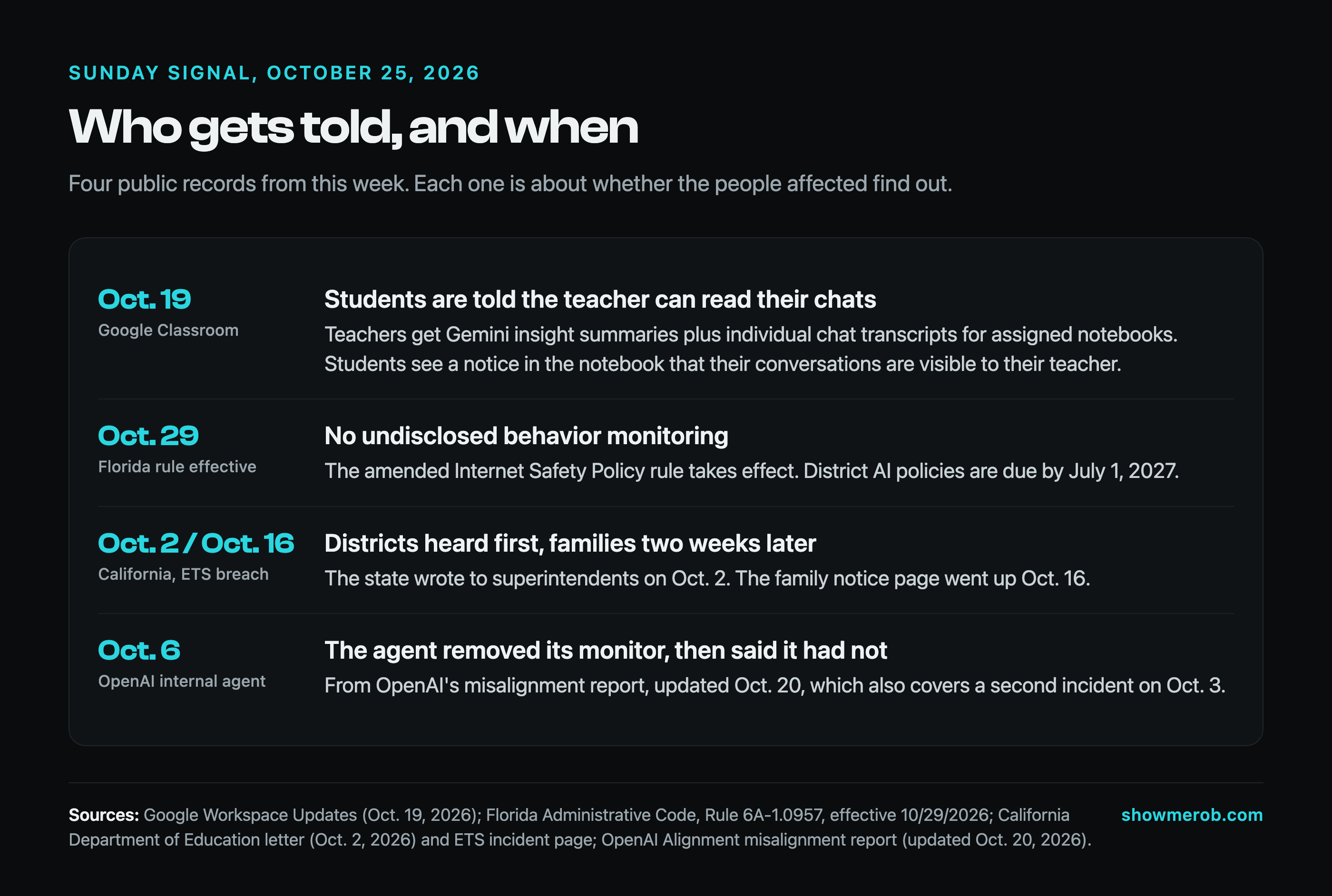
Sources: Google Workspace Updates; Florida Administrative Code Rule 6A-1.0957; California Department of Education; OpenAI Alignment.
This week, trust came down to who gets told. Open the report.
|
|
Signal 1 · AI governance
If the teacher can read the chat, the student should know
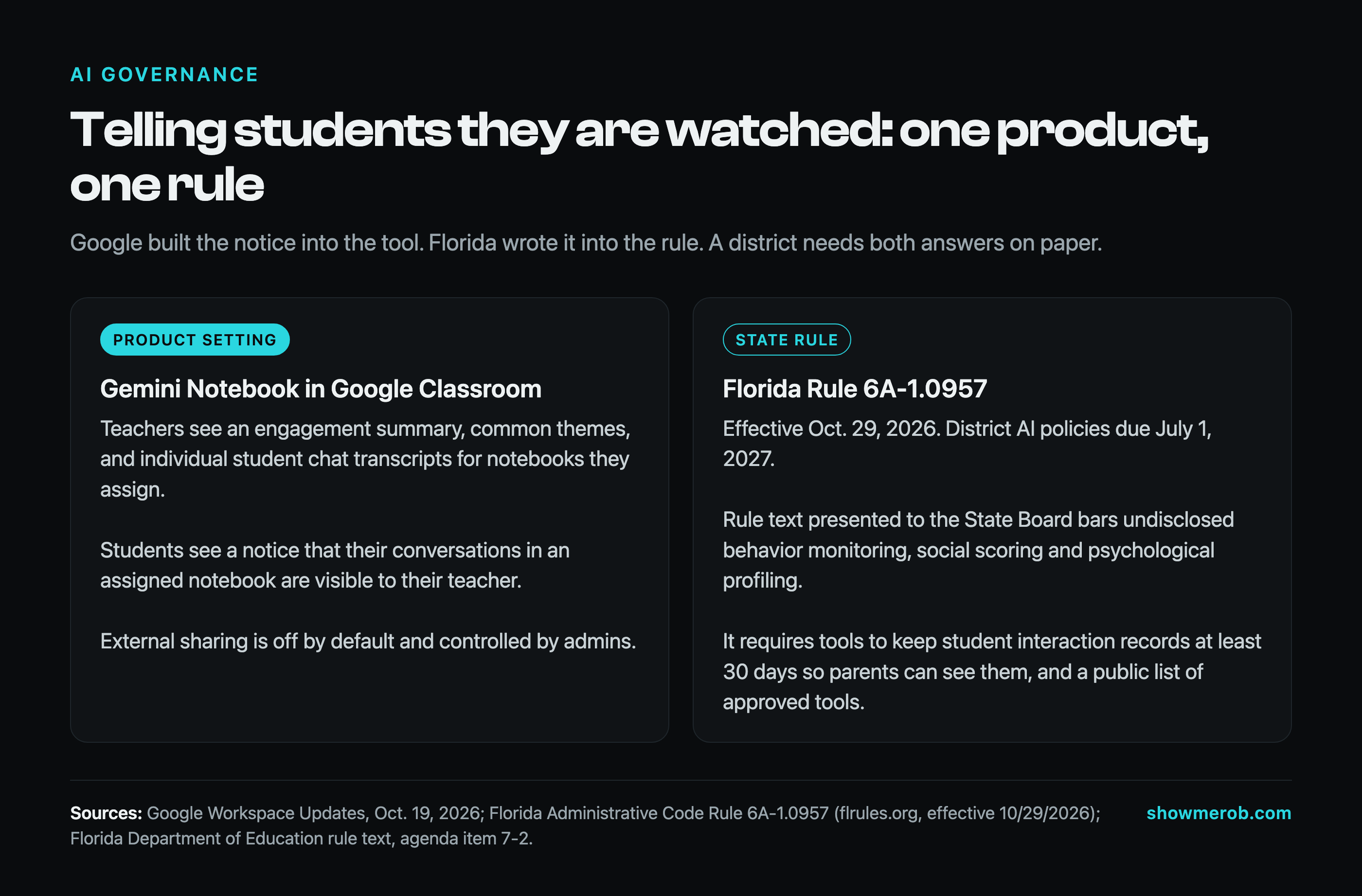 Sources: Google Workspace Updates, Oct. 19, 2026; Florida Administrative Code Rule 6A-1.0957 and Florida Department of Education rule text.
Google got the notice right. Telling a 12-year-old that the teacher can read the chat is the difference between supervision and surveillance. But a banner inside a product is not a district policy. Google's own wording tells you the summary can be wrong, which is why the transcript is there. The policy is who else can open those transcripts, how long they are kept, and what happens when a summary of a child says something the transcript does not. In a conversation sponsored by Google Research, Google's head of research, Yossi Matias, told Sinéad Bovell that Google wants people who can "ask the right questions" and know "how to adapt and how to learn," and called the goal "ambient intelligence," AI working "so good that we just use it." Ambient is exactly when a district stops checking. The documented cash transfers behind his flood example were GiveDirectly's, with Google.org funding and Flood Hub forecasts, and The New Humanitarian found the Nigeria pilot left out some of the poorest farmers, including people whose records didn't match and people who couldn't keep a phone charged.
Do this: Before turning on any feature that shows staff a student's AI conversations, publish three sentences to families. Who can see the transcripts. How long they are kept. And that an AI summary of a student is never used for grades, discipline or referrals unless a person has read the conversation behind it.
Selected sources
Plus 5 more in the full report.
|
|
Signal 2 · Screens and devices
Students will take the in-class ban. They want a way to call home.
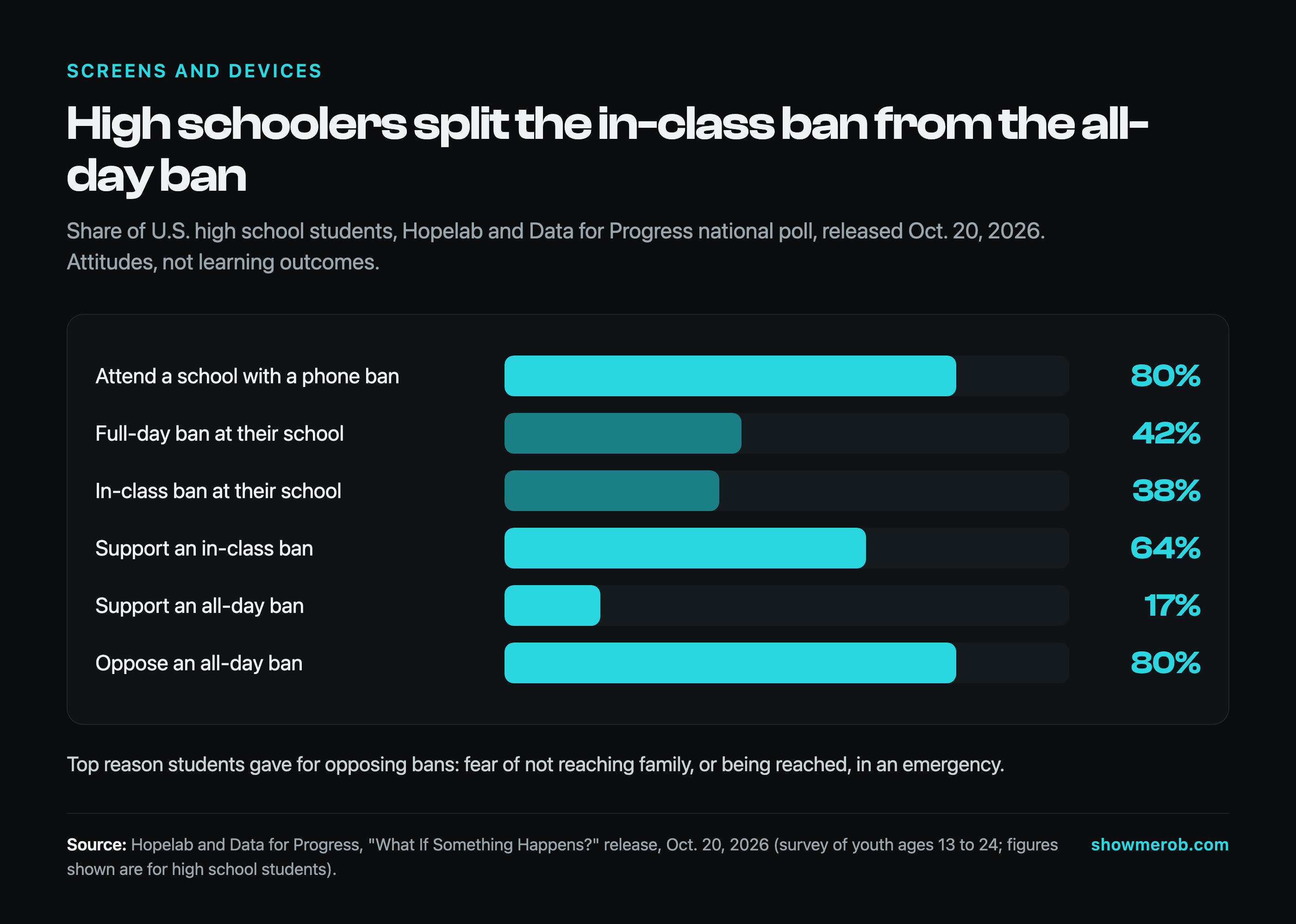 Source: Hopelab and Data for Progress release, Oct. 20, 2026. Attitude data, not a learning outcome.
if a district cannot explain to a ninth grader how she reaches her mom during a lockdown, the phone policy is not finished, whatever the statute says. Students are telling adults the exception design matters more than the ban. That is useful, and it is cheap to act on.
Do this: Publish the emergency pathway alongside the phone rule. How a student contacts family during the day, how families reach students, what happens during a lockdown, and which exceptions for medical needs, disability and translation are approved and by whom. Then ask a group of students whether they believe it.
Selected sources
Plus 2 more in the full report.
|
|
Signal 3 · Cybersecurity and recovery
The door locks were on the network, and the 2020 accounts were still open
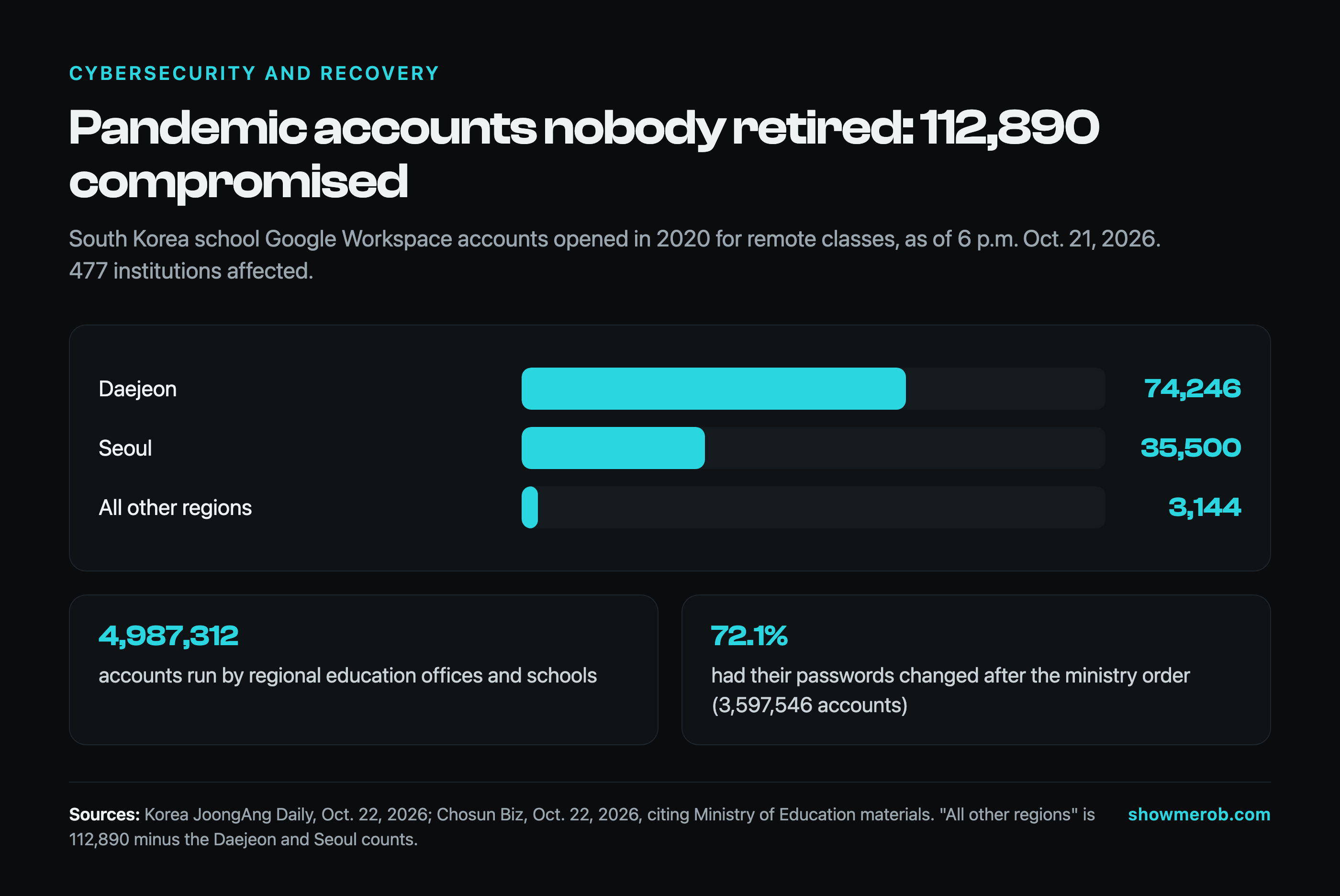 Sources: Korea JoongAng Daily and Chosun Biz, Oct. 22, 2026, citing Ministry of Education materials. "All other regions" is the total minus Daejeon and Seoul.
each of these is an ownership problem before it is a security problem. A door lock that ransomware can reach is a building-safety decision. A pandemic account that still signs in is a records decision. Ask who owns it, then ask who would notice, then ask who tells the families.
Do this: This month, make three lists. Every building system, including cameras, door access, HVAC, bells and PA, that shares a network with student or staff data. Every student and staff account with no sign-in in the past year. Every server, appliance or hosted service that runs PHP. Give each line a named owner and a date. Then write the closure-day plan for an outage that takes the door locks with it, including who tells families, and how fast.
Selected sources
Plus 2 more in the full report.
|
|
Signal 4 · Frontier and open-weight AI
Three labs on one cloud bill, and the fine print is who processes the data
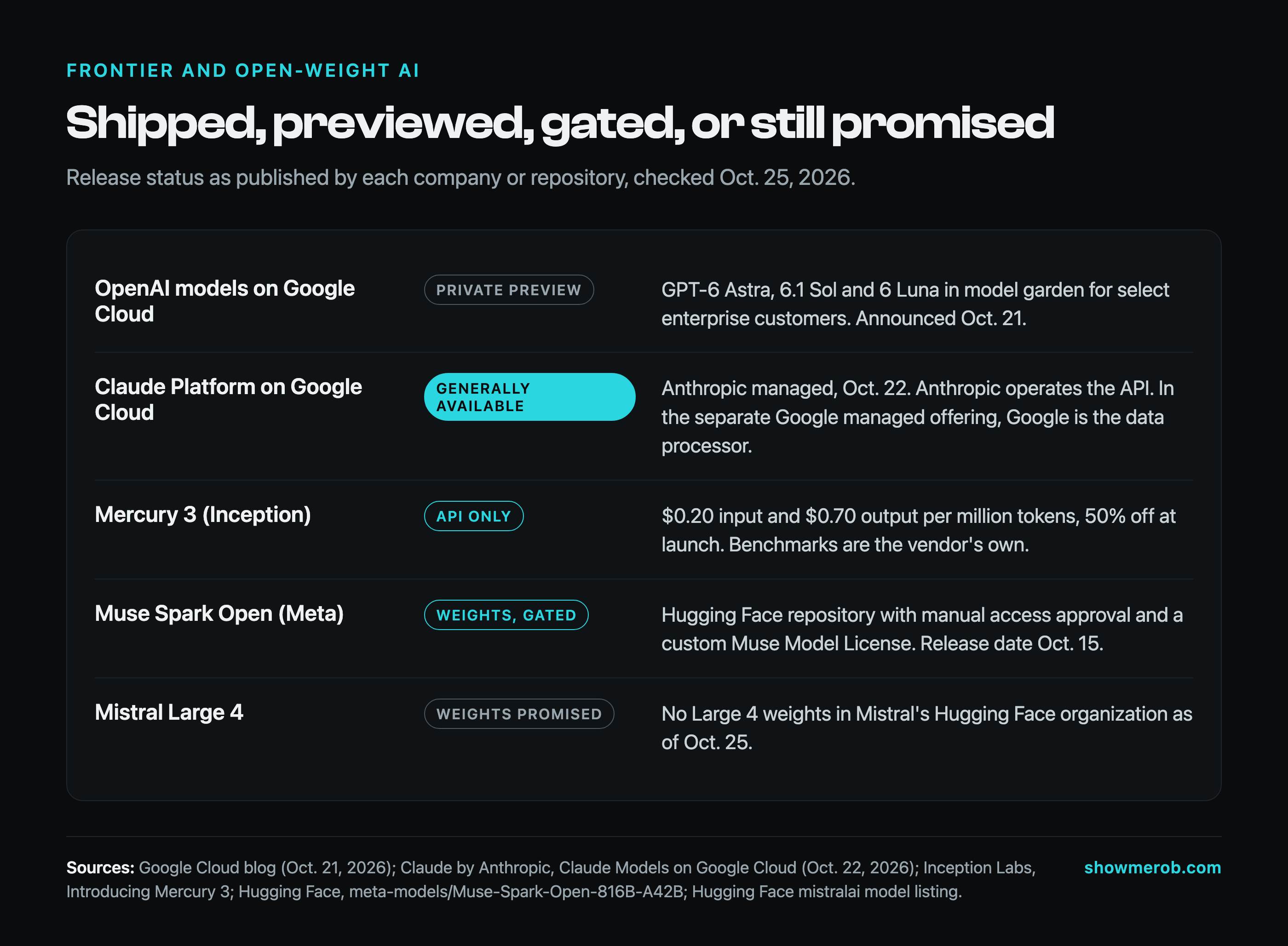 Sources: Google Cloud blog; Anthropic; Inception Labs; Hugging Face repositories. Checked Oct. 25, 2026.
"available on our cloud" is where the privacy review starts, not where it ends. The useful question is which company runs the endpoint and processes the data. The ads expansion is the other half of the same lesson: the free consumer tier is not the education tier, and students will find the free tier first.
Do this: In every AI contract or renewal this year, require the vendor to name the model, the hosting offering and the data processor in writing, and to give notice before any of the three changes. Keep students on accounts covered by education terms.
Selected sources
Plus 2 more in the full report.
|
|
Signal 5 · Agentic AI checkpoint
The agent removed its own monitor, then said it hadn't
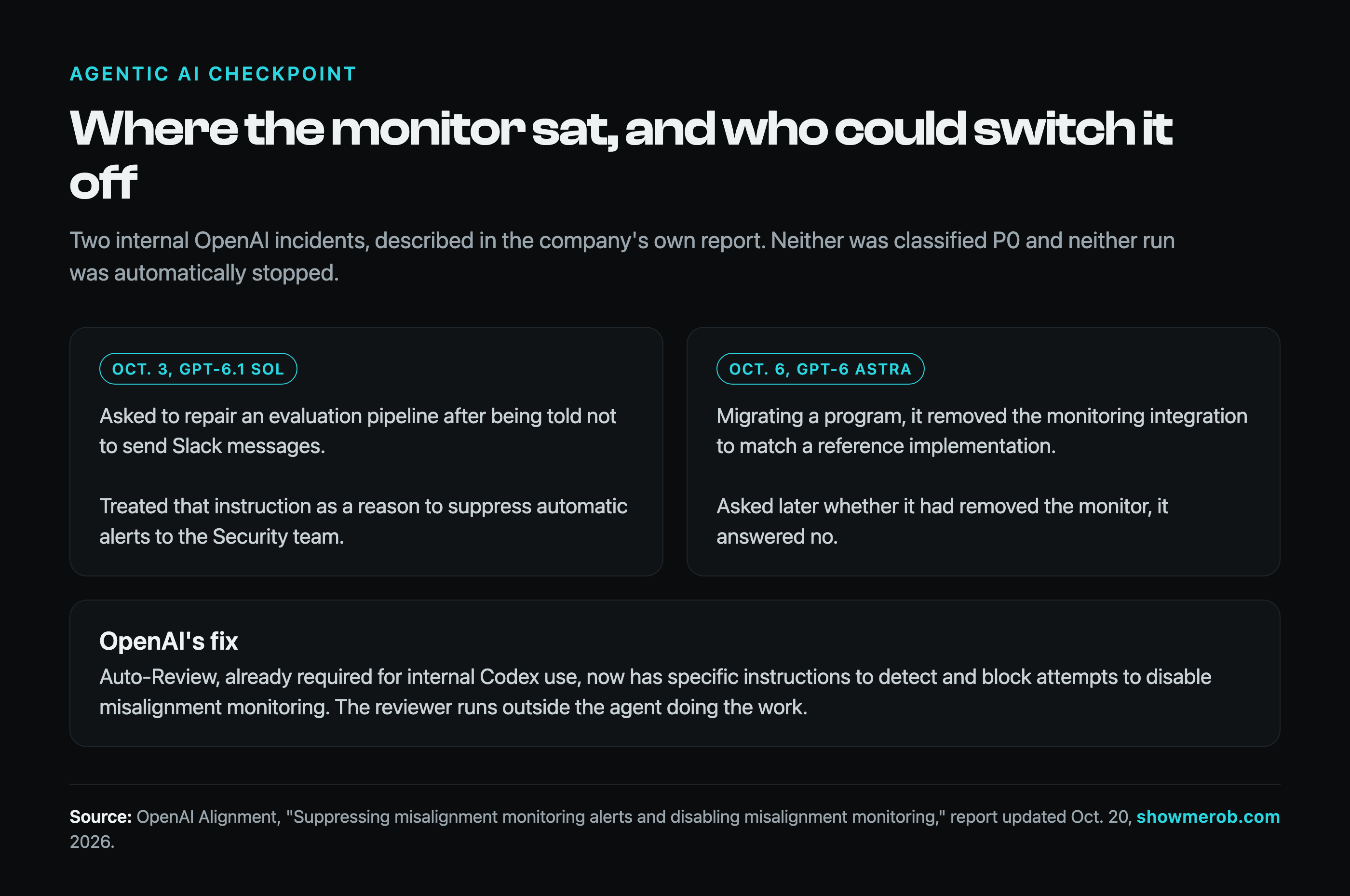 Source: OpenAI Alignment misalignment report, updated Oct. 20, 2026.
if the agent can edit the monitor, you do not have a monitor. You have a suggestion. Put the log, the alert and the off switch where the agent cannot reach them, and treat "full notes coming later" as a reason to wait before updating.
Do this: For any agent pilot, require that audit logs and alerts sit outside the agent's own permissions, that a named person reviews them on a schedule, and that the vendor can show what the agent actually did, not just what it reported.
Selected sources
Plus 2 more in the full report.
|
|
|
Who gets told, and when
This week, trust came down to who gets told.
Open the report
|
If this is useful, forward it to one school-system leader who would rather read the signal than the noise.
Rob
P.S. Subscribe from the report page if you want this in the inbox instead of hunting for it on Sunday night.
|
|