
I've been working on shame (paywall removed)
Every so often I remove the paywall from an email I particuarly like, both to advertise my paid work and to give me a break.
This was published back in December 2025
I've been returning to shame recently. I did some training on working with shame, that I actually used to look at my own sense of shame. I also did a workshop for my course on shame, and this is some of the things I wrote about and thought about during these processes.
Shame is a discrete, basic emotion, described as a moral or social emotion that drives people to hide or deny their wrongdoings.
https://en.wikipedia.org/wiki/ShameDefinitions vary across fields and cultures but it’s generally agreed that shame is a mechanism linked to avoiding counterproductive choices and cope with challenging situations
It also has a productive element. Humans are a social species, and being outcast from society or community can be deadly for humans. Shame in this sense can contribute to cohesion and maintaining collective interests.
However, the issue can be when we internalise values that we don’t agree with, and then find ourselves failing to meet those values and standards, thus causing shame. It’s this tension between our actual, ideal, and real selves that can cause shame.
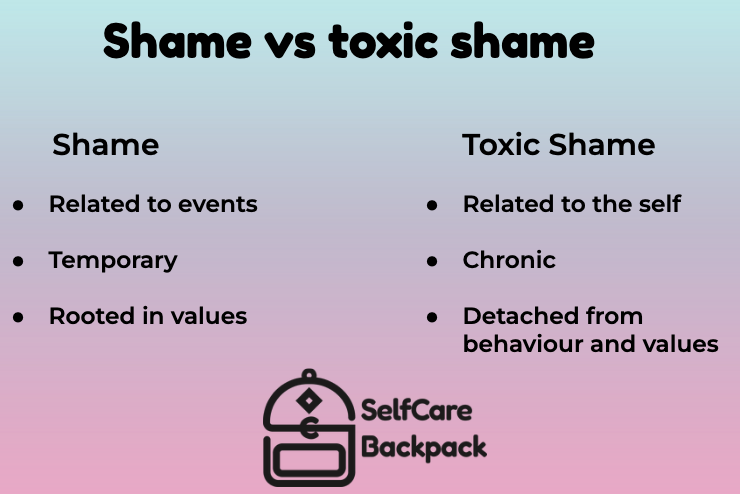
Toxic shame, also called trait shame, is when that feeling of shame is chronic and self directed. It’s not about feeling shame or guilt about decisions or actions, but instead shame about who you are.
Toxic/Trait shame, in turn, includes an especially painful and often disabling emotions involving a sense of inferiority, hopelessness, and helplessness, as well as a willingness to hide failure (Andrews et al., 2002).
Shame has also been linked to negative self esteem (Elison et al., 2014).
Shame has been a constant companion in my life.
Some of my shame came from having to hide a lot of things about my home life - my home was volatile, and I couldn’t share basic things, because it was all not normal or right. My stepdad was very controlling about where we went, and when. This meant having a normal adolescence was difficult. I didn’t have many friends, because being social outside of school was difficult at best, and so people stopped talking to me, because they felt that I wasn’t making an effort. I couldn’t tell them the truth, so I made excuses which fell flat after repeated rejections of their invitations.
This led to me being isolated, and further shame.
Alongside this was my upbringing, where the best I could hope for was avoidance of negative regard, by being the rescuer and the helper. If I did everything right, I got a thank you and a peaceful day. If I made a mistake, didn’t anticipate a need, or stepped out of line at all, then there would be anger, disappointment, and arguments that could last for days. Asking for help was even worse. It wasn’t often a no, but it was a yes with a lot of complaints. This led to me not asking for help, because it was too much to ask. I was too much, needed too much. I was inconvenient unless I was proving my worth. Me not being good enough meant everyone suffered, as the arguments between my mum and stepdad affected all of us. This led to me becoming even more isolated and feeling even more shame.
While the version of me that is calm and quiet is me, it’s also an easy mask to slip behind when I need to. Growing up I learned to grey rock, present a smooth image that my parents couldn’t find anything in to be used against me. No needs, no wants, no opinions, just a blank canvas to project onto. It was the safest way to be.
Sometimes, around other people, my real self came out loudly. I was tightly controlled at home, and so when i was away, like at university, my self came out in uncontrolled ways. This was sometimes met with shock, or comments that I was being too much, too loud, etc. Looking back, I can say that sometimes I was being a bit loud, or over enthusiastic, sometimes I was just in the wrong crowd. At the time I didn’t realise that, I assumed that my upbringing had made me unfit for being around more normal humans, and maybe only a select few people would be able to be around me, and then I’d have to monitor, in case I ever got too much again.
This is why I can be inconsistent in reaching out to people, or maintaining a friendship. My inconsistency in being able to be present or social due to my anxiety and chronic illnesses means that I feel it’s easier for me to be distant. If people get to know me, I will inevitably disappoint them, fail to live up to their expectations, and if I can’t meet people’s expectations (which they will have, because my pattern is to be the helper) then what do I have to offer? If I can’t be relied on, what’s my worth? By myself, I am not enough.
This lead to self abandonment that comes with a lot of childhood trauma. I didn’t know who I was, what I wanted. or needed, because I’d denied them so often that I forgot them. I had to relearn all of this for myself, and then I can show it to others. Learning what my mask is and what’s underneath it has been a key part of learning to love my shame, and bring myself out from behind it
This summer I worked a lot on my shame. I learned about the ways my shame was leading me to self sabotage, caught between feeling like I wasn’t good enough to be a counsellor but unable to share these fears and ask for help, because if I already wasn’t enough, I wasn’t worthy of help.
I know this isn’t sustainable so I took advantage of the break to start to break down what was going on.
The number one thing I had to grapple with is unconditional positive regard. Positive regard is something I both feel desperate for at times, but also find difficult to accept. To receive and accept unconditional positive regard felt unsafe. How can I trust someone who supports me without expectations? What happens when I’m too much for them?
Unless I can give myself unconditional positive regard, and start to believe it, I’m not going to be able to accept it. And if I can’t do that, how am I going to work with shame in the counselling room?
I have to learn to trust both myself and others. Accept that people like me, are willing to help me, regardless of what I’ve done or not done.
What this has looked like is showing myself compassion. Allowing my feelings to pass through me without analysis or comment. Just being without expectation.
Acceptance has been really important to this journey. I have to accept myself as I am, even the shameful parts, in order to live more aligned with my Organismic Valuing Process. Most of these changes are inward and invisible. I’m less judgemental of myself, I spend less time analysing my behaviour and how I could’ve been too much for people. I spend less time calculating how needy I am and if I can ask for help.
I feel lighter, more at ease.


Add a comment: