📚 How to read like a writer
Because reading IS the best work
Hi writer,
I LOVE TO READ.
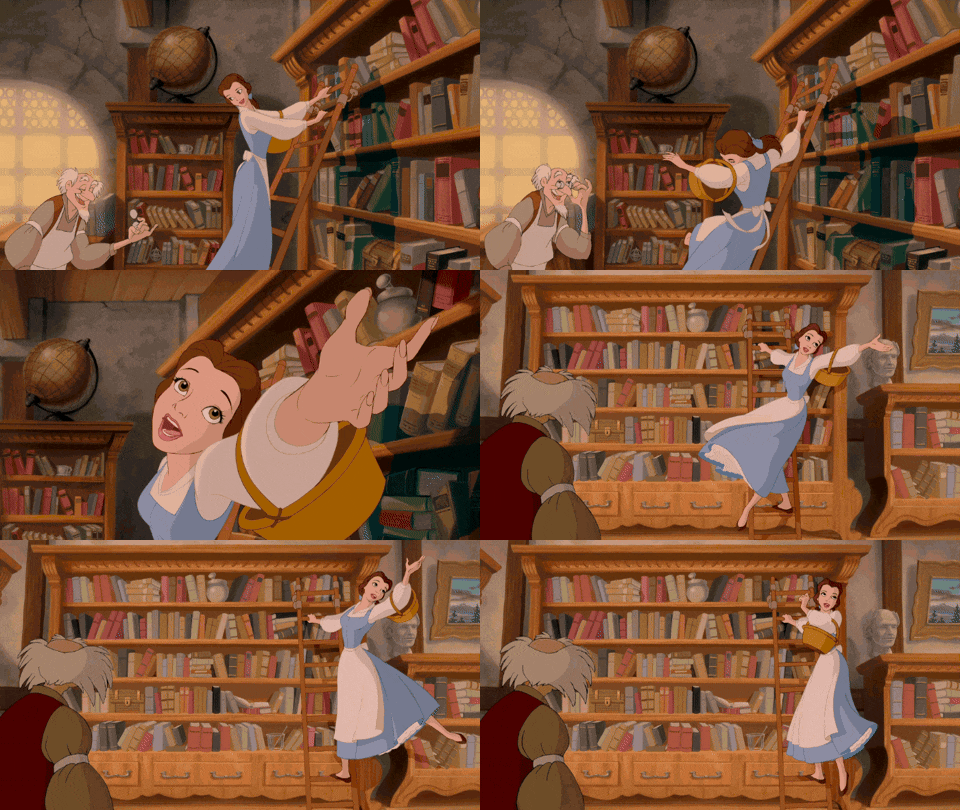
My ideal holiday is one where someone says, “Lie down here, with this view of the water. You aren’t allowed to do anything but read, and you must love what you’re reading. That’s your job.” (I’m SO not a rebel. I usually think I should be doing something other than reading. But if someone tells me it’s my job? *snaps salute* Yes, ma’am! I’m on it!)
Should we be doing something when we’re reading, as writers? Besides just enjoying ourselves? (Because life is too short to read books we’re not completely in love with.)
Yes…?
My answer here is admittedly a little wishy-washy. Yes, we can and do learn so much about our craft by reading. Reading, writing, and having our own work edited are the best and fastest ways to get better at writing.
But I do admit that field-stripping books and examining their innards AS we’re reading can sometimes feel like it might get in the way of fun.
Easy Ways to Learn While Reading
Highlight as you go. You’re doing this already, I bet. If not, you can do this a few different ways.
E-books: On an e-reader, it’s easy to highlight, and if you use a Kindle, did you know that everything you've ever highlighted is right HERE? (Even from library books if you borrow using Libby for Kindle!)
Print books: Use that pencil! Or pen! There’s something so thrilling about writing right in a book, isn’t there? It feels so wrong and oh so right.
Of course, you need to own the book you’re marking in! I’d think that went without saying but just last year, a friend of mine borrowed a friend’s book and returned it with notes inside. They no longer speak, mostly because the person whose book was written in can’t even find the words to cuss the other one out without coming to blows. I’ve just watched this silent fight in wonder, my own personal view into bookish reality TV.
Print + Digital Combo: When reading print books that aren’t my own, I take pictures of the page where I find the quote that speaks to me. On any phone, it’s easy to find the Markup button and then you can draw/highlight all you want. Bonus: you can also select the text and send it to yourself in email or add to other apps. If I’m really on top of it, I pop this photo into my Quotes folder.
Review your highlights.
This is the hard bit, I know. We all have a lot to do, and this feels like homework. But it’s so worth it. You’ve been curating your own learning course this whole time without even trying—don’t let that go.
Once a month or so, I pull together all the highlights I’ve made (and it’s always a LOT).
I reread them all. Often, I just think, “Hmmm. That’s good.” Sometimes I think, “Huh? Why the hell did I highlight this nonsense?”
But other times, I think, “DAMN, THAT IS MASTERFUL.” If I wish I could do that thing in my own writing, it’s time to take the next action:
Handwrite it.
Do you have a commonplace book? You should!
Honestly, I just use whatever journal I’m writing in at the time, but many people have a dedicated notebook just for this. (Any excuse to buy a new notebook!)
Get out your current favorite pen and handwrite out the quote, even if it’s long. Something about letting those words move through you changes the way you think, changes the way the words enter you. They can move in and take up residence (and that’s what we want, right?).
Deeper study:
If you love love love the book and someday want to write one that pays homage to it, open to a fresh page in your notebook, and investigate. You can use these questions as a kick-off point:
a. How did the writer catch your interest on the first page? At what percent does the inciting incident fall? How about the context-shifting midpoint? How about the dark moment?
b. How does the main character(s) change from the first page to the final one?
c. Language-wise, what does the author do that you don’t think you could pull off? How do they do it?
Come up with your own questions! You don’t have to be rigid about any of this. You can do an entire book in 15 minutes or two hours. No matter what, you will learn something new, something exciting.
Bonus action:
Consume that book that you can’t stop telling everyone about in another format. Did you listen to it first? Get it in print and mark it up. If you read the hardcover, get the audiobook and put it on every night as you fall asleep. As you study it, let it study YOU. Let it change you. Notice as it does.
Most of all, read. You can’t be a good writer without reading. Those who say you can are just plain wrong. There are few hills I’m willing to die on, but this is one.
If you’re in a reading slump, treat it like an emergency. Stop trying to read what you’ve been trying to read. Go to the library and read first chapters until your heart beats faster and you MUST keep going. You can do the same thing with sample chapters for your e-reader.
And of course, tell someone what you’ve loved reading lately, and why.
Onward, dear reader/writer!
Rachael
Website | Ink Village | Instagram | Podcast | Patreon
PS - I’m speaking at Dirty Messy Alive: an Embodied Memoir-Writing Workshop Series! This is another FREE conference (don’t we love that these are a thing?) and I’m speaking on fast-drafting your memoir. There are amazing other speakers (Alison K Williams got me into it, and you might know how great she is!) It’s a 4-day virtual workshop series with sessions on outlining, overcoming writer’s block, craft, revision, promotion and more. It starts on Sept 28th, so grab your free ticket now! CLICK HERE.
PPS - Something I just pulled out of my recent highlights: “Odd how reluctant I am to start. I suppose that everyone hates discipline and fights it off at all costs. How the paper eats up pencil line. How it does.” - John Steinbeck, Journal of a Novel
PPPS - OOOH! Tell us WHAT you’ve read and why you loved it here! I’d love to know and so would others! SHARE HERE! (I love doing this. I always need more recs.)
PPPPS - 100% human made, forgive the typos, please. ❤️
-
I so LOVE people who tell me to Go To The Library - that's a definite and instantaneous 'Yes, Ma'am'
Reply: