Sir Gawain and the Green Knight, Part 2 of 3: Winter Road to a Castle
Early English · Part 2 of 3: Winter Road to a Castle
Sir Gawain and the Green Knight
The Gawain Poet (late 14th century) · Fitt 2
Gawain leaves Camelot, rides through a freezing wilderness on Christmas Eve, finds a castle, and agrees to a game of exchanged winnings with its lord.
The story so far: At Camelot's New Year feast a green giant offered a beheading game. Gawain took the axe and cut off the Green Knight's head. The Green Knight then picked it up and told Gawain to meet him in a year.
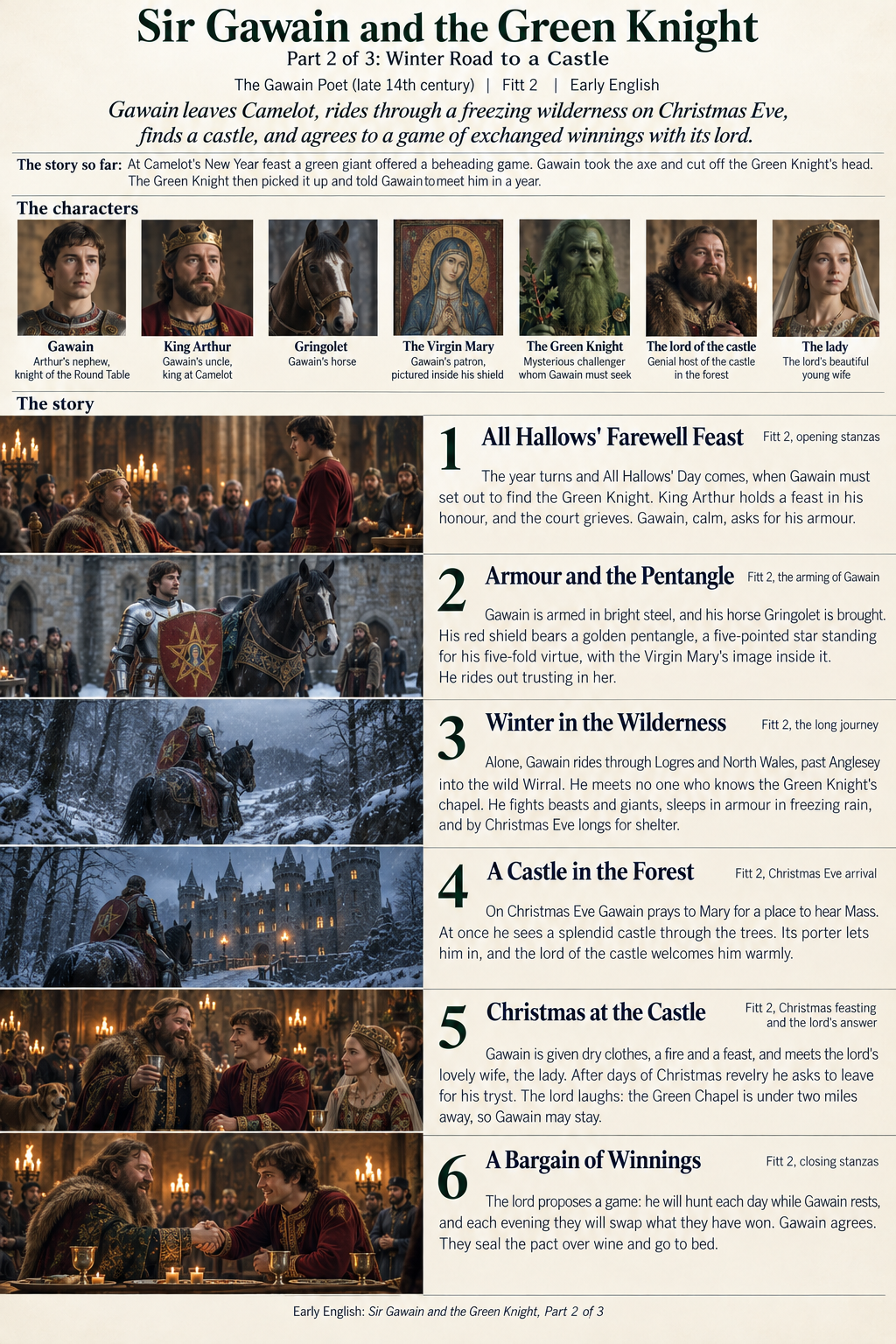
The year turns, and the poem moves through spring, summer and a darkening autumn until All Hallows' Day, the first of November, when Gawain must set out to keep his bargain. King Arthur holds a feast in his honour, but the court is heavy-hearted. The knights and ladies grieve that so good a man must go to meet a blow that may kill him. Gawain, calm, asks what use there is in shrinking from fate, and calls for his arms.
He is armed with great care, in bright steel and golden spurs, with a surcoat over it all. His red shield carries a golden pentangle, a five-pointed star drawn in one unbroken line. The poet explains it at length. Gawain is faultless in his five senses and in his five fingers. He trusts in the five wounds of Christ and the five joys of Mary. He holds five virtues: generosity, fellowship, purity, courtesy and pity. The image of Mary is painted inside the shield, so that he sees it whenever he looks up. Then he takes his leave, mounts his horse Gringolet and rides out while the court commends him to God.
Gawain rides alone through the kingdom of Logres and into North Wales, keeping Anglesey on his left. He crosses into the wilderness of the Wirral, where few who love God or man live. He asks everyone he meets about the Green Knight and the Green Chapel, and no one has heard of them. He fights serpents, wolves, wild men of the woods, bulls, bears, boars and giants. The poet says the winter is worse than any monster: sleet, frozen streams, and nights spent in armour among icy rocks. On Christmas Eve Gawain prays to Mary for a place to hear Mass on Christmas morning. He crosses himself three times, and through the trees he sees a splendid castle.
The porter welcomes him, and the lord of the castle, a big, bearded man in his prime, greets him as an honoured guest. Gawain is given dry clothes, a fire and a rich meal. He meets the lord's wife, the lady, whom he thinks lovelier than Guinevere, and an older woman held in great honour. The household is delighted that the famous Gawain has come, and hopes to learn courtly speech from him. Christmas passes in feasting, carols and dancing. When Gawain asks leave to continue his search, the lord laughs: the Green Chapel is less than two miles away, and Gawain may rest there in comfort until New Year's morning. The lord then proposes a game. He will hunt each day while Gawain stays in bed, and each evening they will exchange whatever they have won. Gawain agrees, and they seal the pact over wine and go to bed.
Gawain's motives are simple: duty, honour and trust in God. The long pentangle passage presents him as an ideal knight, though scholars disagree about whether the poet means it as praise or as the setup for a test. The part develops the contrast between the courtly world of Camelot and the harsh natural world, and the theme of hospitality. It also introduces a bargain that looks like a game but binds a man's word.
Readers can take away three lessons. Courage is not the absence of fear but the choice to go on. Ideals are easy to state and harder to live by, and words given in play can carry real weight. A guest can be comforted by kindness and still need to stay alert.
Further reading
- Simon Armitage, Sir Gawain and the Green Knight: A New Verse Translation (2007)
- W. A. Davenport, The Art of the Gawain-Poet (1978)
- Larry D. Benson, Art and Tradition in Sir Gawain and the Green Knight (1965)