Sir Gawain and the Green Knight, Part 1 of 3: The Beheading Game at Camelot
Early English · Part 1 of 3: The Beheading Game at Camelot
Sir Gawain and the Green Knight
The Gawain Poet (late 14th century) · Fitt 1
A huge green stranger bursts into Arthur's New Year feast, and young Gawain accepts his deadly challenge and cuts off his head.
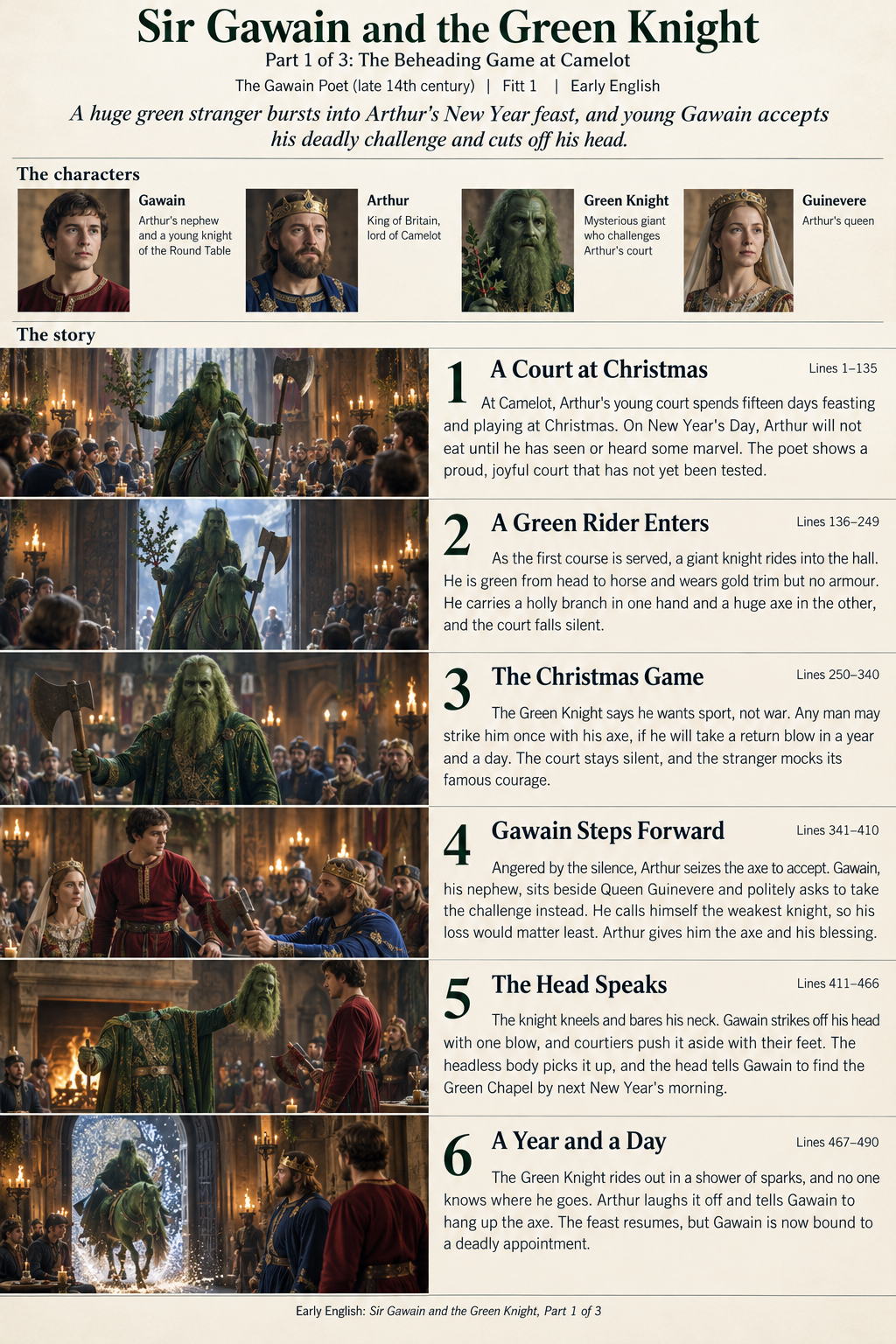
The poem opens with a sweeping glance at history. It begins with the fall of Troy and the founding of Britain, then settles on King Arthur's court at Camelot, then at its brightest and most youthful. The poet wants us to see a society in the glow of its own reputation before anything tests it.
It is Christmas, and the court feasts for fifteen days with games, dancing and jousting. On New Year's Day Arthur keeps his custom of not eating until he has seen or heard some marvel. Just as the first course is served, a gigantic stranger rides into the hall. He is green from head to horse, with green hair and beard, rich gold trimmings and no armour. In one hand he holds a holly branch, and in the other a huge axe.
The Green Knight asks for the head of the court, and says he has come for a Christmas game, not for war. Any man may strike him once with his axe, if he agrees to take a return blow in a year and a day. The court sits in stunned silence, and the knight mocks it for its fame. Stung, Arthur takes the axe himself. Gawain, his nephew, then asks politely to take his place, calling himself the weakest knight and his life the least loss. Arthur agrees and blesses him.
Gawain strikes off the Green Knight's head with a single blow, and the head rolls across the floor. The body picks it up, mounts the green horse and speaks through the head. Gawain must find the Green Chapel by next New Year's morning, or be known as a coward. The stranger rides away in a shower of sparks, and no one knows where he has gone. Arthur laughs and has Gawain hang up the axe, and the feast goes on.
The motives are simple but telling. Arthur acts from pride and anger at his court's shame. Gawain acts from loyalty and courtesy, and perhaps from a desire to protect his king. The court's silence shows that its fame has not yet been tested by a real danger. Arthur's laughter covers a deep unease.
The passage develops the themes of honour, truthfulness to one's word, and the difference between a game and a deadly earnest. The green colour suggests nature, the supernatural, or something stranger. Scholars disagree whether the Green Knight is a figure of fairy, of nature or of something nearer the devil.
The lessons are practical. Reputation is easy to enjoy but costly to defend. A promise made in public as sport can become a binding duty. A courteous offer to take a risk for someone else is admirable, but it has consequences that the speaker cannot see in advance.
Further reading
- Simon Armitage (translator), Sir Gawain and the Green Knight (2007)
- Ad Putter, An Introduction to the Gawain-Poet (1996)
- Derek Brewer and Jonathan Gibson (eds), A Companion to the Gawain-Poet (1997)